Reformer Pilates: How to Choose Your First Class
A reformer adds a sliding carriage and spring resistance to Pilates, so your first class should give you time to learn the equipment.
A beginner reformer class is worth trying if you’re curious about Pilates with adjustable spring resistance. The machine has a sliding platform, springs, pulleys, and ropes; mat Pilates doesn’t require that equipment.24 Before booking, ask whether the instructor introduces the setup, chooses spring settings with beginners, and offers movement options. Those questions help you judge the class, not whether reformer is better than mat.
What the machine changes
On a mat, you perform Pilates movements without a sliding platform or attached springs. A reformer adds a carriage that moves within a frame, with springs, pulleys, and ropes that can be used during exercises.24 That gives an instructor more equipment to set up and explain. It doesn’t, by itself, make the workout easier, harder, safer, or more effective than mat Pilates.
For a first class, the practical difference is the learning curve. You’re learning movements and where to place yourself on unfamiliar equipment. Look for a class that makes room for an introduction rather than assuming every participant already knows the machine. In one study of reformer exercise, participants had a practice session to learn the equipment and exercises before the training program began. That describes the study, not a required format for every studio.2
What you can reasonably expect
Reformer Pilates can be a way to practice controlled movement and work against resistance. In a randomized trial of 47 women ages 30 to 60 with a BMI of at least 25, the exercise group attended physiotherapist-supervised reformer sessions three times a week for eight weeks. The researchers reported changes in body composition, handgrip strength, and muscle-endurance measures. They did not compare reformer classes with mat Pilates, and the study doesn’t tell you what one beginner class will do for your weight or everyday physical function.2
That distinction matters if a class promises results based on the machine alone. Regular physical activity can support muscle strength and weight management, but the effect of any one class depends on what you do there and what else is part of your routine.1 You can choose reformer because you enjoy the format without treating it as a proven shortcut to weight loss.
Questions worth asking before you book
Start with the class description: Is this designed for people who have never used a reformer? “All levels” may mean beginners are welcome, but it doesn’t tell you how much time the instructor can spend explaining setup. Ask whether the first session includes an equipment introduction and whether an instructor can see and help you as you learn.
Then ask about springs and movement options. Who decides the initial settings? Will the instructor explain when settings change? If a position doesn’t work comfortably for you, can they suggest another way to do the movement? These are practical questions, not a test the studio has to pass with one particular spring color or exercise sequence. The supervised research program used different spring combinations and exercises as participants progressed; its settings aren’t a prescription for your class.2
Finally, consider access in the ordinary sense: Can you get onto and off the equipment comfortably, and can the instructor work with any limitations you mention? You don’t need to give a studio your whole medical history to ask whether it can accommodate you. If the answer is vague, a more introductory class or individual instruction may be a better starting point.
When your situation needs a more tailored class
If you’re pregnant, don’t assume evidence about Pilates in pregnancy tells you which reformer movements or class format fit you. A review of trials in healthy, low-risk pregnant women studied Pilates or related movement programs and labor outcomes, not beginner reformer-class selection.6 Ask how the instructor adapts exercises during pregnancy rather than relying on a general “prenatal-friendly” label. The same pregnancy findings don’t establish what works when returning to exercise postpartum.
If you have osteoporosis or a previous fragility fracture, ask whether the instructor can assess what movements are suitable for you rather than offering the same sequence to everyone. A planned study in postmenopausal women with osteoporosis describes individually adapted mat Pilates sessions, but it has not reported outcomes and cannot establish that reformer Pilates is safe or effective for this group.3
And if knee osteoarthritis is part of your decision, don’t choose a reformer because someone claims the machine treats knee pain better than other exercise. A review of Pilates trials in adults with knee osteoarthritis found no demonstrated advantage over conventional exercise for pain, with very low-certainty evidence for that comparison. It did not establish a reformer-specific benefit or report a women’s subgroup result.5
A good first class should leave you understanding how the equipment is being used and able to say when a movement isn’t working for you. That’s a more useful expectation than a promise about what the reformer will change in a few sessions.
Four questions for a first reformer class
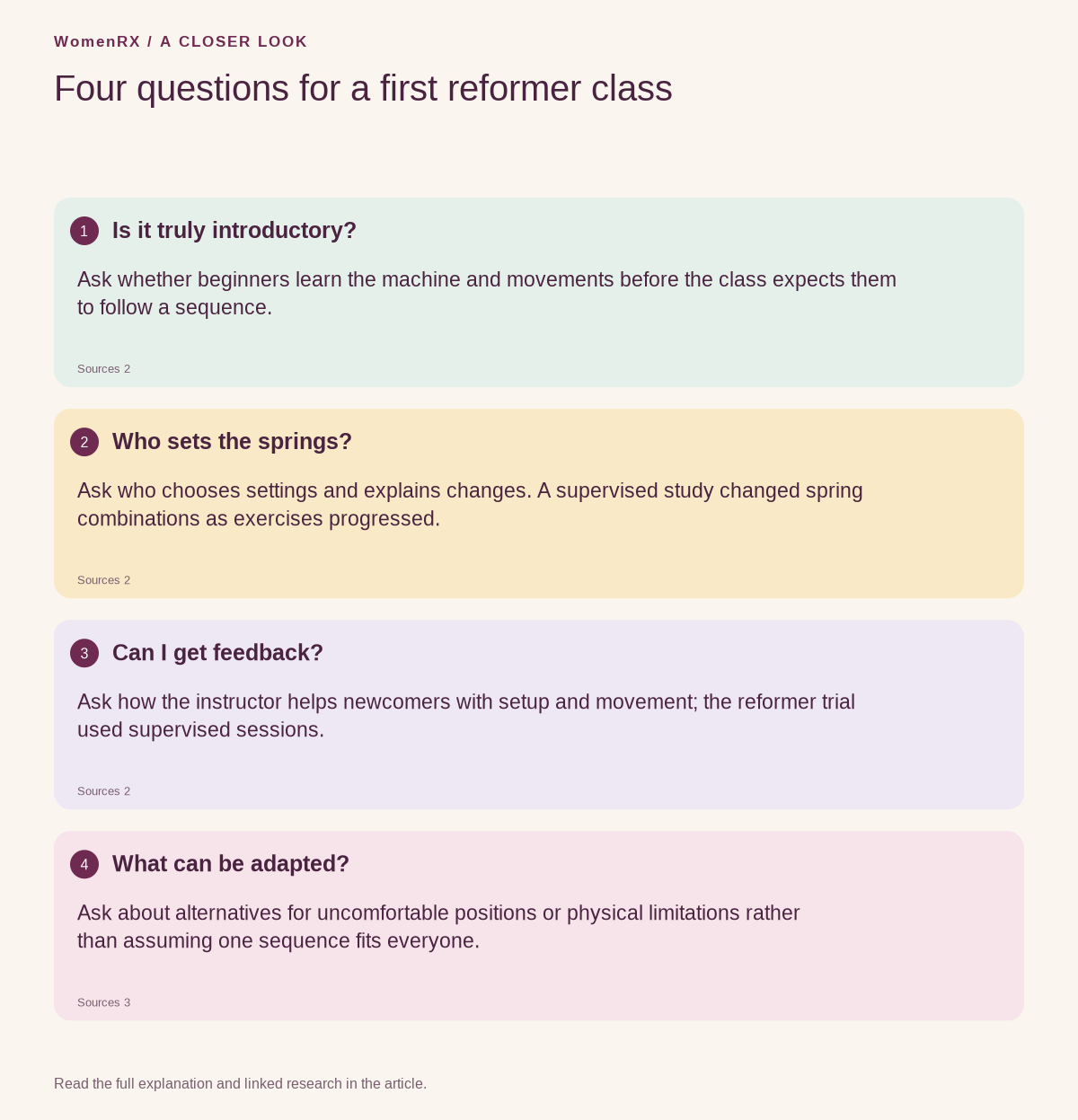
Is it truly introductory?: Ask whether beginners learn the machine and movements before the class expects them to follow a sequence.2
Who sets the springs?: Ask who chooses settings and explains changes. A supervised study changed spring combinations as exercises progressed.2
Can I get feedback?: Ask how the instructor helps newcomers with setup and movement; the reformer trial used supervised sessions.2
What can be adapted?: Ask about alternatives for uncomfortable positions or physical limitations rather than assuming one sequence fits everyone.3
Read the figure as text
Use these questions to find out how a class handles the equipment, instruction, and movement options; they are not a validated studio rating.- Is it truly introductory?: Ask whether beginners learn the machine and movements before the class expects them to follow a sequence.2
- Who sets the springs?: Ask who chooses settings and explains changes. A supervised study changed spring combinations as exercises progressed.2
- Can I get feedback?: Ask how the instructor helps newcomers with setup and movement; the reformer trial used supervised sessions.2
- What can be adapted?: Ask about alternatives for uncomfortable positions or physical limitations rather than assuming one sequence fits everyone.3
More questions, answered
Do I need to try mat Pilates first?
No particular order is established by the research here. Mat and reformer classes use different setups, so choose a genuinely introductory class in the format you want to try. If you’d rather learn Pilates movements without also learning a machine, mat is a reasonable first choice.24
Sources you can check
- Benefits of Exercise: MedlinePlusAccessed 2026-09-25Return to first citation
- Effects of reformer pilates on body composition, strength, and psychosomatic factors in overweight and obese women A randomized controlled trial.Gökalp Ö, Kirmizigil B. · Scientific reports · 2025Return to first citation
- Impact of the Pilates Method on Quality of Life and Functional Well-Being in Women with Osteoporosis: Protocol for a Randomized Controlled Trial.García-Bravo S, García-Bravo C, Gil-Manglano M, Rodríguez-Pérez M, Poveda-García A, Huertas-Hoyas E. · Healthcare (Basel, Switzerland) · 2025Return to first citation
- Effects of Electro-Muscle Stimulation Exercise Combined with Mat Pilates on Pain, Anxiety, and Strength in Sedentary Females with Fibromyalgia: A Single-Blind Randomized Controlled Trial.Eseoğlu İ, Yılmaz AK, Anıl B, Korkmaz E, Akdemir E, Yılmaz C, Kehribar L, Aydın NG, Ermiş E, Yoldaş B, İmamoğlu O. · Journal of personalized medicine · 2024Return to first citation
- Effect of Pilates Exercise on Health-Related Outcomes in Patients With Knee Osteoarthritis: A Systematic Review and Meta-Analysis.de Oliveira TMD, Felício DC, Filho JE, Castro RQ, Gomides FJDS, Pires LFP, Fonseca DS, Malaguti C. · International journal of rheumatic diseases · 2025Return to first citation
- Optimizing labor duration with pilates: evidence from a systematic review and meta-analysis of randomized controlled trials.Haseli A, Eghdampour F, Zarei H, Karimian Z, Rasoal D. · BMC pregnancy and childbirth · 2024Return to first citation