Food and Focus: What Nutrition Can Realistically Change
Caffeine can briefly increase alertness, but the cited diet-and-cognition research does not establish a particular food as a reliable focus treatment.
Caffeine can make you feel more awake for several hours, while too much can cause shakiness or restlessness and caffeine can contribute to insomnia. The diet-and-cognition studies discussed here don’t show that a particular food reliably treats focus problems: one review found observational studies but no randomized trials, and a newer food trial in older adults was still underway. 2 6 5
Start with the kind of change you’re noticing
“Focus” can mean feeling sleepy, losing your train of thought, or struggling to pay attention. Those experiences don’t point to one food or nutrient by themselves. A practical first step is to notice when the change happens: for example, whether it tends to show up after a long stretch without eating, after caffeine, or following a poor night of sleep. That’s a way to gather context, not proof that food caused it.
This evidence doesn’t establish that eating on a particular schedule or drinking more water will fix concentration. A generally varied eating pattern supports health, but that broad nutrition guidance is not the same as evidence that a specific meal or food improves focus. 4
Caffeine can help you feel awake, with tradeoffs
Caffeine stimulates the central nervous system and can make you feel more awake. It reaches peak blood levels within about an hour, and its effects may continue for four to six hours. That makes it different from evidence that a food improves attention or cognition over the long term. 2
More isn’t necessarily better. Too much caffeine can cause restlessness and shakiness; caffeine can also contribute to insomnia, and insomnia can make it harder to focus and pay attention. If you use coffee, tea, energy drinks, or caffeine-containing medicines, notice whether they seem to help alertness or interfere with sleep. Energy drinks vary in caffeine content, and evidence for temporary alertness is limited. 2 3
If you’re pregnant or breastfeeding, caffeine is a separate consideration: it passes through the placenta, and a small amount can pass into breast milk. MedlinePlus advises checking whether you should limit or avoid it in these circumstances. 2
Long-term cognition is a different question
Research on dietary patterns and cognition doesn’t answer whether a snack will help you concentrate this afternoon. A systematic review of studies in middle-aged and older adults included 14 observational studies and no randomized controlled trials. The studies differed in how they assessed diet, brain measures, and cognitive performance, so the authors couldn’t combine results in a meta-analysis. Associations in those studies don’t establish that a diet caused better cognition. 6
A randomized trial designed to test nutritious between-meal foods in adults aged 70 and older had enrolled participants, but its data analysis was still ongoing in the report. A study protocol describes a question being tested, not proof that the foods improve brain function. 5
A separate longitudinal study found that food insecurity was associated with poorer cognitive scores among U.S. adults aged 50 and older. It was observational, and it doesn’t show that a particular food treats an individual’s focus problem. It does underscore that difficulty accessing food is a real part of the nutrition picture, not simply a matter of choosing the “right” food. 7
Don’t diagnose a deficiency from concentration alone
Iron, vitamin B12, and other nutrient deficiencies can be involved in some kinds of anemia, but trouble focusing alone doesn’t establish anemia or identify its cause. Anemia can cause symptoms such as tiredness, feeling cold, dizziness, or irritability; diagnosis involves blood tests, and treatment depends on the type of anemia. 1
If concentration changes come with these symptoms, or the change is new or persistent, it’s reasonable to raise the full picture with a clinician rather than starting supplements based on focus alone. Medications and sleep problems can also be relevant: insomnia may be linked to medical conditions, medicines, or substances including caffeine, and it can affect attention and learning. 1 3
Include the life context, without assuming the cause
Pregnancy, the period after birth, and menopause can be useful context to mention when describing a change in concentration. The studies above don’t establish that hormones explain focus changes in these stages, or that a particular food corrects them. If sleep has been disrupted after a baby arrives, describe that as part of what’s happening rather than assuming it explains everything. Insomnia is associated with difficulty focusing, but that general finding does not specifically establish a postpartum effect. 3
A useful check is to jot down what you ate and drank, caffeine use, sleep, and when the difficulty occurs for a few days if that feels manageable. Look for a pattern, not a perfect diet. If the problem continues, share the timing and relevant life context; that can help distinguish a brief change in alertness from a broader issue worth assessing.
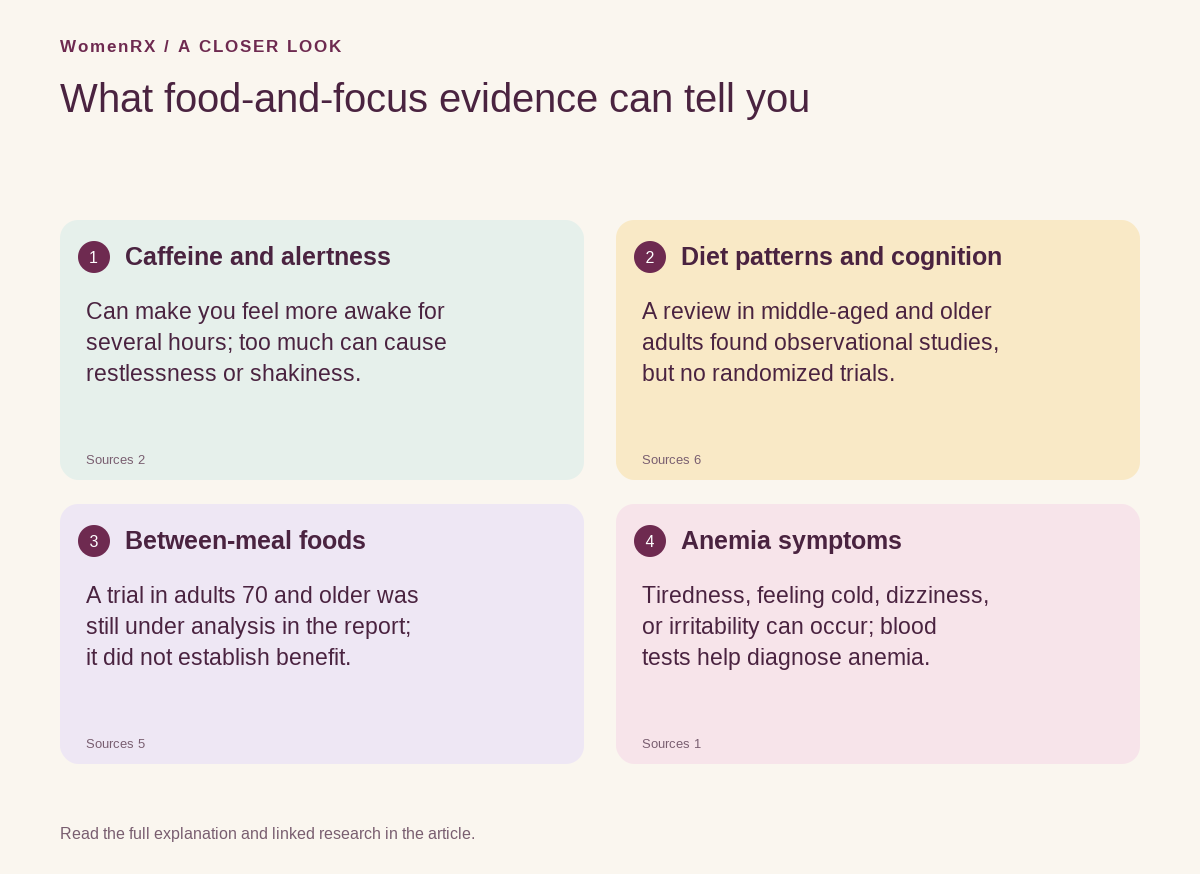
What food-and-focus evidence can tell you
Caffeine and alertness: Can make you feel more awake for several hours; too much can cause restlessness or shakiness.2
Diet patterns and cognition: A review in middle-aged and older adults found observational studies, but no randomized trials.6
Between-meal foods: A trial in adults 70 and older was still under analysis in the report; it did not establish benefit.5
Anemia symptoms: Tiredness, feeling cold, dizziness, or irritability can occur; blood tests help diagnose anemia.1
Read the figure as text
These examples distinguish a short-term alertness effect from studies of cognition over time and from symptoms that may merit a broader assessment.- Caffeine and alertness: Can make you feel more awake for several hours; too much can cause restlessness or shakiness.2
- Diet patterns and cognition: A review in middle-aged and older adults found observational studies, but no randomized trials.6
- Between-meal foods: A trial in adults 70 and older was still under analysis in the report; it did not establish benefit.5
- Anemia symptoms: Tiredness, feeling cold, dizziness, or irritability can occur; blood tests help diagnose anemia.1
Sources you can check
- Anemia | MedlinePlusAccessed 2026-09-25Return to first citation
- Caffeine: MedlinePlusAccessed 2026-09-25Return to first citation
- Insomnia | MedlinePlusAccessed 2026-09-25Return to first citation
- Nutrition: MedlinePlusAccessed 2026-09-25Return to first citation
- Effects of a Nutritionally Balanced Between-Meal Food Product on Brain Function in Older Adults: Protocol for a Randomized Controlled Trial (the MiniMeal Study).Tingö L, Veen J, Andersson P, Chatzopoulou M, Rode J, Andersson K, Kaya I, Rascón A, Edholm P, Brummer R, Bergh C, Hutchinson AN. · JMIR research protocols · 2026Return to first citation
- The association of dietary patterns with cognition through the lens of neuroimaging-a Systematic review.Rodrigues B, Asamane EA, Magalhães R, Sousa N, Thompson JL, Santos NC. · Ageing research reviews · 2020Return to first citation
- Food Insecurity, Supplemental Nutrition Assistance Program Participation and Cognitive Function Among Middle-Aged and Older Adults: Longitudinal Evidence from the Health and Retirement Study.Luo Y, Li M, Zhang Z. · Nutrients · 2026Return to first citation