Which Sleep Habits Help, and When Are They Not Enough?
A manageable sleep habit may help with a short rough patch, but persistent insomnia needs more than an ever-longer list of bedtime rules.
For short-term sleep trouble, start with a habit that fits your life: go to bed when you’re sleepy, keep your sleep hours reasonably consistent when you can, or consider whether caffeine or alcohol is contributing. These changes may help, but they aren’t a test of how hard you’re trying. If insomnia persists or another problem keeps waking you, look beyond sleep hygiene. 12

Pick a habit that matches the problem
Sleep hygiene works best as a set of possibilities, not a checklist you have to complete. Lifestyle changes, including good sleep habits, often help with short-term insomnia. They may make it easier to fall asleep or stay asleep, but they won’t explain every night you’re awake. 1
If you’re lying in bed before you feel ready for sleep, try using sleepiness rather than a fixed clock time as your cue to go to bed. If your schedule has become erratic, keeping sleep hours reasonably consistent may be a more useful experiment. Those are both suggested sleep habits, but they address different situations. You don’t need to change everything at once to find out whether one helps. 2
If falling asleep has become harder, consider what you’re drinking as well as what you’re doing at bedtime. Caffeine and alcohol can contribute to insomnia. That doesn’t mean either one is the cause of your sleep trouble. It does mean that adjusting a possible contributor may be more relevant than adding another rule about your bedroom. 1
Stress and family pressures can also bring on a short spell of insomnia. A steadier routine may offer support during that spell without removing the pressure itself. 1
Make the advice fit your actual hours
“Keep regular hours” can sound simple until your hours aren’t yours to choose. If you work nights or rotating shifts, a conventional bedtime isn’t a sensible standard. Shift work can contribute to ongoing insomnia. Where your schedule allows it, think about which sleep hours you can keep reasonably consistent, rather than measuring yourself against a daytime worker’s routine. 12
Pregnancy discomfort or caring for an infant can interrupt sleep even when your habits are sound. For example, if you’re awake because you’re caring for a baby, going to bed only when sleepy won’t create an uninterrupted stretch of time. Choose a habit only if it addresses a part of the night you can influence; don’t treat unavoidable interruptions as a failure of sleep hygiene.
The same distinction helps if a symptom during perimenopause or after menopause seems to wake you. A routine might make it easier to settle down, but it won’t necessarily address the symptom that woke you. That’s a reason to pay attention to what interrupts sleep, not to collect more bedtime rules. Medical conditions and other sleep disorders can contribute to insomnia, and treating a contributing problem may be part of treating the sleep trouble. 1
Know when habits have reached their limit
If sleep trouble keeps going, or tiredness is affecting your concentration and daily life, the next step isn’t necessarily a stricter routine. Ongoing insomnia can be linked to medicines, medical conditions, substances, shift work, or another sleep disorder. Identifying a contributor can change the approach. If you’re getting drowsy while driving, take that seriously rather than waiting to see whether a new habit works; insomnia-related sleepiness can make driving unsafe. 12
Treatment for insomnia can also be more specific than sleep-hygiene education. Cognitive behavioral therapy for insomnia, or CBT-I, addresses thoughts and behaviors that can keep sleep trouble going. In a preliminary randomized trial of 45 people recovering from stroke, brief behavioral insomnia therapy delivered in person or online reduced insomnia severity more than sleep-hygiene education. That small study involved stroke survivors, so it doesn’t tell us how much benefit every reader should expect. It does show why general tips and a structured insomnia treatment shouldn’t be treated as interchangeable. 123
This distinction matters in pregnancy, too. A small randomized trial enrolled 64 pregnant women with clinical insomnia in CBT-I, a mindfulness-based sleep treatment, or sleep-hygiene education. A secondary analysis found improvements in some outcomes beyond sleep with the targeted treatments, including bedtime procrastination and positive affect. Those findings aren’t a universal pregnancy sleep plan, but they’re a reminder that clinical insomnia deserves more consideration than a list of routine tips. 4
A practical way to decide what to try: choose one habit that matches a change you’ve noticed and is feasible in your circumstances. If the problem persists, your days are suffering, or something else seems to be driving the awakenings, seek help identifying that problem and ask about insomnia-focused treatment. You don’t have to perfect your routine before doing that. 12
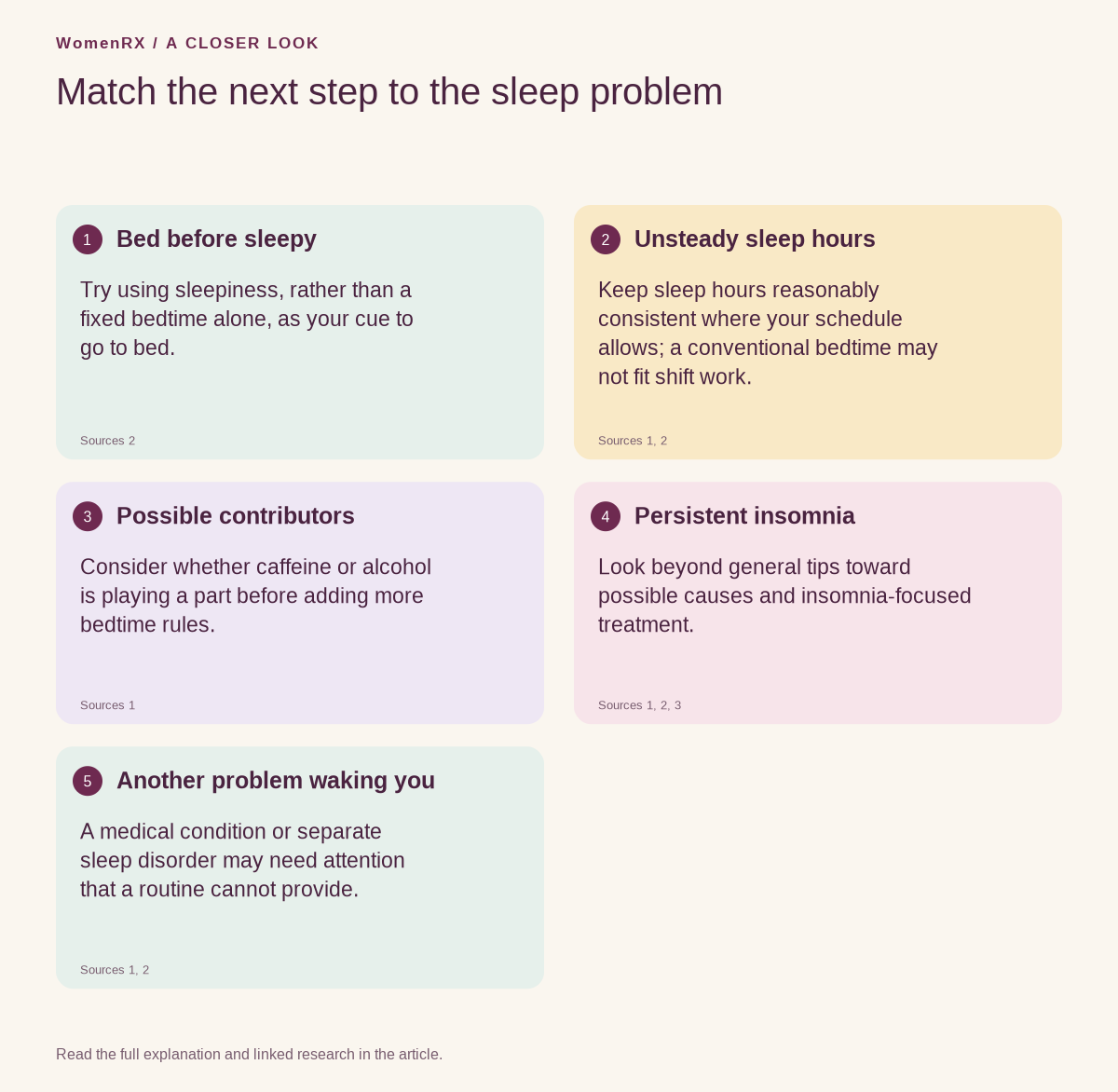
Match the next step to the sleep problem
Bed before sleepy: Try using sleepiness, rather than a fixed bedtime alone, as your cue to go to bed.2
Unsteady sleep hours: Keep sleep hours reasonably consistent where your schedule allows; a conventional bedtime may not fit shift work.12
Possible contributors: Consider whether caffeine or alcohol is playing a part before adding more bedtime rules.1
Persistent insomnia: Look beyond general tips toward possible causes and insomnia-focused treatment.123
Another problem waking you: A medical condition or separate sleep disorder may need attention that a routine cannot provide.12
Read the figure as text
Sleep habits are most useful when they address something you can change; persistent trouble or a separate cause calls for a closer look.- Bed before sleepy: Try using sleepiness, rather than a fixed bedtime alone, as your cue to go to bed.2
- Unsteady sleep hours: Keep sleep hours reasonably consistent where your schedule allows; a conventional bedtime may not fit shift work.12
- Possible contributors: Consider whether caffeine or alcohol is playing a part before adding more bedtime rules.1
- Persistent insomnia: Look beyond general tips toward possible causes and insomnia-focused treatment.123
- Another problem waking you: A medical condition or separate sleep disorder may need attention that a routine cannot provide.12
Sources you can check
- Insomnia | MedlinePlusAccessed 2026-09-25Return to first citation
- Insomnia - NHSAccessed 2026-09-25Return to first citation
- Effects of nurse-led, web-based brief behavioral therapy on insomnia severity in patients in the chronic stage of stroke recovery: a preliminary randomized controlled trial.Hasan F, Prasetya EC, Gordon CJ, Romadlon DS, Chang KM, Bartlett DJ, Lin CJ, Gautama MSN, Izzati N, Chiu HY. · Journal of clinical sleep medicine : JCSM : official publication of the American Academy of Sleep Medicine · 2025Return to first citation
- Treating insomnia during pregnancy improves bedtime procrastination, rumination, anxiety, and positive affect: a randomized controlled trial of cognitive-behavioral and mindfulness-based therapies for prenatal insomnia.Kalmbach DA, Reffi AN, Cheng P, Kaliush PR, Jennings MB, Afaneh HA, Yu A, Jaziri M, Drake CL. · Sleep advances : a journal of the Sleep Research Society · 2026Return to first citation