Menopause Fatigue: Which Food Habits Are Worth Reviewing?
Start with the eating and drinking habits that have changed, while making room to investigate fatigue that persists.
If you’re tired during menopause, try changing one disrupted habit at a time: return to a manageable meal routine or your usual drinking routine, then notice whether your energy feels different. That comparison isn’t a diagnosis or a proven menopause-fatigue treatment. Lost sleep can contribute to fatigue, but anemia and thyroid disease can too. If fatigue hasn’t improved after several weeks, arrange an evaluation. 1
Start with what changed
Maybe you’re waking with hot flashes and reaching the afternoon exhausted. Maybe your appetite or workday has changed, and meals have become less predictable. Both are worth noticing. Too little sleep can contribute to fatigue, and MedlinePlus includes healthy eating and avoiding alcohol among its general suggestions for managing it. Fatigue can also have medical causes, including anemia, thyroid disease, and sleep disorders. 1
A useful food check is about your own routine, not finding a food that promises more energy. Pick one changed habit to try at a time, then compare how you feel with days when that habit slipped:
- Meal timing: Have you started missing a meal because your mornings are rushed or you’re too tired to prepare food? If so, try returning to a manageable eating routine and notice whether your day feels different.
- Overall intake: Are you eating less than usual because your appetite has changed? That’s worth mentioning if you seek care. MedlinePlus identifies appetite as one of the things a clinician may ask about when evaluating fatigue. 1
- Drinks: On days when you’re tired, are you also drinking less than you normally do? If so, try returning to your usual drinking routine and notice how you feel, without aiming for a special hydration target.
- Alcohol: If drinking is part of your routine, you can include it in a broader review of habits while addressing fatigue. Avoiding alcohol is part of MedlinePlus’s general fatigue advice. 1
You don’t need an elaborate log. A short note about sleep, meals, drinks, and when your energy dips can help you spot patterns. A pattern is a clue about your day, though, not a test that proves what caused the fatigue. MedlinePlus suggests a fatigue diary for noticing when energy is higher or lower. 1
If sleep is the bigger issue, address that issue
If hot flashes are waking you, food changes may leave the main problem untouched. Lost sleep is a possible contributor to fatigue. For bothersome hot flashes, menopause guidance identifies evidence-supported options, including cognitive behavioral therapy, clinical hypnosis, and certain prescription treatments. It does not recommend dietary modification or soy foods as hot-flash treatments. That finding concerns hot flashes, not a test of whether changing meals improves fatigue. 12
This is why “eat better” can be both reasonable and incomplete. In a 12-week randomized trial, dietary-quality education reduced cancer-related fatigue more than standard care among people with breast cancer. That is a different cause and setting; the result can’t tell you which diet, if any, relieves fatigue during menopause. 3
Don’t let a food experiment delay an explanation
If fatigue hasn’t improved after several weeks, contact a healthcare provider even if you’ve noticed a possible meal or sleep pattern. An evaluation may cover sleep, daily activities, appetite, and exercise, along with an exam and lab tests. It gives you a way to consider causes such as anemia or thyroid disease rather than assuming menopause explains everything. 1
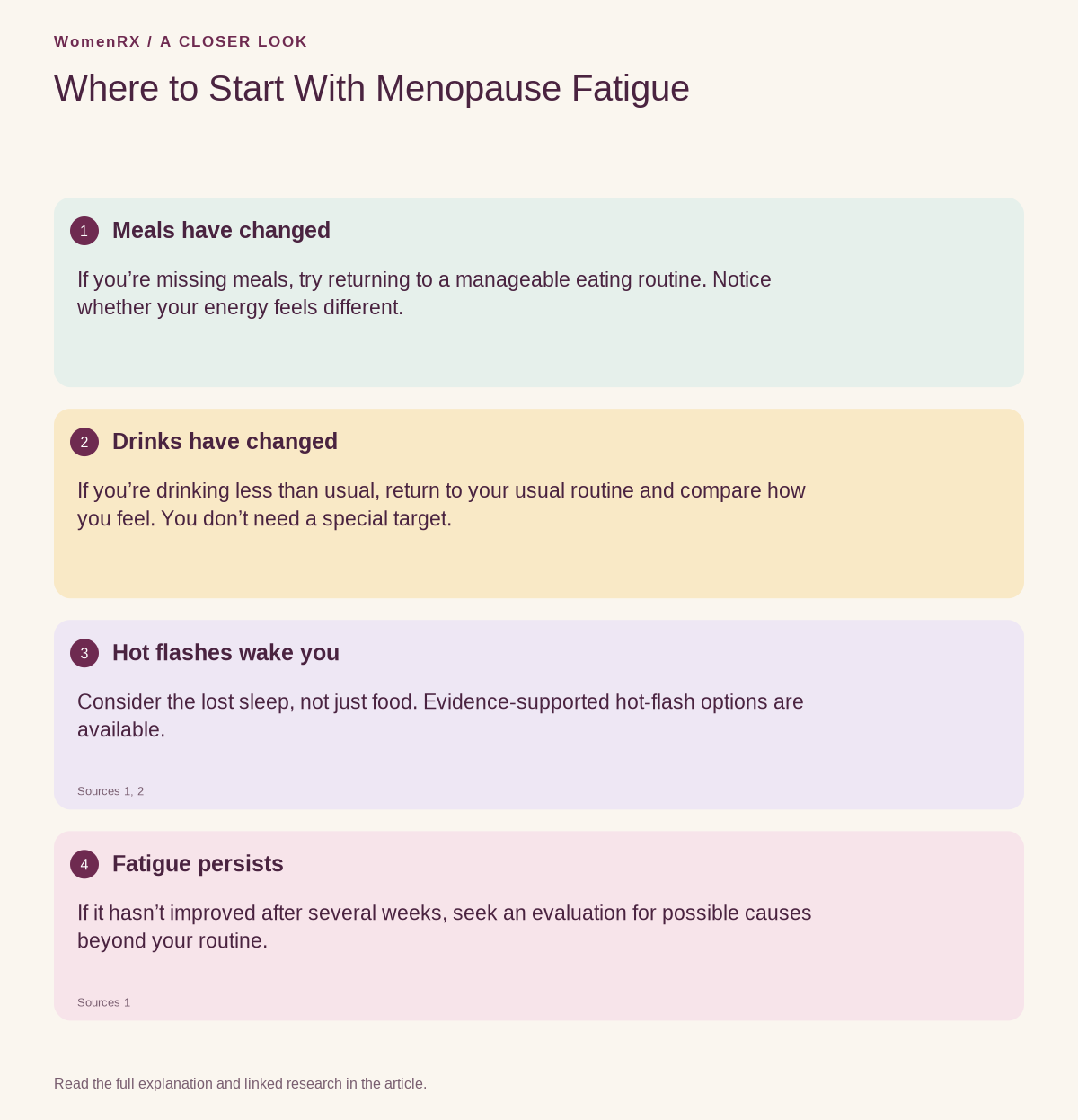
Where to Start With Menopause Fatigue
Meals have changed: If you’re missing meals, try returning to a manageable eating routine. Notice whether your energy feels different.
Drinks have changed: If you’re drinking less than usual, return to your usual routine and compare how you feel. You don’t need a special target.
Hot flashes wake you: Consider the lost sleep, not just food. Evidence-supported hot-flash options are available.12
Fatigue persists: If it hasn’t improved after several weeks, seek an evaluation for possible causes beyond your routine.1
Read the figure as text
Match the change you’ve noticed with a useful next step, without mistaking a daily pattern for a diagnosis.- Meals have changed: If you’re missing meals, try returning to a manageable eating routine. Notice whether your energy feels different.
- Drinks have changed: If you’re drinking less than usual, return to your usual routine and compare how you feel. You don’t need a special target.
- Hot flashes wake you: Consider the lost sleep, not just food. Evidence-supported hot-flash options are available.12
- Fatigue persists: If it hasn’t improved after several weeks, seek an evaluation for possible causes beyond your routine.1
Sources you can check
- Fatigue: MedlinePlusAccessed 2026-09-25Return to first citation
- The 2023 nonhormone therapy position statement of The North American Menopause Society.Menopause (New York, N.Y.) · 2023Return to first citation
- Effect of Nutrition Education Focusing on Dietary Quality on Cancer-Related Fatigue in Breast Cancer Patients: A 12-Week Randomized Controlled Trial.Miao X, He J, Cheng L, Cheng X, Wang Y, Lin X, Huang Z, Wang R, Xia S. · Nutrients · 2026Return to first citation