Which Habits Help With Insulin Resistance?
For people with prediabetes, lifestyle programs can lower the chance of developing type 2 diabetes, but a better glucose result isn’t the same as proof that insulin resistance has disappeared.
The strongest evidence here is for lifestyle interventions with varying components, including diet, physical activity, or both, and, when appropriate, weight loss. In randomized trials involving people with prediabetes, these programs reduced progression to type 2 diabetes. They don’t prove that one diet, workout, or sleep change reverses insulin resistance in every person. Your glucose results and health history help determine what those findings mean for you. 23
First, know which result you’re trying to change
Insulin helps move glucose from your blood into your cells. With insulin resistance, cells don’t respond to it as well. But an insulin-resistance concern, prediabetes, and type 2 diabetes aren’t interchangeable diagnoses. Prediabetes means blood glucose is above the normal range but not high enough for a diabetes diagnosis; clinicians use blood tests, including A1C, to assess diabetes. 1
That distinction matters when you read lifestyle research. A lower fasting glucose level shows a change in one blood measure. A study that follows people with prediabetes to see whether they develop type 2 diabetes answers a different, longer-term question. Neither result, by itself, means insulin resistance has been permanently “reversed.”
The clearest outcome: fewer people with prediabetes developed diabetes
In a review of 16 randomized trials, adults with prediabetes assigned to lifestyle interventions were less likely to progress to type 2 diabetes than those receiving usual treatment. At one year, the pooled rates were 4% versus 10%; at three years, they were 14% versus 23%. The interventions varied, so those figures describe the programs studied, not the effect you can expect from one habit on its own. 3
A separate review of 44 randomized trials of lifestyle weight-loss interventions in people with prediabetes found about 8 fewer people per 100 progressed to type 2 diabetes, compared with control groups, over interventions lasting 6 to 72 months. About 11 more per 100 returned to normal-range glucose. Average weight loss across the trials ranged from 1% to 9%, and the review found a graded relationship across that range rather than a single threshold at which benefits began. Returning to normal-range glucose is an encouraging outcome, but it isn’t a guarantee that diabetes won’t develop later. 2
Weight is not a character judgment or the only relevant result. The useful finding is narrower: among people with prediabetes, programs that produced weight loss reduced diabetes progression. Whether weight loss is an appropriate goal for you depends on your situation.
Activity and food changes: think program, not magic ingredient
Lifestyle weight-loss trials have studied diet, activity, and combined approaches. US diabetes-prevention-style programs set goals for both dietary changes and activity, but their results can’t isolate the benefit of either component. 24 A review of US programs modeled on the Diabetes Prevention Program described goals of moderate physical activity, dietary changes, and modest weight loss. Across 44 studies, participants had improvements in weight, fasting glucose, and A1C. Most studies compared results before and after a program, however, so those changes can’t establish what activity alone caused. 4
You don’t need to treat one particular workout as the proven option. Walking is an example of an activity you might choose; the evidence above supports structured activity as part of a broader program, not a special effect of walking over other activities. 4
The same care applies to diet claims. In a 16-week randomized study of adults with prediabetes and overweight or obesity, a calorie-restricted higher-carbohydrate diet and a reduced-carbohydrate diet produced similar weight loss. The higher-carbohydrate group had a greater improvement in fasting glucose, but changes in A1C, fasting insulin, and a calculated insulin-sensitivity measure did not differ between diets. Most participants were women, though the study did not report a separate women’s result. It’s a useful counterpoint to the idea that cutting carbohydrates further must improve insulin sensitivity more. It does not establish one ideal eating pattern for everyone. 5
What about sleep? It’s reasonable to include it when discussing your health, but the reported results of these prevention studies don’t provide a sleep-specific estimate for insulin sensitivity or diabetes risk. There’s no sound basis here for ranking a sleep routine against the studied lifestyle programs. 23
Your history changes which evidence applies
If you’ve had gestational diabetes, that history raises your later risk of type 2 diabetes, even though gestational diabetes usually goes away after birth. It’s worth bringing up when discussing glucose testing or prevention, rather than assuming that normal glucose after pregnancy closes the question. Pregnancy itself calls for its own care plan: gestational diabetes is not simply the same situation as prediabetes outside pregnancy. 1
If you have polycystic ovary syndrome (PCOS), be wary of a diet claim that leaps from a hormone or insulin measure to promised diabetes prevention. A small systematic review of ketogenic diets reported possible improvements in insulin sensitivity and reproductive-hormone measures among women with PCOS. Its seven studies also included studies of active or athletic men, and its conclusion does not establish that a ketogenic diet prevents type 2 diabetes in women with PCOS or that it works better than other sustainable approaches. PCOS is a reason to make the discussion specific to your health, not a reason to assume one diet is required. 6
Menopause can also be a useful time to revisit your health picture, but don’t mistake evidence about menopause hormone therapy for evidence about lifestyle choices. A review of studies in women undergoing the menopause transition or after menopause found small differences in some insulin and glucose measures among hormone-therapy users. Its evidence for a lower rate of new type 2 diabetes was rated very low certainty, and the authors judged the metabolic effects generally too small to be clinically significant. That research neither shows that menopause itself establishes your individual diabetes risk nor makes hormone therapy a diabetes-prevention strategy. 7
The practical next move is to find out which question applies to you: Are your glucose tests in the normal range, the prediabetes range, or the diabetes range? Have you had gestational diabetes, and are you pregnant now? Those answers make a prevention plan more useful than trying to prove that a single habit has “fixed” insulin resistance. If you already take treatment for diabetes, lifestyle changes aren’t a reason to stop it: some people with type 2 diabetes need medication, while people with type 1 diabetes need insulin. 1
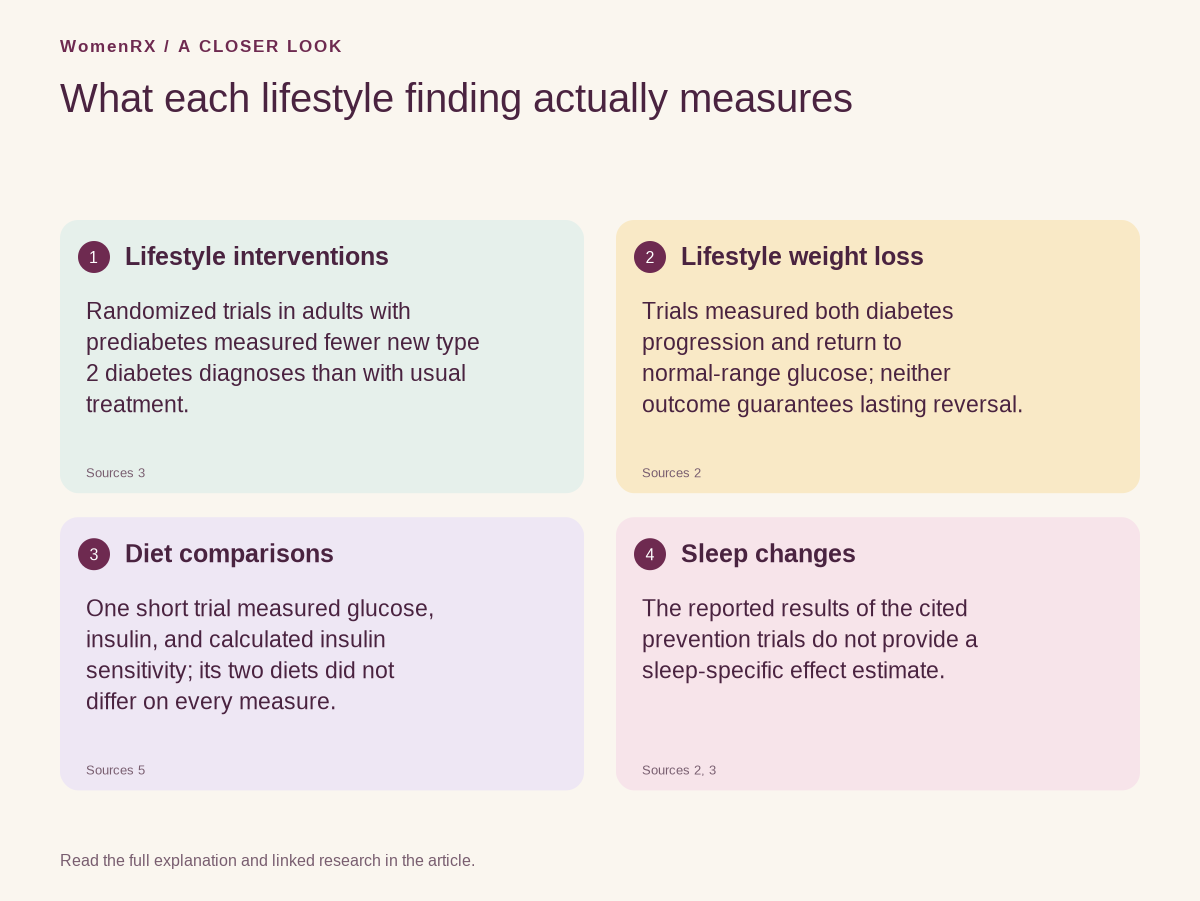
What each lifestyle finding actually measures
Lifestyle interventions: Randomized trials in adults with prediabetes measured fewer new type 2 diabetes diagnoses than with usual treatment.3
Lifestyle weight loss: Trials measured both diabetes progression and return to normal-range glucose; neither outcome guarantees lasting reversal.2
Diet comparisons: One short trial measured glucose, insulin, and calculated insulin sensitivity; its two diets did not differ on every measure.5
Sleep changes: The reported results of the cited prevention trials do not provide a sleep-specific effect estimate.23
Read the figure as text
These outcomes answer different questions; an improvement in one measure shouldn’t be presented as proof of every other benefit.- Lifestyle interventions: Randomized trials in adults with prediabetes measured fewer new type 2 diabetes diagnoses than with usual treatment.3
- Lifestyle weight loss: Trials measured both diabetes progression and return to normal-range glucose; neither outcome guarantees lasting reversal.2
- Diet comparisons: One short trial measured glucose, insulin, and calculated insulin sensitivity; its two diets did not differ on every measure.5
- Sleep changes: The reported results of the cited prevention trials do not provide a sleep-specific effect estimate.23
More questions, answered
If my glucose returns to the normal range, am I no longer at risk?
It’s a meaningful improvement, not a lifetime guarantee. Lifestyle weight-loss trials in people with prediabetes measured both return to normal-range glucose and later progression to type 2 diabetes as separate outcomes. Your health history still matters when deciding what follow-up makes sense. 21
Sources you can check
- Diabetes | Type 1 Diabetes | Type 2 Diabetes | MedlinePlusAccessed 2026-09-25Return to first citation
- Efficacy of lifestyle weight loss interventions on regression to normoglycemia and progression to type 2 diabetes in individuals with prediabetes: a systematic review and pairwise and dose-response meta-analyses.Jayedi A, Soltani S, Emadi A, Najafi A, Zargar MS. · The American journal of clinical nutrition · 2024Return to first citation
- Effects of lifestyle changes on adults with prediabetes: A systematic review and meta-analysis.Glechner A, Keuchel L, Affengruber L, Titscher V, Sommer I, Matyas N, Wagner G, Kien C, Klerings I, Gartlehner G. · Primary care diabetes · 2018Return to first citation
- Cardiometabolic Risk Factor Changes Observed in Diabetes Prevention Programs in US Settings: A Systematic Review and Meta-analysis.Mudaliar U, Zabetian A, Goodman M, Echouffo-Tcheugui JB, Albright AL, Gregg EW, Ali MK. · PLoS medicine · 2016Return to first citation
- Adaptive dietary and exercise strategies for weight loss in Adults with Prediabetes Trial (ADAPT): a sequential multiple assignment randomized trial.Ellison KM, El Zein A, Baidwan NK, Ferguson CC, Fowler LA, Bryan DR, Reynolds C, Hermanson D, Berg KJ, Mehta T, Hill JO, Wyatt HR, Sayer RD. · The American journal of clinical nutrition · 2025Return to first citation
- Effects of the Ketogenic Diet on Gonadal Hormones: A Systematic Review.Lima M, Fabe J, Grigolon RB, Ceolin G, Palma N, Gerchman F, Brietzke E, Gomes FA. · Nutrition reviews · 2026Return to first citation
- Menopause hormone therapy and type 2 diabetes risk and prognosis: systematic review and meta-analyses.Liang C, Dobson AJ, Doust J, Ribeiro LW, Mishra GD. · Diabetologia · 2026Return to first citation