Do Supplements Help With Insulin Resistance?
A few trials found changes in insulin-related blood tests, but their results depend on who was studied and what was measured.
Some supplement trials report improved insulin-related measures, but they don’t show that supplements prevent diabetes or replace diabetes care. Zinc was studied in adults with obesity, selenium in people with diabetes receiving hemodialysis, and vitamin D in pregnant women with gestational diabetes. Those findings can’t be assumed to apply to someone with PCOS or insulin resistance in a different setting. 123
A supplement result is most useful when you know two things: who took it, and what changed. A change in an insulin-related blood test may be worth studying further. It isn’t the same as showing that fewer people developed diabetes or that treatment can be stopped.
What changed in the trials?
Researchers often use HOMA-IR, a measure calculated from fasting glucose and insulin, to assess insulin resistance. It helps them compare groups in a study, but a lower HOMA-IR result alone doesn’t tell you whether a supplement prevents diabetes or improves long-term health. 123
Zinc alongside a calorie-restricted diet: In a 15-week randomized trial, 40 adults with obesity received zinc or placebo while both groups followed a calorie-restricted diet. HOMA-IR was lower in the zinc group than in the placebo group. Because everyone followed the diet, the result concerns zinc alongside that approach, not zinc on its own. The study included men and women, but its reported results weren’t separated by sex. 2
Selenium during hemodialysis: A 24-week trial studied 60 people with diabetes who were receiving hemodialysis. The selenium group had improved measures of insulin resistance and insulin sensitivity compared with the placebo group. Hemodialysis is a distinct medical setting, so this result doesn’t establish a benefit for someone who isn’t receiving it. 3
Vitamin D in gestational diabetes: A three-month randomized trial enrolled 120 pregnant women who already had gestational diabetes. It reported reductions in fasting glucose, fasting insulin, and HOMA-IR with vitamin D supplementation. That’s a finding about metabolic measures during treatment for gestational diabetes, not evidence that vitamin D prevents gestational diabetes or improves pregnancy outcomes. 1
Why PCOS and pregnancy aren’t interchangeable
If you have PCOS, none of these results gives you a PCOS-specific answer. The zinc trial enrolled adults with obesity, the selenium trial involved people receiving dialysis, and the vitamin D trial involved women with gestational diabetes. A result in one group shouldn’t be carried over to another simply because insulin resistance can occur in both. 123
Pregnancy also changes the question you’re asking. The vitamin D trial studied women after a gestational-diabetes diagnosis. If that’s your situation, discuss a proposed supplement with your prenatal care team in the context of the care and glucose monitoring you already have, rather than treating the trial result as a reason to change them. 1
Before buying one, check what the evidence can tell you
Bring the exact product label and your medicine list to a conversation about a supplement. Ask: Does this study resemble my situation? What result am I hoping to change: an insulin-resistance measure, blood glucose, or a longer-term health outcome? How would we tell whether the supplement is helping without changing established care on the strength of a lab marker alone?
The zinc trial offers a concrete reason to ask about medicines. It excluded people taking anticoagulants, lipid-lowering drugs, or beta blockers. That doesn’t prove zinc interacts with those medicines; it means this trial can’t tell us how zinc performed in people taking them. It also excluded people who were pregnant or lactating. 2
These are promising signals in narrow settings, not a ranked list of supplements for everyone with insulin resistance. The practical next step is to match any proposed product to your own diagnosis, medicines, and reason for taking it, then decide what evidence would actually make a difference to your care. 123
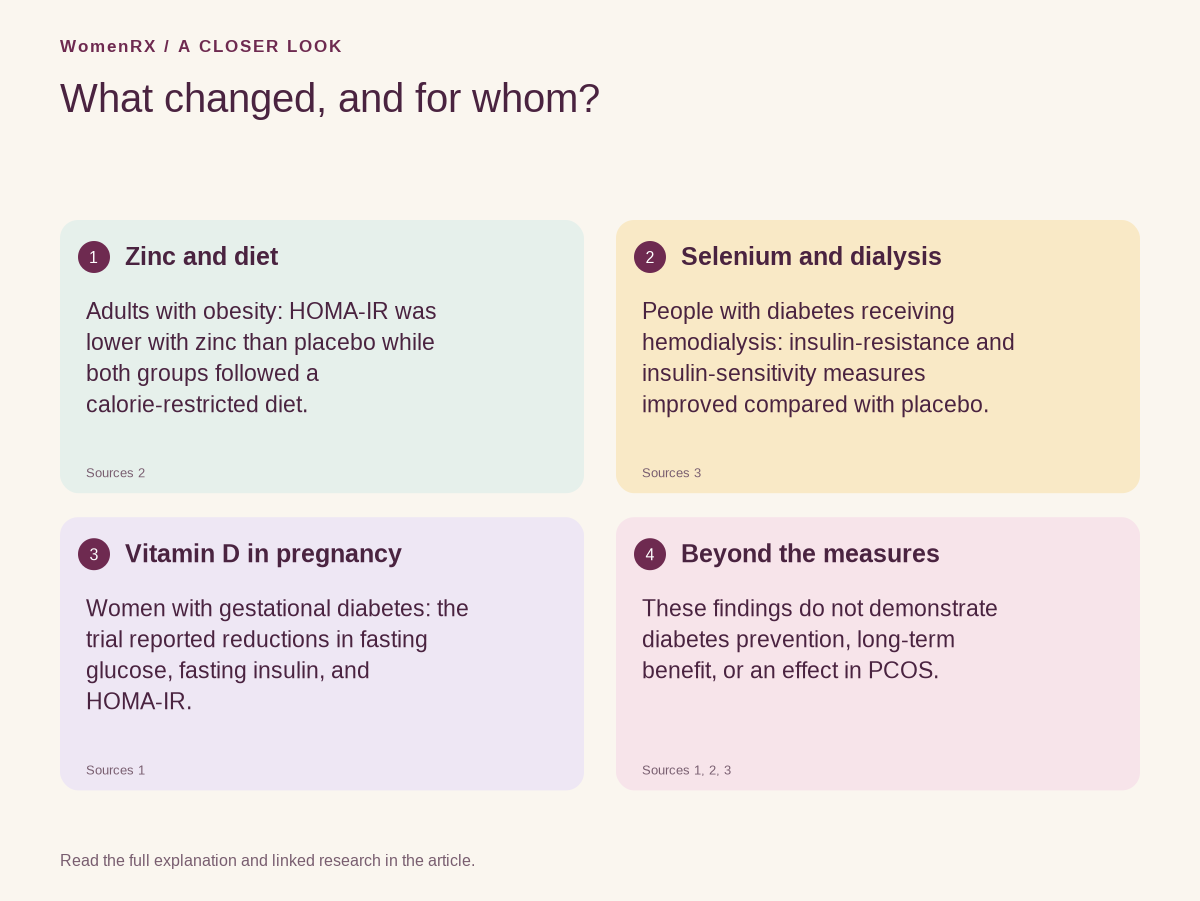
What changed, and for whom?
Zinc and diet: Adults with obesity: HOMA-IR was lower with zinc than placebo while both groups followed a calorie-restricted diet.2
Selenium and dialysis: People with diabetes receiving hemodialysis: insulin-resistance and insulin-sensitivity measures improved compared with placebo.3
Vitamin D in pregnancy: Women with gestational diabetes: the trial reported reductions in fasting glucose, fasting insulin, and HOMA-IR.1
Beyond the measures: These findings do not demonstrate diabetes prevention, long-term benefit, or an effect in PCOS.123
Read the figure as text
Each trial connects a supplement to a measured result in a specific group; none establishes diabetes prevention.- Zinc and diet: Adults with obesity: HOMA-IR was lower with zinc than placebo while both groups followed a calorie-restricted diet.2
- Selenium and dialysis: People with diabetes receiving hemodialysis: insulin-resistance and insulin-sensitivity measures improved compared with placebo.3
- Vitamin D in pregnancy: Women with gestational diabetes: the trial reported reductions in fasting glucose, fasting insulin, and HOMA-IR.1
- Beyond the measures: These findings do not demonstrate diabetes prevention, long-term benefit, or an effect in PCOS.123
Sources you can check
- Effects of vitamin D supplementation on insulin resistance and lipid metabolic profiles in women with gestational diabetes mellitus: A randomized controlled trial.Duan Y, Zhang S, Ma X, Li L, Jia K. · African journal of reproductive health · 2026Return to first citation
- Zinc supplementation improves body weight management, inflammatory biomarkers and insulin resistance in individuals with obesity: a randomized, placebo-controlled, double-blind trial.Khorsandi H, Nikpayam O, Yousefi R, Parandoosh M, Hosseinzadeh N, Saidpour A, Ghorbani A. · Diabetology & metabolic syndrome · 2019Return to first citation
- The effects of selenium administration on carotid intima-media thickness and metabolic status in diabetic hemodialysis patients: A randomized, double-blind, placebo-controlled trial.Salimian M, Soleimani A, Bahmani F, Tabatabaei SMH, Asemi Z, Talari HR. · Clinical nutrition ESPEN · 2022Return to first citation