Myo-Inositol for PCOS: What Results Can You Expect?
Short PCOS trials have reported changes in insulin-resistance measures and menstrual patterns, but they don’t establish myo-inositol as a reliable weight-loss supplement.
If you have PCOS, inositol may be worth considering for insulin-related or menstrual concerns, but set a specific expectation: short trials reported improvements in insulin-resistance measures and cycle regularity, not dependable weight loss or restored ovulation. The trials tested myo-inositol combined with D-chiro-inositol, so they can’t tell you what myo-inositol alone would do. 3 4
A supplement described as helping “metabolic health” can sound as if it will lower blood sugar, reduce weight, and make periods predictable all at once. Those are different outcomes. In PCOS studies of inositol, the most useful question is which one was measured and what else participants received.
An insulin-resistance result isn’t a blood sugar result
Insulin helps move sugar from your blood into your cells. With insulin resistance, the body doesn’t respond to insulin as well, which can contribute to high blood sugar. People with PCOS have an increased risk of metabolic syndrome, a group of risk factors that includes blood sugar and other measures. 1
A 12-week randomized trial enrolled 192 women ages 18 to 35 with PCOS. It compared metformin, an inositol blend, calorie restriction, and all three together. The inositol group received myo-inositol plus D-chiro-inositol. The group receiving all three interventions had the largest reported reduction in HOMA-IR, the trial’s measure of insulin resistance. Because those participants also received metformin and dietary restriction, the result can’t be credited to inositol alone. 3
Another 12-week study compared an inositol blend with metformin in 60 women with PCOS. It reported improvement in HOMA-IR in both groups. That’s an insulin-related finding, not evidence that the blend prevents diabetes or produces a predictable change in blood sugar for an individual. 4 If blood sugar is your concern, a blood glucose result answers a different question from HOMA-IR. 1 2
Weight loss has a weaker case
The 192-person trial reported its largest BMI reduction in the group receiving metformin, inositol, and dietary restriction together. Its abstract doesn’t give a specific BMI change for the group receiving the inositol blend without those other interventions. 3
The 60-person study reported BMI improvement in both its inositol-blend and metformin groups, but its abstract doesn’t give the size of the BMI change. It also doesn’t describe a placebo or untreated comparison group. Those results don’t establish how much weight change the blend caused, let alone whether myo-inositol alone is an effective weight-loss supplement. 4
This distinction is useful when you see a claim that inositol “improves metabolism.” A change in an insulin-resistance measure does not automatically mean a meaningful change on the scale.
More regular periods don’t prove ovulation
In the larger trial, 64.6% of participants in the inositol-blend group reported cycle regularization over 12 weeks. The reported proportions were 85.4% with all three interventions, 72.9% with dietary restriction, and 39.6% with metformin. These are results for particular study groups over a short period, not a forecast of your response. 3
The smaller study also reported improved menstrual regularity in both groups. 4 Regular bleeding and confirmed ovulation are different outcomes, though. These reported cycle findings don’t establish that an inositol blend will restore ovulation or improve the chance of pregnancy. 3 4
Check the blend before comparing products with studies
Both trials used a 40:1 ratio of myo-inositol to D-chiro-inositol. The larger trial specified 2 grams of myo-inositol plus 50 milligrams of D-chiro-inositol twice daily. The smaller study’s abstract gave the ratio but not the amounts taken. These are descriptions of what researchers tested, not a recommended dose. Neither trial compared different ratios or tested myo-inositol by itself. 3 4
So if a product contains only myo-inositol, or a different blend, it isn’t the same formulation tested in these trials. And because the participants had PCOS, their results shouldn’t be assumed to apply to someone taking inositol for general weight or blood sugar goals without PCOS. 3 4
The clearest way to weigh the claim is to name the outcome you care about: an insulin-resistance measure, blood glucose, weight, or menstrual regularity. The short PCOS studies offer some findings for the first and the last. They leave much less certainty about meaningful weight loss, sustained results, and the effect of myo-inositol on its own. 3 4
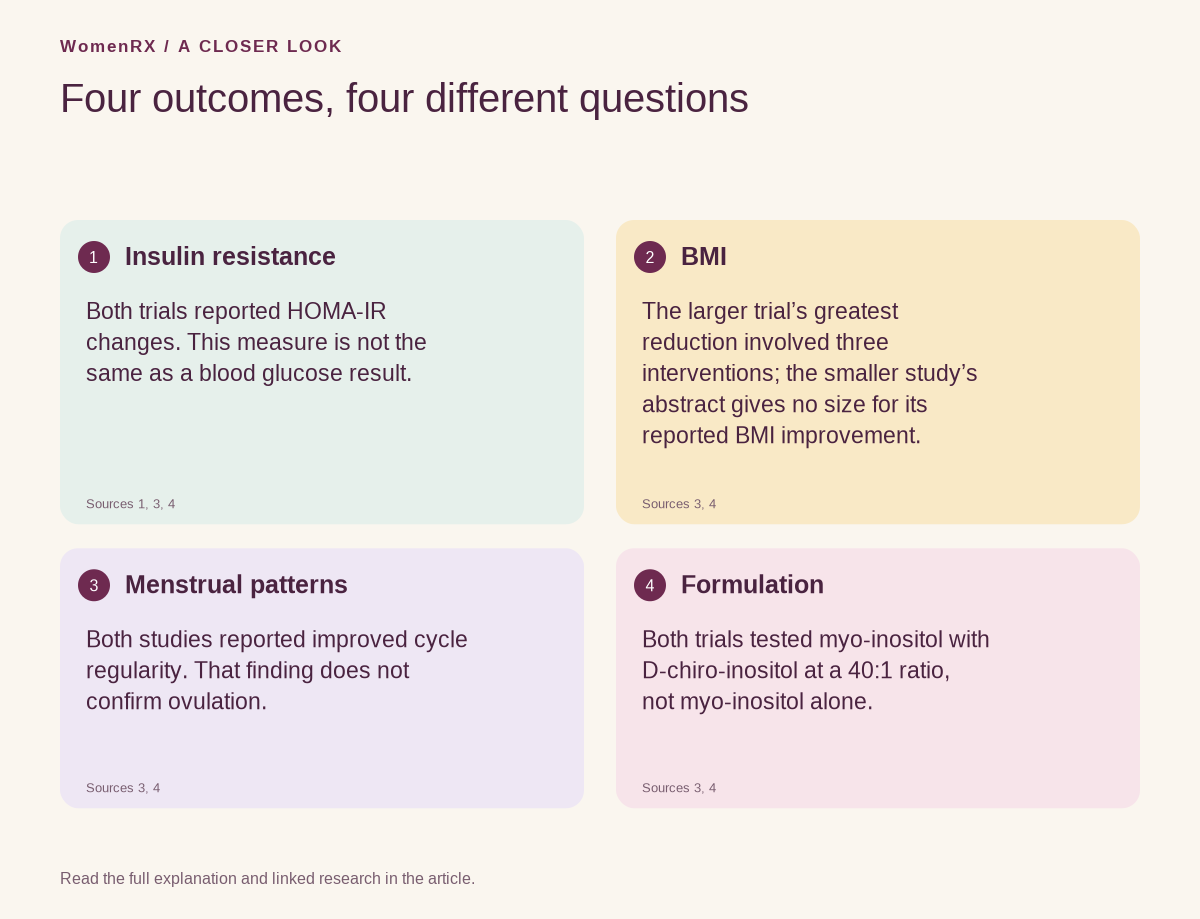
Four outcomes, four different questions
Insulin resistance: Both trials reported HOMA-IR changes. This measure is not the same as a blood glucose result.134
BMI: The larger trial’s greatest reduction involved three interventions; the smaller study’s abstract gives no size for its reported BMI improvement.34
Menstrual patterns: Both studies reported improved cycle regularity. That finding does not confirm ovulation.34
Formulation: Both trials tested myo-inositol with D-chiro-inositol at a 40:1 ratio, not myo-inositol alone.34
Read the figure as text
The short PCOS trials measured several outcomes, but a finding for one does not establish a benefit for another.- Insulin resistance: Both trials reported HOMA-IR changes. This measure is not the same as a blood glucose result.134
- BMI: The larger trial’s greatest reduction involved three interventions; the smaller study’s abstract gives no size for its reported BMI improvement.34
- Menstrual patterns: Both studies reported improved cycle regularity. That finding does not confirm ovulation.34
- Formulation: Both trials tested myo-inositol with D-chiro-inositol at a 40:1 ratio, not myo-inositol alone.34
More questions, answered
Does a more regular period mean I’m ovulating?
Not necessarily. The trials reported menstrual regularity, but those results don’t confirm that ovulation returned. 3 4
Sources you can check
- Metabolic Syndrome | MedlinePlusAccessed 2026-09-25Return to first citation
- Metabolic syndrome - NHSAccessed 2026-09-25Return to first citation
- Multimodal Therapy With Metformin, Inositol and Dietary Restriction Improves Insulin Resistance and Endocrine Outcomes in Women With Polyendocrine Metabolic Ovarian Syndrome: A Randomized Controlled Trial.Irfan NU, Saleem S, Irfan A. · Clinical endocrinology · 2026Return to first citation
- Comparative efficacy of combined myo-inositol and D-chiro inositol versus metformin across PCOS Phenotypes: enhancing ovarian function, ovulation, and stress response in a prospective clinical trial.Gul M, Khan H, Rauf B, Bukhari SMS, Ehtesham E, Malik MO, Shah FA, Alanazi FE, Shah M. · Naunyn-Schmiedeberg's archives of pharmacology · 2025Return to first citation