Myo-Inositol Dose: What PCOS Research Can Tell You
A PCOS combination trial and a safety review offer different kinds of dose information, but neither sets a personal dose.
One PCOS trial tested myo-inositol at 600 mg twice daily only as part of a combination product with metformin, not on its own. A separate safety review reported mild digestive symptoms at the highest dose it discussed, 12 g a day. These findings describe different research contexts; they don’t establish a universal dose or a safe upper limit. 1 3
Two findings, two different contexts
A dose from a study is meaningful only alongside the study’s population, product, and treatment context. In a 24-week randomized trial of 196 people with PCOS, one group received a fixed combination of metformin 500 mg and myo-inositol 600 mg twice daily; the comparison group received metformin alone. Because the myo-inositol was combined with metformin, this trial does not establish 600 mg twice daily as a standalone dose or show what myo-inositol alone contributed. 1
A separate review of inositol safety reported mild gastrointestinal effects, including nausea, gas, and diarrhea, at the highest myo-inositol dose it discussed: 12 g a day. This is a finding from the reviewed evidence, not a target, a recommended upper limit, or proof that lower or higher amounts are right for you. 3
These findings aren’t a dose range to choose from. One is a combination-treatment regimen in a PCOS trial; the other is a side-effect observation from a safety review. They answer different questions.
What fertility research can and can’t clarify
A Cochrane review included trials of oral inositol in subfertile women with PCOS who were trying to conceive. The review assessed different types, doses, or combinations as eligible interventions, and included comparisons such as inositol with standard treatment, metformin, clomiphene, or another type of inositol. Its abstract does not provide enough detail to compare the actual regimens or identify a fertility dose to use. 2
The review judged the evidence for fertility outcomes low or very low quality. It found uncertainty about outcomes including live birth and clinical pregnancy, and noted that adverse effects were often not reported. So fertility studies don’t provide a clear basis for choosing a dose for everyday PCOS care. 2
Check the product, not just the number
Before comparing products, check how much myo-inositol is in a serving, rather than relying on a front-label amount for a blend. Look for whether the product contains myo-inositol alone or combines it with another form of inositol or other ingredients. A number on a label doesn’t establish that the product matches a studied regimen or that the amount is right for your situation.
Also note how many servings make up the labeled daily amount. The cited PCOS trial tested myo-inositol with metformin, while the fertility review does not provide enough regimen detail in its abstract for a product-to-study comparison. Neither establishes a preferred myo-inositol-to-D-chiro-inositol ratio or a standard standalone dose. 1 2
When the study context matters to you
If you’re considering myo-inositol while trying to conceive or receiving fertility treatment, ask your fertility clinician how it fits with your plan. The Cochrane review found uncertainty about important fertility outcomes, and adverse effects were often not reported. Use in fertility studies isn’t proof that it improves the outcome that matters most to you. 2
If you take metformin, don’t use a combination-product trial as a reason to stop, replace, or change your prescribed medicine. The trial compared metformin plus myo-inositol with metformin alone; it did not test myo-inositol as a substitute for metformin. 1
If you’re pregnant, ask your pregnancy-care clinician before choosing a product or dose. A review discusses myo-inositol in pregnancy and describes the available safety evidence as favorable, while also saying pregnancy-related acne evidence is limited. The cited abstract does not establish a personal pregnancy dose. 4
The practical takeaway: bring the exact product label to the conversation. The ingredient list and amount per serving help your clinician compare the product with the particular research or care plan being discussed, rather than treating a study dose as a universal answer.
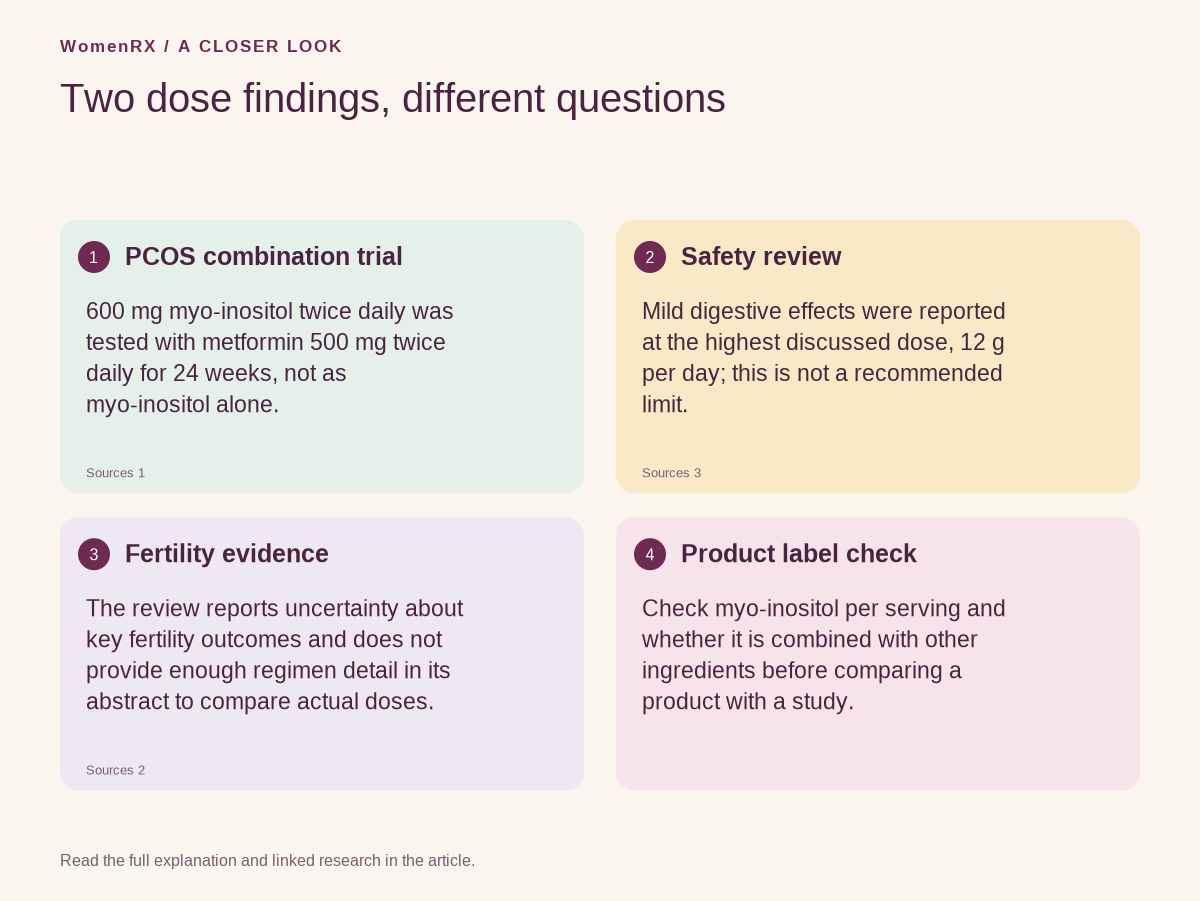
Two dose findings, different questions
PCOS combination trial: 600 mg myo-inositol twice daily was tested with metformin 500 mg twice daily for 24 weeks, not as myo-inositol alone.1
Safety review: Mild digestive effects were reported at the highest discussed dose, 12 g per day; this is not a recommended limit.3
Fertility evidence: The review reports uncertainty about key fertility outcomes and does not provide enough regimen detail in its abstract to compare actual doses.2
Product label check: Check myo-inositol per serving and whether it is combined with other ingredients before comparing a product with a study.
Read the figure as text
These research findings are not a dose range: one describes a PCOS combination regimen, while the other describes digestive effects at a high reviewed amount.- PCOS combination trial: 600 mg myo-inositol twice daily was tested with metformin 500 mg twice daily for 24 weeks, not as myo-inositol alone.1
- Safety review: Mild digestive effects were reported at the highest discussed dose, 12 g per day; this is not a recommended limit.3
- Fertility evidence: The review reports uncertainty about key fertility outcomes and does not provide enough regimen detail in its abstract to compare actual doses.2
- Product label check: Check myo-inositol per serving and whether it is combined with other ingredients before comparing a product with a study.
More questions, answered
Does the 12 g amount mean that’s the maximum safe dose?
No. A safety review reported mild digestive effects at the highest dose it discussed, 12 g a day. That finding doesn’t establish a recommended maximum or show that other amounts are appropriate for you. 3
Can I use a myo-inositol and metformin combination instead of metformin?
The cited PCOS trial compared a fixed-dose product containing myo-inositol and metformin with metformin alone. It did not test myo-inositol as a replacement for metformin. Don’t change a prescribed treatment based on that comparison. 1
Sources you can check
- A Phase III, Double-Blind, Randomized, Multicenter, Clinical Trial to Evaluate the Efficacy and Safety of a Fixed-Dose Combination of Metformin Hydrochloride and Myo-Inositol Compared to Metformin in Patients With Polycystic Ovary Syndrome.Kriplani A, Tank P, Singh P, Maini N, Kaitala S, Kantha G L, Paul J, Shah S, Bhatara U, Sinha A, Singh T, Srivastava S, Malvi A. · Cureus · 2024Return to first citation
- Inositol for subfertile women with polycystic ovary syndrome.Showell MG, Mackenzie-Proctor R, Jordan V, Hodgson R, Farquhar C. · The Cochrane database of systematic reviews · 2018Return to first citation
- Inositol safety: clinical evidences.Carlomagno G, Unfer V. · European review for medical and pharmacological sciences · 2011Return to first citation
- Myo-Inositol in Pregnancy: Implications for Acne Management.Baboun D, Yaghi M, Keelin J, Hernandez-Bueso DM, Fernandez Fernandez V, Keri J. · Journal of drugs in dermatology : JDD · 2026Return to first citation