Electrolyte Drinks: When They Help and When Water Is Enough
For everyday activity, water is usually a sensible choice; electrolyte drinks are more relevant when heavy sweating or illness causes fluid and salt losses.
You probably don’t need an electrolyte drink for ordinary daily activity or exercise without substantial sweating. Water is generally enough in those situations. A sports drink may help after prolonged, vigorous exercise or heavy sweating in heat. For diarrheal illness, an oral rehydration solution is different from a sports drink. If vomiting makes drinking difficult, try small sips. 1 2 4
Start with what you’ve lost
Electrolytes are minerals, including sodium and potassium, that help regulate fluid balance. The useful question is whether you’ve lost a lot of fluid and minerals through sweating, vomiting, or diarrhea. Dehydration happens when your body loses more fluid than it takes in. For mild dehydration, water may be enough. 2
For ordinary activity, drinking water regularly is a sensible starting point. If you’re exercising in hot weather or sweating heavily, replacing fluids matters, and replacing lost salt and minerals may matter too. Heat illness can develop after extended time in the heat, especially with exercise or outdoor work. 1 2
Match the drink to the situation
Everyday activity or a workout without heavy sweating: Choose water as your starting point. 2 A small study of 14 female field hockey players across three training sessions compared drinks with different mineral content. The researchers found some differences in measured indicators, but concluded that mineralization did not have a very significant overall effect on the indicators they assessed. This limited result doesn’t establish how every drink affects hydration in every workout. 3
Prolonged, vigorous exercise or heavy sweating in heat: A sports drink can be useful when you’re losing substantial fluid and salt through sweat. Check the label for sodium and sugar per serving, and consider whether you also want the carbohydrates a sports drink may provide during demanding exercise. Some sports drinks contain a lot of sugar, so more isn’t automatically better. 2 4
Diarrhea: Don’t assume a sports drink and an oral rehydration solution are interchangeable. Oral rehydration solutions are designed to replace fluid and salts lost during diarrheal illness. A review describes sports drinks, juice, and soft drinks as poor substitutes in that situation, though other liquids may be considered for no or mild dehydration. 4
Vomiting: If you’re struggling to keep liquids down, try small sips of water or sucking on ice chips. Get medical help right away if dehydration is accompanied by confusion. 2
Read the label for the job you need done
Compare sodium and sugar amounts between products rather than choosing by words such as “electrolyte” or “hydration.” A sports drink for exercise and an oral rehydration solution for diarrheal illness serve different purposes. If your goal is simply to drink more after a hot walk or workout, water may be enough; if you’ve had substantial sweat loss, a product with sodium may be useful. There isn’t one best choice for every person or activity. 2 4
What the women’s study can and can’t tell you
The study of female field hockey players described above involved 14 athletes during three training sessions. It did not examine menstrual bleeding, pregnancy, breastfeeding, or menopause, so it can’t answer whether hydration needs differ in those contexts. Its findings are specific to the drinks, players, and training sessions studied. 3
Menstrual bleeding, pregnancy, breastfeeding, or menopause alone doesn’t establish a need for an electrolyte product. Instead, separate what happened from the life-stage label: sweating heavily during an outdoor workout and losing fluid through diarrhea call for different options. If you’re unsure how much fluid to drink for your individual circumstances, ask your clinician for guidance. 2 4
When to get help
Confusion during dehydration or heat exposure needs prompt medical attention. Heat stroke can include dizziness, nausea, and a rapid, strong pulse; if you see signs of heat stroke, get medical help right away. Don’t try to manage a serious heat illness by switching drinks. 1 2
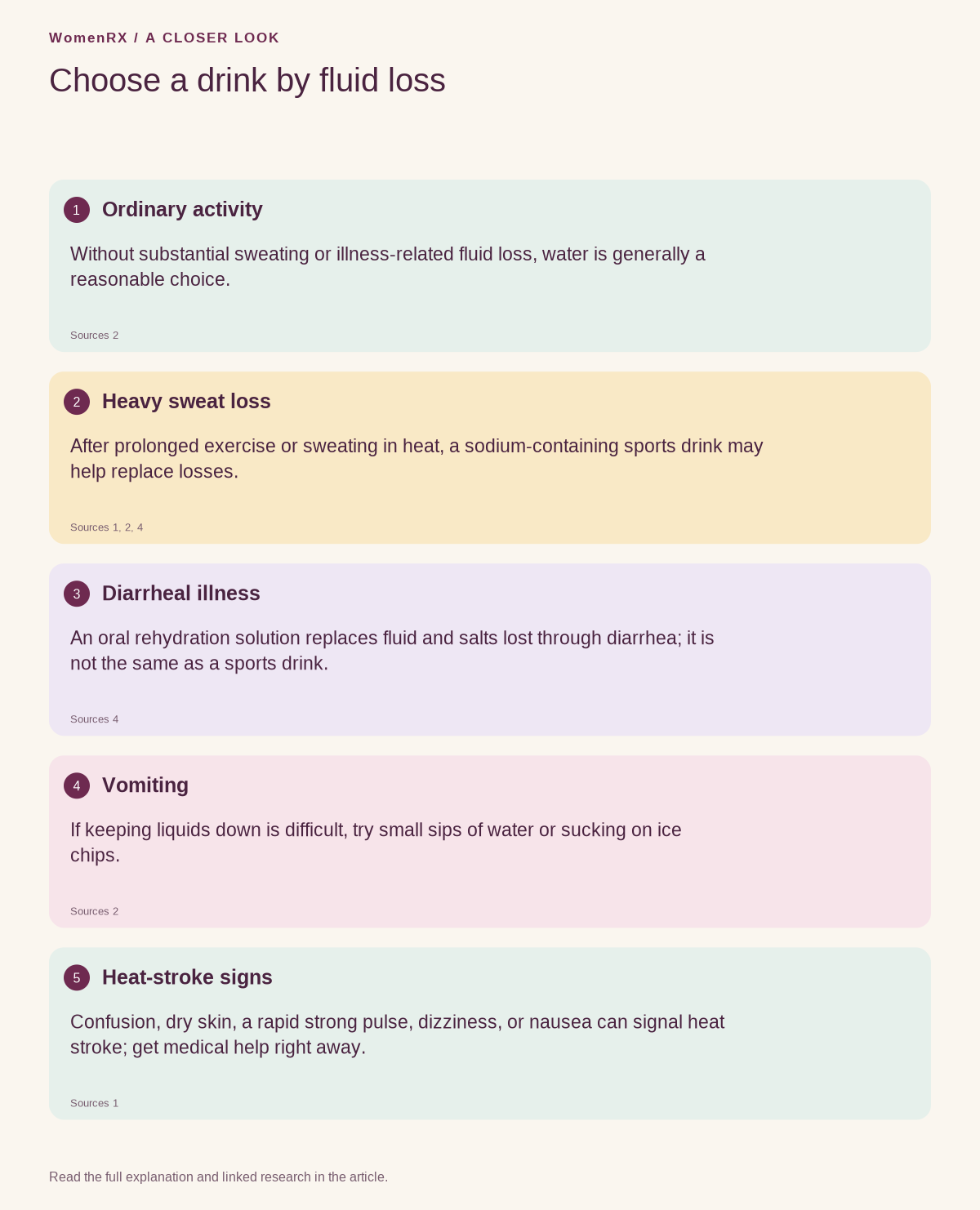
Choose a drink by fluid loss
Ordinary activity: Without substantial sweating or illness-related fluid loss, water is generally a reasonable choice.2
Heavy sweat loss: After prolonged exercise or sweating in heat, a sodium-containing sports drink may help replace losses.124
Diarrheal illness: An oral rehydration solution replaces fluid and salts lost through diarrhea; it is not the same as a sports drink.4
Vomiting: If keeping liquids down is difficult, try small sips of water or sucking on ice chips.2
Heat-stroke signs: Confusion, dry skin, a rapid strong pulse, dizziness, or nausea can signal heat stroke; get medical help right away.1
Read the figure as text
The main decision is whether you’ve had ordinary activity, substantial sweat loss, diarrhea, or trouble drinking because of vomiting.- Ordinary activity: Without substantial sweating or illness-related fluid loss, water is generally a reasonable choice.2
- Heavy sweat loss: After prolonged exercise or sweating in heat, a sodium-containing sports drink may help replace losses.124
- Diarrheal illness: An oral rehydration solution replaces fluid and salts lost through diarrhea; it is not the same as a sports drink.4
- Vomiting: If keeping liquids down is difficult, try small sips of water or sucking on ice chips.2
- Heat-stroke signs: Confusion, dry skin, a rapid strong pulse, dizziness, or nausea can signal heat stroke; get medical help right away.1
More questions, answered
Are sports drinks the same as oral rehydration solutions?
No. Oral rehydration solutions are used to replace fluid and salts lost during diarrheal illness. Sports drinks may help with substantial sweat loss during exercise, but they aren’t an interchangeable choice for illness-related fluid loss. 2 4
Sources you can check
- Heat Illness: MedlinePlusAccessed 2026-09-25Return to first citation
- Dehydration: MedlinePlusAccessed 2026-09-25Return to first citation
- Does the Minerals Content and Osmolarity of the Fluids Taken during Exercise by Female Field Hockey Players Influence on the Indicators of Water-Electrolyte and Acid-Basic Balance?Kamińska J, Podgórski T, Rachwalski K, Pawlak M. · Nutrients · 2021Return to first citation
- Electrolytes: Oral Electrolyte Solutions.Harris L, Braun M. · FP essentials · 2017Return to first citation