Electrolyte Drinks: What to Choose for Exercise and Heat
Water is often enough for everyday hydration, while long, strenuous or hot workouts can make a drink with sodium more useful.
For routine hydration and most activity lasting less than an hour, water is usually sufficient. During prolonged, strenuous exercise, especially in heat, sweat can carry away water and sodium, so a drink containing sodium may help replace losses. Compare sodium and carbohydrates per serving, and check the serving size. Carbohydrates can provide exercise fuel, but an electrolyte drink isn’t automatically better for every workout. 4
Choose for the workout, not the marketing
If you’re going about an ordinary day or doing a shorter workout, water is usually the practical choice. A review of beverage composition says plain water may be enough for physical activity lasting less than an hour. You don’t need an electrolyte product just because you exercised. 4
The balance can change during longer or harder exercise. Sweating removes water and electrolytes, particularly sodium and chloride. How much you lose varies with the person and conditions such as heat, humidity, clothing and acclimatization. That’s why a drink with sodium may make sense for a long, sweaty workout, without being necessary for every exercise session. 4
What to compare on the label
Sodium: For exercise-related sweat loss, this is often the most relevant electrolyte to compare. Look at the sodium listed for the serving you expect to drink. Don’t assume that a product with “electrolytes” on the front provides a particular amount, or that the product with the most sodium is the right one for you. Sweat losses vary, and the research doesn’t establish one ideal drink formula for every setting. 4
Carbohydrates: These can supply energy during long, demanding exercise. A sports drink may be useful when you want both fluid and fuel; extra carbohydrate isn’t automatically a benefit if you only want a drink to sip during an easier workout. Carbohydrate content also affects how concentrated a drink is. In a meta-analysis of continuous exercise, hypotonic carbohydrate-electrolyte drinks had an advantage over isotonic drinks on change in plasma volume. That’s a specific hydration measure, not proof that a particular store-bought product improves performance or is best for everyone. 3
Serving size: Compare the nutrition information with the amount you’ll actually drink. A number listed per serving can be misleading if your usual amount is more or less than that serving. And don’t choose by “isotonic” alone: products using that term may not all have the same composition. 34
Potassium: It’s an essential electrolyte, but a higher potassium number doesn’t automatically make a drink a better choice for exercise. If you have kidney disease or take medicine that affects potassium, added potassium may warrant extra care. NIH guidance notes this concern for potassium-containing salt substitutes; it doesn’t establish the risk from every sports drink, so ask about your own situation if it applies. 12
Match the drink to the reason you’re drinking
- Everyday hydration or a shorter workout: Water is usually enough. Skip the extra product if it isn’t meeting a particular need. 4
- Long or strenuous exercise: Decide whether you want carbohydrates for fuel as well as fluid. Then compare the sodium and carbohydrate amounts for the serving you’ll drink. 34
- A hot, sweaty workout: Sodium may be useful alongside fluid, but needs vary with the person and conditions. A label can help you compare products; it can’t tell you exactly how much you personally lose in sweat. 4
- Diarrhea-related fluid loss: An oral rehydration solution is a different category from an ordinary sports drink. These solutions were developed for diarrhea-related dehydration, so don’t assume the products are interchangeable. 4
Sports-drink research doesn’t establish that women need a different formula. For this comparison, the type and length of exercise, heat and individual sweat loss matter more than a gendered label. The research also doesn’t provide specific hydration recommendations for pregnancy or breastfeeding, so this exercise-based comparison shouldn’t be treated as individual guidance for those situations. 34
A simple buying rule
Start with the reason you need a drink. If water is enough, there’s no need to pay for added electrolytes. If you’re exercising hard for a long time or sweating heavily, compare sodium for fluid replacement and carbohydrates if you also want fuel. If the fluid loss is from diarrhea, look for an oral rehydration solution rather than assuming a sports drink serves the same purpose.
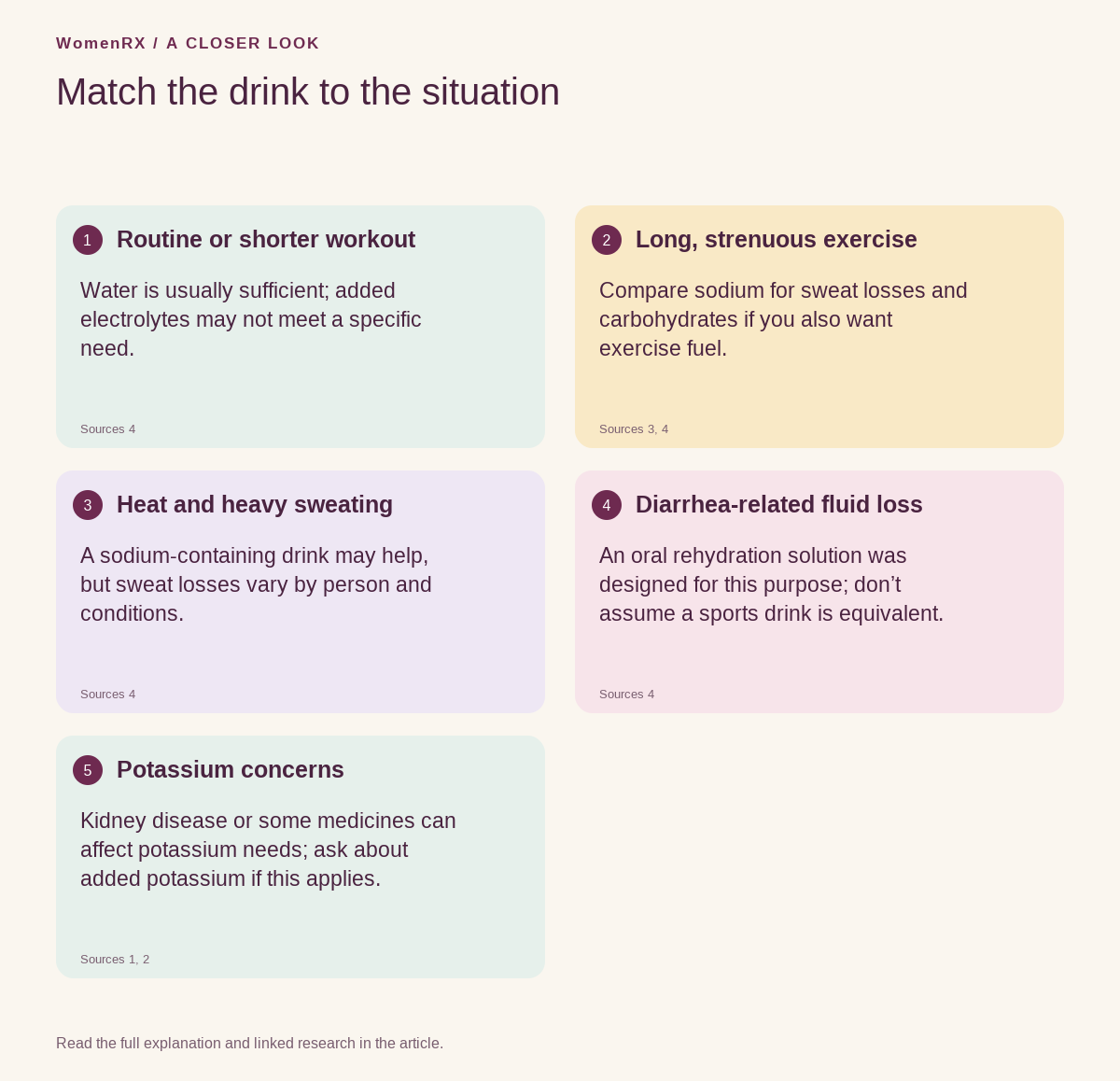
Match the drink to the situation
Routine or shorter workout: Water is usually sufficient; added electrolytes may not meet a specific need.4
Long, strenuous exercise: Compare sodium for sweat losses and carbohydrates if you also want exercise fuel.34
Heat and heavy sweating: A sodium-containing drink may help, but sweat losses vary by person and conditions.4
Diarrhea-related fluid loss: An oral rehydration solution was designed for this purpose; don’t assume a sports drink is equivalent.4
Potassium concerns: Kidney disease or some medicines can affect potassium needs; ask about added potassium if this applies.12
Read the figure as text
Start with the reason you need a drink, then compare sodium, carbohydrates and the serving you expect to consume.- Routine or shorter workout: Water is usually sufficient; added electrolytes may not meet a specific need.4
- Long, strenuous exercise: Compare sodium for sweat losses and carbohydrates if you also want exercise fuel.34
- Heat and heavy sweating: A sodium-containing drink may help, but sweat losses vary by person and conditions.4
- Diarrhea-related fluid loss: An oral rehydration solution was designed for this purpose; don’t assume a sports drink is equivalent.4
- Potassium concerns: Kidney disease or some medicines can affect potassium needs; ask about added potassium if this applies.12
More questions, answered
Are sports drinks and oral rehydration solutions the same?
No. Sports drinks are commonly formulated to provide carbohydrates for energy as well as fluid, while oral rehydration solutions were developed for diarrhea-related dehydration. The names and ingredients matter more than the fact that both contain electrolytes. 4
Sources you can check
- Potassium - Health Professional Fact SheetAccessed 2026-09-25Return to first citation
- Potassium | Dietary Potassium | MedlinePlusAccessed 2026-09-25Return to first citation
- The Hydrating Effects of Hypertonic, Isotonic and Hypotonic Sports Drinks and Waters on Central Hydration During Continuous Exercise: A Systematic Meta-Analysis and Perspective.Rowlands DS, Kopetschny BH, Badenhorst CE. · Sports medicine (Auckland, N.Z.) · 2022Return to first citation
- Compositional Aspects of Beverages Designed to Promote Hydration Before, During, and After Exercise: Concepts Revisited.Pérez-Castillo ÍM, Williams JA, López-Chicharro J, Mihic N, Rueda R, Bouzamondo H, Horswill CA. · Nutrients · 2023Return to first citation