Why Did My Period Come Early? Read the Pattern
Count from one period’s first day to the next, then check whether the change was a short cycle, bleeding between periods, or a pattern worth assessing.
Count cycle length from the first day of one period to the first day of the next. In NHS guidance, gaps under 21 days or over 35 days are irregular; one unexpected date doesn’t explain why the bleeding happened. Keep a record of start dates and any bleeding between periods. If your usual pattern changes, your periods last longer than seven days, or you bleed between periods, seek assessment. 1
First, count the days between starts
Cycle length is the gap from the first day of one period to the first day of the next. The day before the next period is the final day of the previous cycle. For example, if one period starts on the 2nd and the next starts on the 27th, the cycle is 25 days long. 1 3
NHS guidance describes gaps under 21 days or over 35 days as irregular. A period that arrives earlier than you expected may still fall within that range. The calendar helps you describe the timing, but it doesn’t explain the cause. 1
An early period or bleeding between periods?
If a new period starts sooner than you expected, record its first day and count the gap from the previous period’s start. If bleeding happens between periods instead, keep a separate note of when it began and ended. That distinction matters: NHS guidance recommends assessment for bleeding between periods, rather than treating it as just another early cycle. 1
A calendar can show when bleeding occurred, but it can’t confirm what caused it. If you’re unsure whether a bleed was a period or bleeding between periods, record the dates and describe what happened without forcing a label. Bring that record if you seek care.
One change is different from a new pattern
Periods aren’t always exactly on schedule. NHS guidance says the gap can be a little shorter or longer than the average; it also recommends speaking to a clinician if your normal pattern changes or periods are irregular. Tracking can help you describe the change, whether it has happened once or more than once. 1
Make a simple record with each period’s first day and last day, plus any bleeding between periods. Note whether the timing seems different from your usual pattern. An app or paper calendar is fine. The aim is to make the pattern easier to describe, not to diagnose yourself. 1
Your age changes the context
Irregular timing is more likely when periods first begin during puberty and as menopause approaches, according to NHS guidance. That makes age relevant, but it doesn’t make every change automatically harmless: bleeding between periods and periods lasting longer than seven days are still reasons to seek assessment. 1
A large U.S. digital cohort also found that cycle length and regularity patterns differed by age among participants with and without reported PCOS or early-life irregular cycles. The study included logged cycles from people not using hormones and not pregnant or lactating, so it describes those groups and conditions, not a diagnostic rule for every woman. 2
During the reproductive years, hormonal contraception, excessive exercise, thyroid problems, and PCOS are among the possible reasons for irregular periods listed by the NHS. These are possibilities, not conclusions you can draw from an early date alone. 1
When to seek assessment
Arrange an assessment if your usual pattern changes, your periods are irregular, a period lasts longer than seven days, or you have bleeding between periods. You don’t need to wait for a change in your normal pattern to happen again before seeking care. If irregular periods come with symptoms such as tiredness, weight gain, facial hair growth, or dry or oily skin, mention those too. 1
The most useful next step is a clear record: period start dates, how long each bleed lasted, and any bleeding in between. That helps distinguish a short cycle from bleeding between periods and gives you a more specific starting point for a conversation about what has changed.
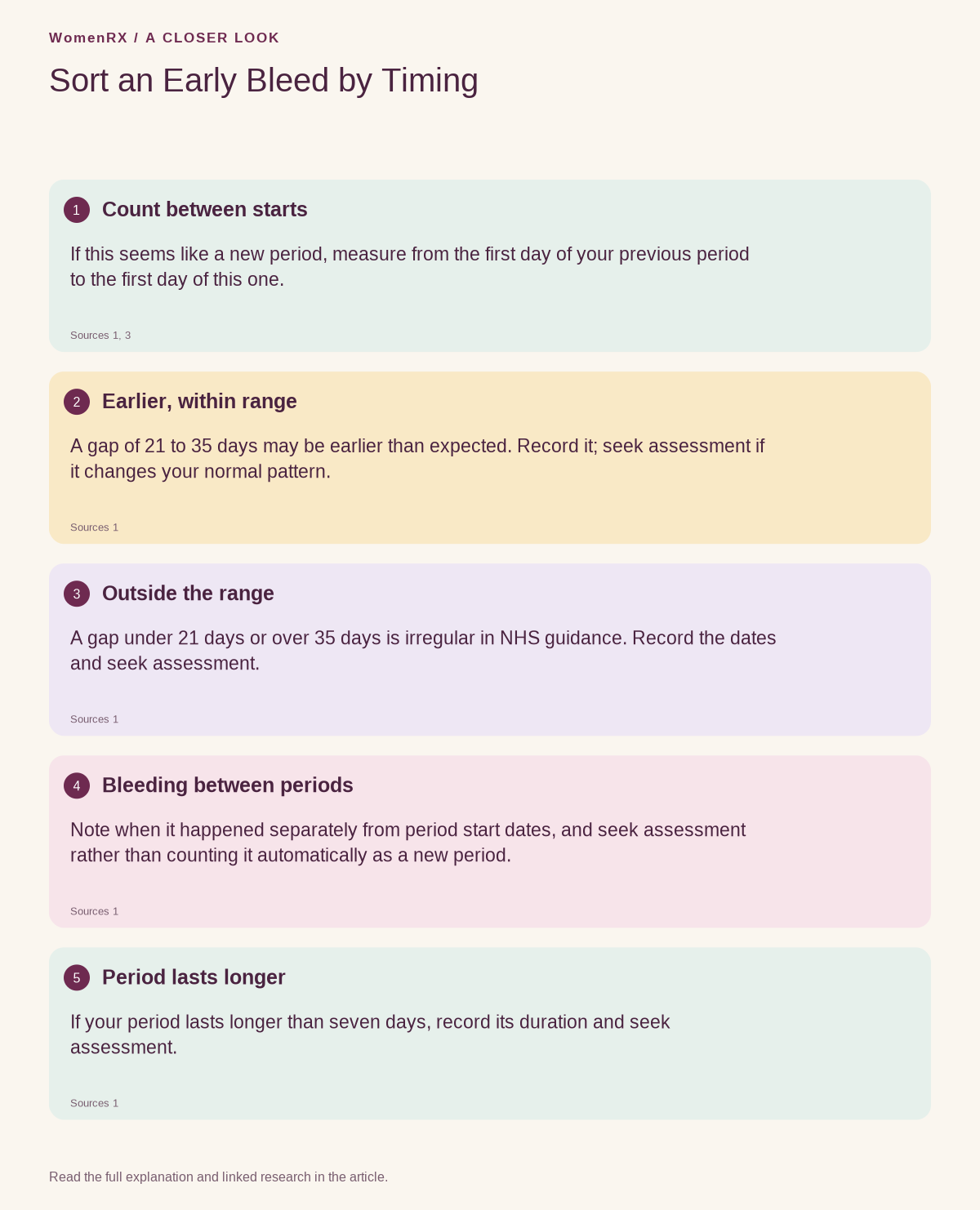
Sort an Early Bleed by Timing
Count between starts: If this seems like a new period, measure from the first day of your previous period to the first day of this one.13
Earlier, within range: A gap of 21 to 35 days may be earlier than expected. Record it; seek assessment if it changes your normal pattern.1
Outside the range: A gap under 21 days or over 35 days is irregular in NHS guidance. Record the dates and seek assessment.1
Bleeding between periods: Note when it happened separately from period start dates, and seek assessment rather than counting it automatically as a new period.1
Period lasts longer: If your period lasts longer than seven days, record its duration and seek assessment.1
Read the figure as text
Start with the dates, then follow the branch that best describes the bleeding. The flow helps you choose what to record and when to seek assessment, not diagnose a cause.- Count between starts: If this seems like a new period, measure from the first day of your previous period to the first day of this one.13
- Earlier, within range: A gap of 21 to 35 days may be earlier than expected. Record it; seek assessment if it changes your normal pattern.1
- Outside the range: A gap under 21 days or over 35 days is irregular in NHS guidance. Record the dates and seek assessment.1
- Bleeding between periods: Note when it happened separately from period start dates, and seek assessment rather than counting it automatically as a new period.1
- Period lasts longer: If your period lasts longer than seven days, record its duration and seek assessment.1
More questions, answered
What counts as the first day of a cycle?
It’s the first day of a period. Count to the first day of the next period to work out the gap between starts. 1 3
Does one early period mean something is wrong?
An early date alone doesn’t identify a cause. Record the dates, and seek assessment if your normal pattern has changed, periods are irregular, or bleeding happens between periods. 1
Sources you can check
- Irregular periods - NHSAccessed 2026-09-25Return to first citation
- Variability of menstrual cycles by age, polycystic ovary syndrome, and early-life cycle irregularity in the apple Women's Health Study.Mortimer R, Asokan G, Baird DD, Wilcox AJ, Abrams K, Curry CL, Onnela JP, Coull BA, Hauser R, Williams MA, Wang Z, Mahalingaiah S. · American journal of obstetrics and gynecology · 2026Return to first citation
- Within-individual changes in BMI and menstrual irregularity: a cohort study using real-world data.Itoi S, Sampei M, Tatsumi T, Ishida R, Izumi G, Osuga Y, Koga K, Narumi S, Morisaki N. · BMC women's health · 2026Return to first citation