Why Did My Period Suddenly Become Irregular?
A changed cycle can have several explanations, but pregnancy and the kind of bleeding you’re having shape what to do first.
A period that arrives early, comes late, or doesn’t come at all can reflect your life stage, changes in ovulation, or a condition such as a thyroid problem. 2 If pregnancy is possible, consider a test. An early negative may not settle the question, especially if you’re unsure when your period was due. 45 New bleeding between periods or a lasting change in your usual pattern deserves evaluation. 2
A calendar prediction is easy to notice when it’s wrong. The more useful comparison is with your own usual pattern: When did bleeding start, how long did it last, and was it heavier or different from what you normally experience? Count a cycle from the first day of one period to the first day of the next. Gaps shorter than 21 days or longer than 35 days are generally considered irregular, but a new change matters even if both dates fall within that range. 2
First, consider pregnancy
If pregnancy is possible and your expected period hasn’t arrived, consider a pregnancy test. A negative result on the first day of a missed period doesn’t always settle the question. In a prospective study of women planning pregnancy, 14 of 136 clinical pregnancies had not yet implanted by that day, so even a highly sensitive urine test could not have detected them. A week after the expected missed period, more pregnancies were detectable in that study, but a negative result still could not rule out pregnancy. 45
If your cycles are irregular, you may not know when a period is due. Research on testing relative to an expected period does not establish a testing date for unpredictable cycles. 5
Pain or bleeding that raises concern about pregnancy needs attention regardless of a test result: ectopic pregnancy can involve a missed or abnormal period, vaginal bleeding, and pelvic or abdominal pain. When pregnancy is possible, seek urgent care for significant pain or bleeding, particularly if you feel suddenly unwell. 4
What changed around the same time?
Your stage of life can change the pattern. Irregular periods are more likely soon after periods first begin and as menopause approaches. That context can explain why dates vary, but it doesn’t mean every new bleeding pattern should be dismissed. 2
After a birth, bleeding isn’t necessarily a period. Spotting or bleeding can come and go during the first six weeks postpartum. An observational study of 762 Japanese mothers found that breastfeeding at 18 months was associated with a later return of periods; it cannot predict when yours will return. If pregnancy is possible, don’t assume the absence of a period answers that question. 36
Ovulation may be less predictable. Irregular periods can make conception harder because you may not release an egg regularly. Excessive exercise is one possible contributor to an irregular cycle. Thyroid problems and polycystic ovary syndrome (PCOS) are also possible explanations, especially when the change comes with other symptoms rather than appearing on its own. 2
Think about what else changed recently. If you’ve begun exercising much more intensely, excessive exercise is one possible reason for irregular periods, though the timing alone cannot show it caused your change. 2 You may also have changed contraception, been ill, felt unusually stressed, or noticed a weight shift. Note those changes for an assessment rather than assuming any one of them explains your cycle. If nothing obvious has changed, symptoms alongside the irregularity may offer more clues. A new pattern is still worth assessing. 2
For example, irregular periods alongside tiredness, weight gain, new facial hair growth, or a change in skin texture give a clinician more to investigate than a shifted date alone. These clues don’t identify a cause by themselves. 2
When to get the change checked
Arrange an assessment if your normal cycle pattern has changed, your periods last longer than seven days, you bleed between periods, or irregular cycles are making it difficult to get pregnant. Heavy bleeding that affects daily life, severe period pain, or bleeding after sex also warrants evaluation. What happens next depends on the pattern and its possible cause; treatment isn’t always needed. 12
Bleeding that requires changing a pad or tampon every one to two hours is a useful way to describe heaviness when you seek help. If pregnancy is possible and bleeding is significant or comes with concerning abdominal or pelvic pain, seek urgent care rather than waiting to see whether the next cycle is regular. 14
You don’t need a perfect cycle history to take that next step. The dates of your last few periods, whether bleeding occurred between them, any pregnancy test results, and symptoms that appeared alongside the change can help make the conversation more specific. 2
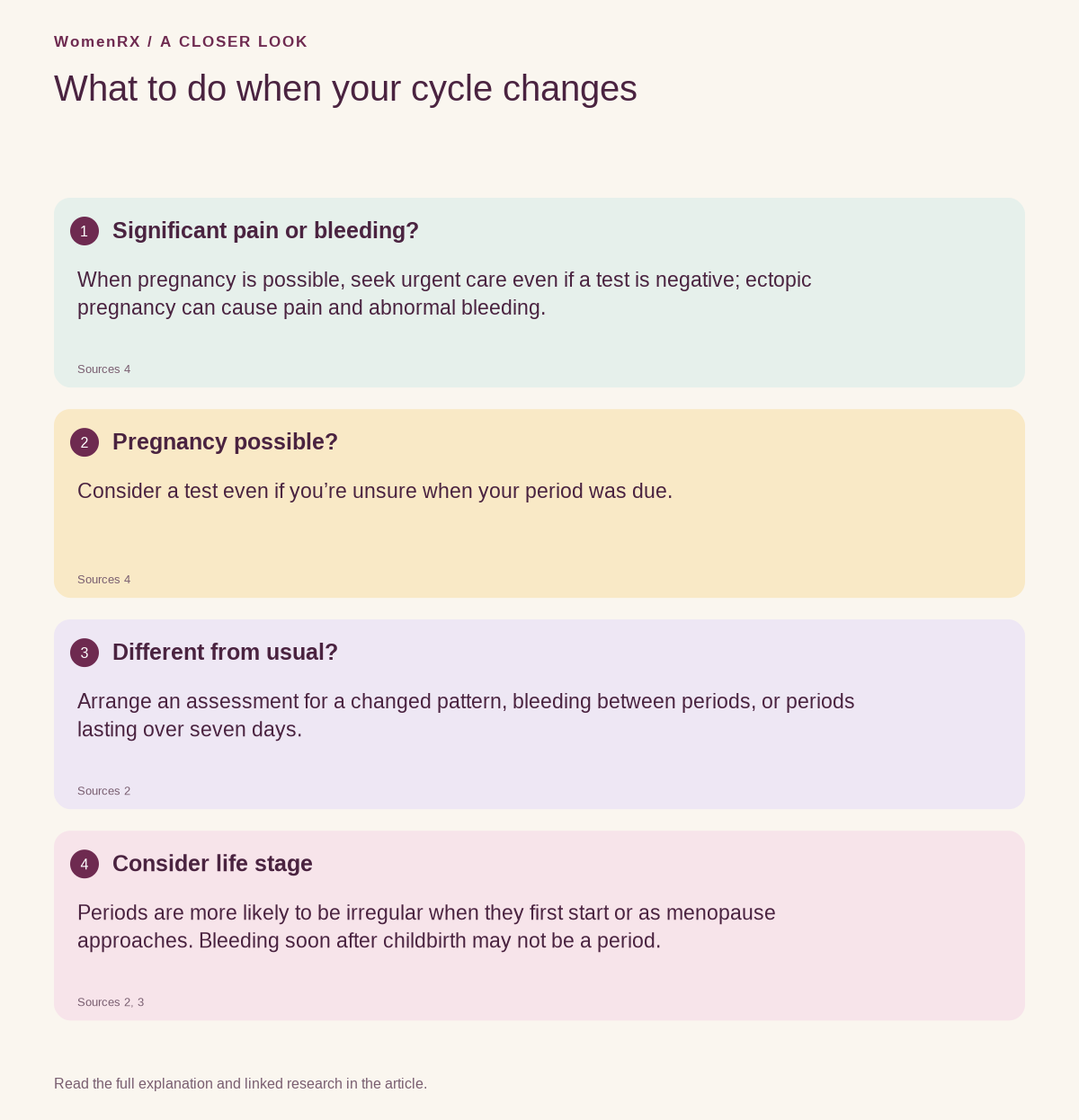
What to do when your cycle changes
Significant pain or bleeding?: When pregnancy is possible, seek urgent care even if a test is negative; ectopic pregnancy can cause pain and abnormal bleeding.4
Pregnancy possible?: Consider a test even if you’re unsure when your period was due.4
Different from usual?: Arrange an assessment for a changed pattern, bleeding between periods, or periods lasting over seven days.2
Consider life stage: Periods are more likely to be irregular when they first start or as menopause approaches. Bleeding soon after childbirth may not be a period.23
Read the figure as text
If pregnancy is possible, start with concerning pain or bleeding. Then consider testing, your usual pattern and life stage.- Significant pain or bleeding?: When pregnancy is possible, seek urgent care even if a test is negative; ectopic pregnancy can cause pain and abnormal bleeding.4
- Pregnancy possible?: Consider a test even if you’re unsure when your period was due.4
- Different from usual?: Arrange an assessment for a changed pattern, bleeding between periods, or periods lasting over seven days.2
- Consider life stage: Periods are more likely to be irregular when they first start or as menopause approaches. Bleeding soon after childbirth may not be a period.23
More questions, answered
Can a negative test on the first missed day rule out pregnancy?
No. Implantation may not have happened yet, so pregnancy may not be detectable that day. 5
Does irregular bleeding near menopause always mean perimenopause?
No. Irregular periods become more likely as menopause approaches, but bleeding between periods, bleeding after sex, heavy bleeding that affects your life, or a changed usual pattern still merits assessment. 12
Sources you can check
- Heavy periods - NHSAccessed 2026-09-25Return to first citation
- Irregular periods - NHSAccessed 2026-09-25Return to first citation
- Postpartum Care: MedlinePlusAccessed 2026-09-25Return to first citation
- Diagnosis and treatment of ectopic pregnancy.Epee-Bekima M, Overton C. · The Practitioner · 2013Return to first citation
- Natural limits of pregnancy testing in relation to the expected menstrual period.Wilcox AJ, Baird DD, Dunson D, McChesney R, Weinberg CR. · JAMA · 2001Return to first citation
- The Current Status of Postpartum Menstrual Resumption Delay and Associated Risk Factors in Japanese Women: An Adjunct Study of the Japan Environment and Children's Study.Samejima A, Motoki N, Haga A, Tokutake C, Nakagomi S, Tsukahara T, Nomiyama T, Kanai M. · Yonago acta medica · 2024Return to first citation