Periods Every Two Weeks in Perimenopause: When to Get Assessed
Perimenopause can change your cycle, but repeated bleeding every two weeks is worth assessing rather than assuming it’s part of the transition.
If bleeding starts roughly every two weeks more than once, arrange an assessment. Shifting ovarian function can make bleeding less predictable in perimenopause, but pregnancy, infections, polyps, fibroids, and other conditions can also cause abnormal bleeding. Bring the start date, duration, and flow of each episode, plus any related symptoms and pregnancy or contraception context. 1 2
First, pin down what “every two weeks” means
Count from the first day of one bleeding episode to the first day of the next. If bleeding began on April 1 and again on April 15, those start dates are 14 days apart, regardless of when the first episode ended. Also note whether the second episode felt like another period or was lighter bleeding between periods. You don’t need to decide what to call it before asking about it.
Cycles often become less predictable during the menopause transition. Changes in ovarian function are one possible explanation, but timing alone can’t tell you why you’re bleeding. Polyps and fibroids can cause abnormal bleeding, and an evaluation may also need to consider pregnancy, sexually transmitted infections, cervical or vaginal causes, and precancerous or cancerous conditions. 1 2
When to make an appointment
If the short interval keeps recurring, arrange an assessment rather than waiting for it to become your new normal. Mention if the bleeding is getting heavier or lasting longer, and whether pregnancy is possible. Contraception use and any recent changes are useful context to bring, but contraception alone doesn’t rule out every other cause. Pregnancy is among the possibilities a clinician may need to check. 1
Heavy bleeding that has caused anemia needs prompt treatment. If you’ve been told you’re anemic, say so when you seek care. A clinician may consider hemoglobin and iron testing in selected cases. 1
Bring a record, not a guess at the cause
A note on your phone or a calendar is enough. For each bleeding episode, record:
- First day and last day: These show both the interval between starts and how long each episode lasted.
- Flow: Describe what you observed, including whether it was spotting, lighter bleeding, or heavy flow, and whether that changed.
- Other symptoms: Note symptoms that occurred alongside the bleeding, such as pelvic pain.
- Relevant context: Note whether pregnancy is possible, what contraception you use, and any recent changes.
This isn’t a test that can diagnose perimenopause or another condition. It helps you describe a repeated pattern clearly, especially when one episode blends into the next.
What might happen at the assessment
The evaluation depends on your history and what the clinician finds. It may include an examination for cervical or vaginal sources of bleeding and checks for pregnancy or infection. Hemoglobin, iron, or thyroid tests may be useful in selected cases. Transvaginal ultrasound can help assess possible causes inside the uterus; its findings may lead to a discussion of further evaluation, such as an endometrial biopsy or hysteroscopy. Not everyone needs every test. 1
What happens after that depends on the cause and how much the bleeding affects you. Once concerning causes have been excluded, observation may be reasonable for some less severe bleeding patterns. Bleeding that causes anemia or interferes with daily life may call for treatment. 1
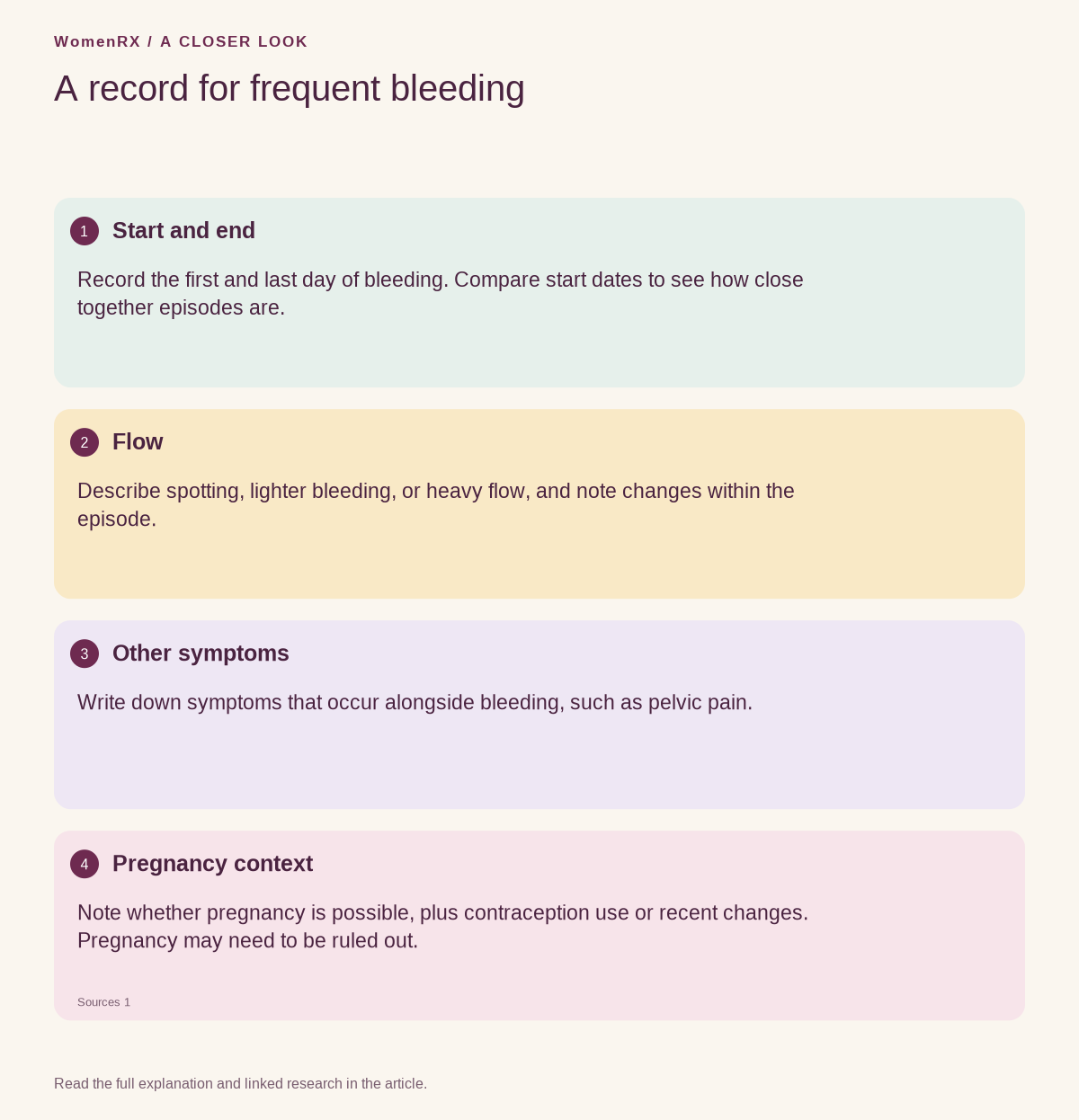
A record for frequent bleeding
Start and end: Record the first and last day of bleeding. Compare start dates to see how close together episodes are.
Flow: Describe spotting, lighter bleeding, or heavy flow, and note changes within the episode.
Other symptoms: Write down symptoms that occur alongside bleeding, such as pelvic pain.
Pregnancy context: Note whether pregnancy is possible, plus contraception use or recent changes. Pregnancy may need to be ruled out.1
Read the figure as text
Use these prompts for each episode so you can describe the pattern clearly. They aren’t a diagnostic score.- Start and end: Record the first and last day of bleeding. Compare start dates to see how close together episodes are.
- Flow: Describe spotting, lighter bleeding, or heavy flow, and note changes within the episode.
- Other symptoms: Write down symptoms that occur alongside bleeding, such as pelvic pain.
- Pregnancy context: Note whether pregnancy is possible, plus contraception use or recent changes. Pregnancy may need to be ruled out.1
More questions, answered
What if it’s only spotting between periods?
Tell your clinician about the spotting and when it happens. Bleeding between periods is part of the pattern to assess, even if it isn’t heavy. After concerning causes have been excluded, observation may be an option in some less severe cases. 1
Sources you can check
- Perimenopausal abnormal uterine bleeding.Dreisler E, Frandsen CS, Ulrich L. · Maturitas · 2024Return to first citation
- Genitourinary symptoms in the menopausal transition.Van Voorhis BJ. · The American journal of medicine · 2005Return to first citation