Could Your Changing Periods Be Perimenopause?
A changing cycle can fit the menopausal transition, but the bleeding pattern and your history help determine what to do next.
Periods that become less predictable or sometimes disappear can fit perimenopause, especially alongside hot flashes or night sweats. But a cycle change alone can’t tell you the cause. Pregnancy remains a possibility if it applies to you, and bleeding can also come from conditions such as polyps or fibroids. New or troublesome bleeding deserves a closer look rather than an automatic perimenopause label. 25
Start with what changed about your cycle
Think back to your usual pattern. Are periods arriving at different intervals, or have you skipped one? Increasing variation in cycle length and stretches without a period are characteristic of the menopausal transition. Hot flashes or night sweats may happen alongside those changes. Menopause itself is identified only after 12 months without a menstrual period, so a few missed periods don’t mean you’ve reached it. 2
The kind of bleeding matters, too. A period that arrives later than expected is a different question from bleeding between periods or a flow that has become much heavier. Irregular ovulation can contribute to abnormal bleeding, but polyps, fibroids and changes in the uterine lining are other possibilities. More than one cause can be present at the same time. 453
Put the change in context
Age changes what else may explain bleeding. Benign growths such as polyps and fibroids become more common with age and can cause abnormal bleeding. That’s why your usual cycle pattern and the type of new bleeding matter alongside your age. 5
If pregnancy is possible, don’t assume a missed period is perimenopause. Pregnancy is one of the causes to rule out when evaluating abnormal bleeding; a pregnancy test is a useful first step when it applies to your situation. Thyroid problems and low blood counts or iron levels may also be relevant in selected cases, depending on the bleeding and other symptoms. 5
Combined oral contraceptives and hormonal IUDs can change or reduce bleeding. If you use either, a change in bleeding may be harder to interpret as a change in your natural cycle. Tell the clinician what you use and when you started it. If you’ve had a hysterectomy, the usual guide based on periods or 12 months without one doesn’t apply; mention that history when discussing your symptoms. Neither situation can be settled by a period-pattern checklist. 52
Mood changes or exhaustion may be part of what you’ve noticed. In a study of adult app users who weren’t taking hormonal contraception or hormone therapy, women who identified themselves as perimenopausal reported more psychological symptoms, including exhaustion, than those who identified themselves as premenopausal. Because the groups were self-identified, that finding doesn’t make mood or energy changes a way to diagnose perimenopause. 1
Know when bleeding needs its own assessment
It’s reasonable to note when bleeding starts, how long it lasts, whether it occurs between periods and whether the flow is heavier than usual. That description helps separate a shifting cycle from bleeding that needs investigation. Bleeding between periods, a marked change in flow or bleeding that’s disrupting your life is worth discussing with a clinician rather than waiting to see whether it’s perimenopause. Heavy bleeding that has caused anemia needs prompt treatment. 5
Depending on the situation, a clinician may check for pregnancy, anemia or a thyroid issue and consider an examination or ultrasound to look for a cause of bleeding. Further evaluation may be needed if findings raise concern about the uterine lining. The point is to work out why the bleeding changed before deciding whether it needs treatment. 53
A useful first move is therefore specific to your situation: compare the new pattern with your usual one if periods are a useful guide for you, consider pregnancy if possible, and seek assessment when bleeding is heavy, occurs between periods or otherwise concerns you. Perimenopause may be the explanation, but you don’t have to settle that question on your own before getting help with the bleeding. 25
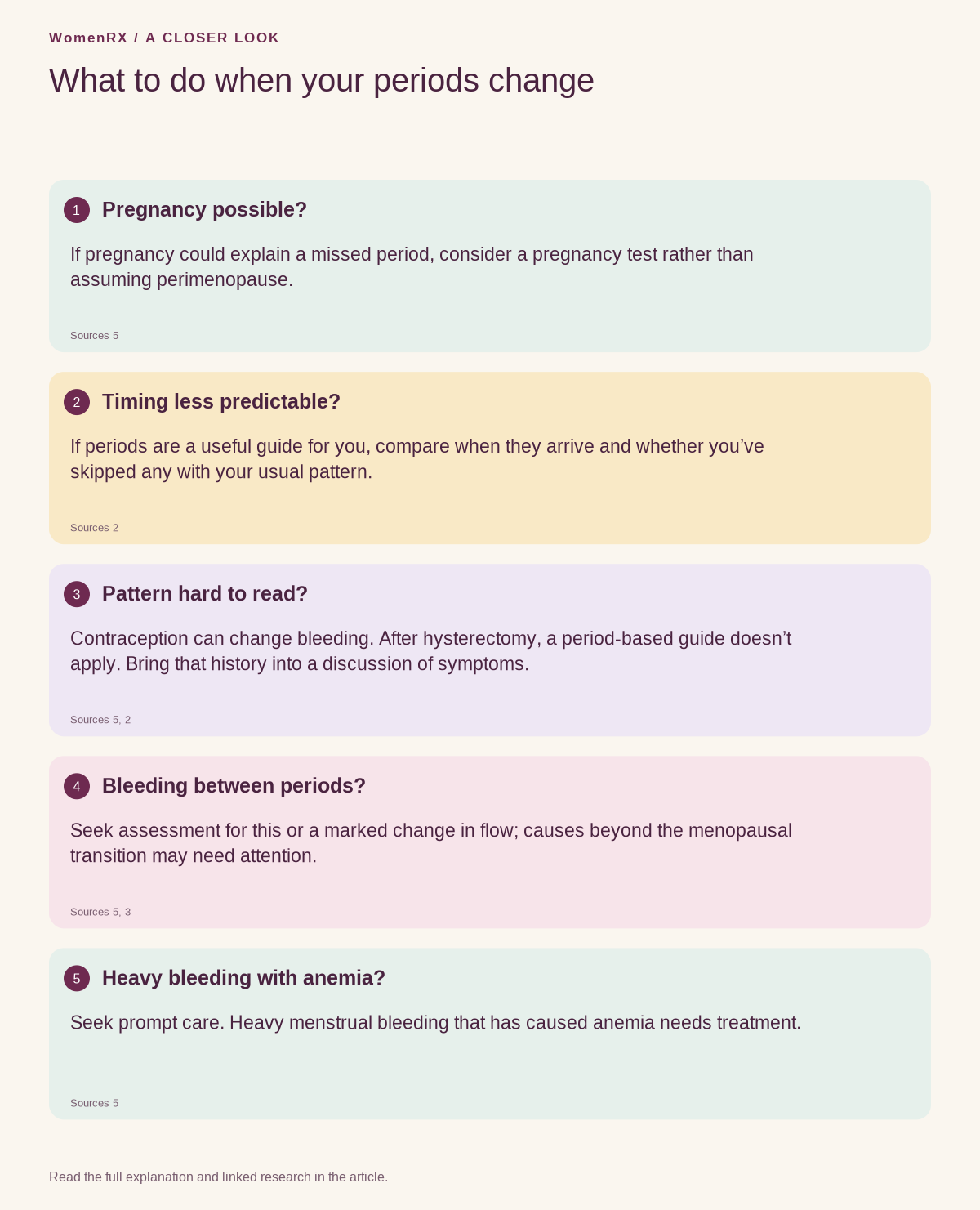
What to do when your periods change
Pregnancy possible?: If pregnancy could explain a missed period, consider a pregnancy test rather than assuming perimenopause.5
Timing less predictable?: If periods are a useful guide for you, compare when they arrive and whether you’ve skipped any with your usual pattern.2
Pattern hard to read?: Contraception can change bleeding. After hysterectomy, a period-based guide doesn’t apply. Bring that history into a discussion of symptoms.52
Bleeding between periods?: Seek assessment for this or a marked change in flow; causes beyond the menopausal transition may need attention.53
Heavy bleeding with anemia?: Seek prompt care. Heavy menstrual bleeding that has caused anemia needs treatment.5
Read the figure as text
First consider pregnancy possibility and whether periods are a useful guide for you. Then use the type of bleeding change to choose a next step, not to diagnose yourself.- Pregnancy possible?: If pregnancy could explain a missed period, consider a pregnancy test rather than assuming perimenopause.5
- Timing less predictable?: If periods are a useful guide for you, compare when they arrive and whether you’ve skipped any with your usual pattern.2
- Pattern hard to read?: Contraception can change bleeding. After hysterectomy, a period-based guide doesn’t apply. Bring that history into a discussion of symptoms.52
- Bleeding between periods?: Seek assessment for this or a marked change in flow; causes beyond the menopausal transition may need attention.53
- Heavy bleeding with anemia?: Seek prompt care. Heavy menstrual bleeding that has caused anemia needs treatment.5
More questions, answered
Can I be in perimenopause if I still get periods?
Yes. The menopausal transition happens before the final period. Cycles may become more variable, and periods may occasionally be missed. Menopause is identified retrospectively, after 12 months without a menstrual period. That period-based rule isn’t useful after a hysterectomy. 2
Does heavy bleeding mean it’s perimenopause?
Not necessarily. Changes in ovulation can cause abnormal bleeding, but polyps, fibroids and changes in the uterine lining are among the other possibilities. Heavy bleeding that has caused anemia needs prompt treatment. 45
Sources you can check
- Psychological symptoms during perimenopause: a global perspective.Cunningham AC, Hedges MS, Hewings-Martin Y, Castaneda R, Karam J, Zhaunova L, Faubion SS, Shufelt CL. · Menopause (New York, N.Y.) · 2026Return to first citation
- Hormone Therapy for the Primary Prevention of Chronic Conditions in Postmenopausal Persons: US Preventive Services Task Force Recommendation Statement.US Preventive Services Task Force, Mangione CM, Barry MJ, Nicholson WK, Cabana M, Caughey AB, Chelmow D, Coker TR, Davis EM, Donahue KE, Jaén CR, Kubik M, Li L, Ogedegbe G, Pbert L... · JAMA · 2022Return to first citation
- Complex benign gynecology in perimenopause: current evidence and future directions.Goren R, Shats M, Ciesielski K, Siedhoff M, Meyer R. · Current opinion in obstetrics & gynecology · 2026Return to first citation
- Diagnostic and therapeutic use of oral micronized progesterone in endocrinology.Memi E, Pavli P, Papagianni M, Vrachnis N, Mastorakos G. · Reviews in endocrine & metabolic disorders · 2024Return to first citation
- Perimenopausal abnormal uterine bleeding.Dreisler E, Frandsen CS, Ulrich L. · Maturitas · 2024Return to first citation