Periods changing before 45? Here’s what to check
Periods that stop or become irregular before 45 deserve an assessment, but the next questions differ if you’re under 40.
If your periods have stopped or changed before 45, make an appointment to discuss the pattern, any symptoms, and whether contraception or medical treatment could explain it. Menopause at 40 to 44 is called early menopause; before 40, a clinician may assess for premature ovarian insufficiency (POI). Neither age nor one hormone result tells the whole story. The assessment can also open a conversation about symptoms, fertility if relevant to you, and bone and heart health. 4567
First, describe what changed
You don’t have to wait until your periods have stopped completely to raise the question. Periods that become irregular, or stop before 45, can be a sign of early menopause. Hot flashes, night sweats, sleep problems, vaginal dryness and mood changes may add to the picture, but you might not have all of them. Menopause itself is generally defined after 12 months without a period when you’re not using hormonal contraception. 57
For an appointment, the useful starting point is your actual pattern: for example, whether periods have become less frequent, stopped, or changed after a treatment. Mention any symptoms that are affecting daily life. Also say if you use hormonal contraception, which can make the usual period-based definition harder to apply. This is information for an assessment, not a way to diagnose yourself. 567
Your age changes the assessment
At 40 to 44, a menopause diagnosis is described as early menopause. In someone this age who has menopause-associated symptoms, including a menstrual change, NICE guidance says a clinician may consider a blood test for follicle-stimulating hormone, or FSH, to help confirm menopause. The result belongs alongside the symptoms and history, not in place of them. 6
Under 40, the question is whether you could have premature ovarian insufficiency, or POI. POI describes declining ovarian function with infrequent or absent periods, low estrogen and elevated gonadotropins. Its assessment is more specific than simply noticing that periods have stopped. NICE guidance describes elevated FSH on two blood samples taken 4 to 6 weeks apart as part of diagnosing POI. That’s why one result shouldn’t be treated as a final answer. 46
If you’ve had both ovaries removed, the history may already explain why hormone levels fell. Other medical or surgical treatments, including chemotherapy and radiotherapy, can also cause early or premature menopause. Tell the clinician about these even if they happened some time ago. 15
What else belongs in the conversation?
The cause isn’t always clear. A clinician may ask about family history, smoking, low body weight and treatments that affect the ovaries or hormones. Those details can help put your menstrual changes in context; none proves a cause on its own. Hormonal contraception also matters when interpreting whether a lack of periods meets the usual menopause definition. 57
An irregular cycle is not, by itself, proof that ovarian function has ended. For example, research has found an association between shift work and menstrual irregularity, but that does not establish that shift work caused menopause in an individual woman. If a change in your schedule coincided with a change in periods, it’s worth mentioning without assuming it explains everything. 2
Care is about more than stopping hot flashes
Early menopause and POI can affect bone and cardiovascular health as well as symptoms, sexual function and fertility. That makes it reasonable to discuss longer-term health even if your symptoms are mild. If the news is distressing, emotional support is a legitimate part of care too. 456
Hormone therapy is commonly discussed because it can replace hormones that have fallen and help manage symptoms and longer-term concerns. A clinical review recommends hormone replacement through approximately the usual age of menopause for POI and a similar approach for early menopause, while NICE notes that the balance of benefits and risks at 40 to 44 lies between that for POI and menopause at 45 or older. Your medical history and preferences matter: hormone treatment may not be suitable after certain cancers, and a history of endometriosis can change which regimen is considered. 3456
You can keep the follow-up focused on the decisions in front of you: What is the working explanation for my period changes? Do I need further assessment to distinguish early menopause from POI or a treatment-related change? What are my options for symptoms and bone health? If pregnancy is something you want to discuss, say so; early or premature menopause can make it harder to conceive, and fertility deserves its own conversation rather than an assumption about your plans. 456
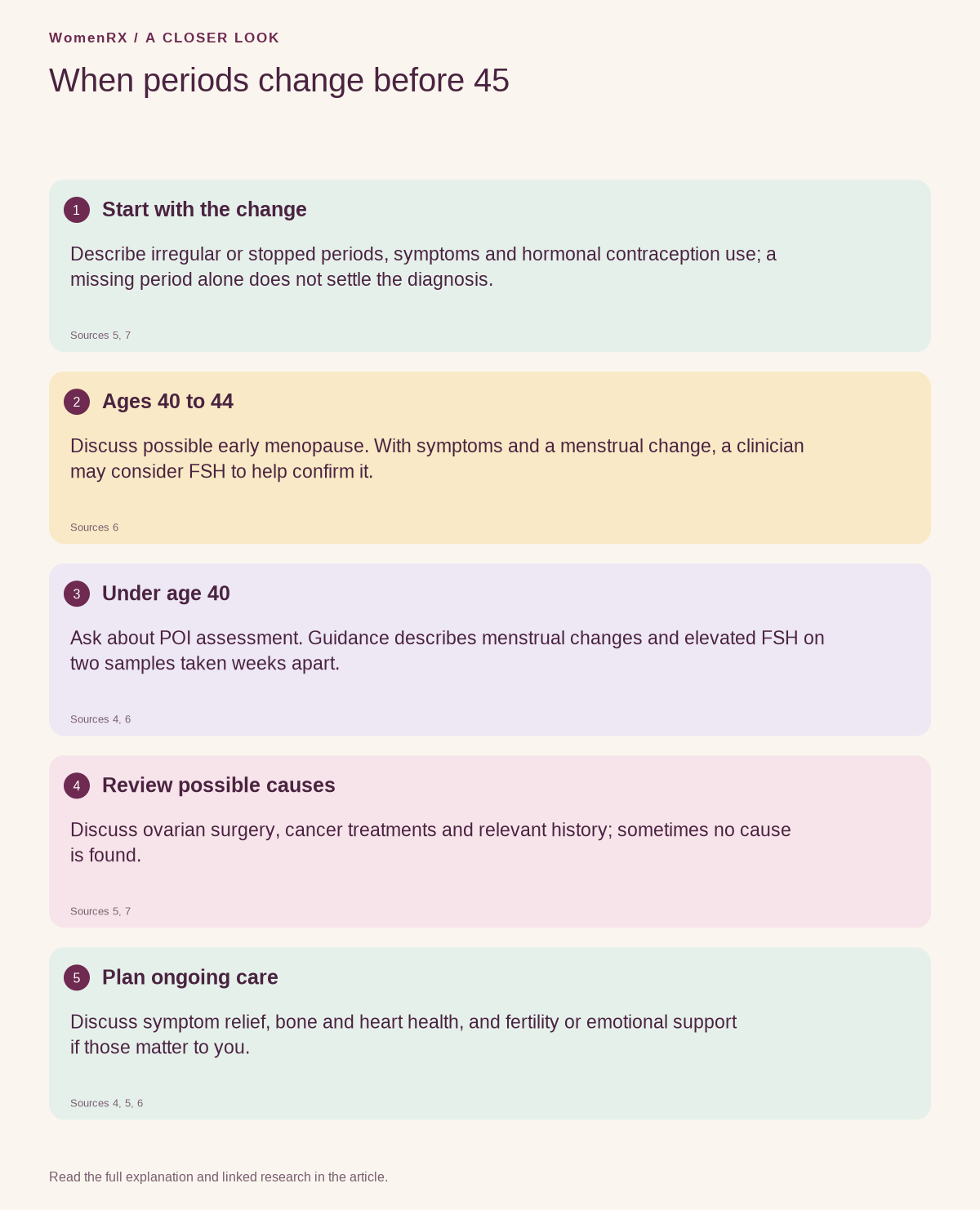
When periods change before 45
Start with the change: Describe irregular or stopped periods, symptoms and hormonal contraception use; a missing period alone does not settle the diagnosis.57
Ages 40 to 44: Discuss possible early menopause. With symptoms and a menstrual change, a clinician may consider FSH to help confirm it.6
Under age 40: Ask about POI assessment. Guidance describes menstrual changes and elevated FSH on two samples taken weeks apart.46
Review possible causes: Discuss ovarian surgery, cancer treatments and relevant history; sometimes no cause is found.57
Plan ongoing care: Discuss symptom relief, bone and heart health, and fertility or emotional support if those matter to you.456
Read the figure as text
Age guides the hormone-testing question, while symptoms and medical history shape what happens next.- Start with the change: Describe irregular or stopped periods, symptoms and hormonal contraception use; a missing period alone does not settle the diagnosis.57
- Ages 40 to 44: Discuss possible early menopause. With symptoms and a menstrual change, a clinician may consider FSH to help confirm it.6
- Under age 40: Ask about POI assessment. Guidance describes menstrual changes and elevated FSH on two samples taken weeks apart.46
- Review possible causes: Discuss ovarian surgery, cancer treatments and relevant history; sometimes no cause is found.57
- Plan ongoing care: Discuss symptom relief, bone and heart health, and fertility or emotional support if those matter to you.456
More questions, answered
Can you have early menopause if you still get some periods?
Periods may become irregular before they stop. If that’s happening before 45, especially with menopause symptoms, it’s reasonable to seek an assessment rather than wait for 12 months without a period. 567
Does a high FSH result mean I have POI?
Not on its own. For someone under 40, NICE guidance describes elevated FSH on two samples taken 4 to 6 weeks apart as part of the POI diagnosis. Menstrual changes and the wider clinical picture matter too. 46
Sources you can check
- CLIMARA PRO (ESTRADIOL AND LEVONORGESTREL) PATCH [BAYER HEALTHCARE PHARMACEUTICALS INC.] | US prescribing information and patient instructionsAccessed 2026-09-25Return to first citation
- Shift work and menstruation: A meta-analysis study.Hu F, Wu C, Jia Y, Zhen H, Cheng H, Zhang F, Wang L, Jiang M. · SSM - population health · 2023Return to first citation
- Endometriosis and menopausal health: An EMAS clinical guide.Erel CT, Nigdelis MP, Ozcivit Erkan IB, Goulis DG, Chedraui P, Giannini A, Kiesel L, Phillips N, Simoncini T, Armeni E, Boban J, Ceausu I, Hillard T, Lambrinoudaki I, Smetnik A, Go... · Maturitas · 2025Return to first citation
- Premature ovarian insufficiency, early menopause, and induced menopause.Hamoda H, Sharma A. · Best practice & research. Clinical endocrinology & metabolism · 2024Return to first citation
- Early or premature menopause - NHSAccessed 2026-09-25Return to first citation
- Recommendations | Menopause: identification and management | Guidance | NICEAccessed 2026-09-25Return to first citation
- What are menopause and perimenopause? - NHSAccessed 2026-09-25Return to first citation