Changing Periods in Your 40s: Is It Perimenopause?
Changing cycles can be part of the menopause transition, but the pattern and any symptoms alongside it tell you more than one hormone result.
Perimenopause is one possible reason your periods are changing in your 40s, not an explanation for every change. Hormones and ovulation can vary from cycle to cycle, so a single FSH result may tell you little about where you are in the transition. Notice the pattern over time, and bring up heavy or unusual bleeding rather than assuming it’s hormonal. 21
What changes first?
You might expect estrogen to fall steadily and periods to gradually fade out. The transition is usually less orderly. Research following women through midlife found that menstrual irregularity could begin without a clear early drop in estradiol, a form of estrogen. One earlier change was a decline in inhibin B, a hormone made by the ovaries that helps regulate follicle-stimulating hormone, or FSH. Estradiol tended to fall and FSH to rise closer to the final menstrual period. Those are group patterns, not a schedule you can use to date your own menopause. 23
That helps explain why a few unusual periods can be confusing. A cycle may run long because the part before ovulation lasts longer. In a small study that repeatedly sampled hormones and recorded bleeding as women approached menopause, longer cycles with altered hormone patterns became more common nearer the final period. But regular ovulatory cycles can also occur after irregular ones, even after several months without a period. Skipping a period doesn’t mean ovulation has permanently stopped. 42
Why one hormone test can be misleading
FSH is often talked about as if it gives a simple answer: high means perimenopause, low means not yet. In a longitudinal study of women initially recruited at ages 45 to 55, FSH results varied widely in the early stages regardless of menopausal status. The researchers concluded that a single FSH measurement offered little useful information about menopausal status. Your bleeding pattern and what else is happening matter more than treating one number as a verdict. This doesn’t mean a clinician would never order tests to investigate a change; it means one FSH result cannot, by itself, settle this question. 2
Symptoms need context, too. Hot flashes and sleep disturbance can occur alongside mood changes during perimenopause, but overlap does not tell you that hormones caused every difficult night or low mood. Guidance on perimenopausal depression calls for considering menopause symptoms, other possible causes, and what’s going on in a woman’s life together. If low mood is affecting your life, it deserves attention in its own right, whether or not your cycles are changing. 5
Which bleeding changes deserve a closer look?
A different cycle length may fit the transition. Heavy bleeding should not automatically be filed under “just perimenopause.” Heavy periods can occur as menopause approaches, but fibroids, adenomyosis, endometriosis, pelvic inflammatory disease, and some medicines are among other possible causes. Treatment may also help when heavy periods disrupt daily life. 1
Make time to discuss bleeding that affects your life, has been heavy for some time, comes with severe period pain, or happens between periods or after sex. Changing a pad or tampon every one to two hours, needing two period products together, or often feeling tired or short of breath are concrete details worth mentioning. They help describe the bleeding and its effect on you; they do not identify its cause on their own. 1
Bring a pattern, not a perfect diary
If you decide to talk about possible perimenopause, a short record can make the conversation more useful. Note when each period starts, whether the gap from the previous one was shorter or longer than usual for you, how many days you bleed, and whether the flow interferes with ordinary activities. Add any bleeding between periods or after sex. If you’re also having hot flashes, disturbed sleep, or mood changes, note when they happen rather than trying to prove they’re connected to a particular hormone level. Include medicines you take, since some can contribute to heavy bleeding. 15
The point isn’t to diagnose yourself from a calendar. It’s to make two questions easier to discuss: Does the overall pattern fit a possible menopause transition, and is there a bleeding or mood concern that needs attention regardless of your menopausal stage? 125
How cycles can change around menopause
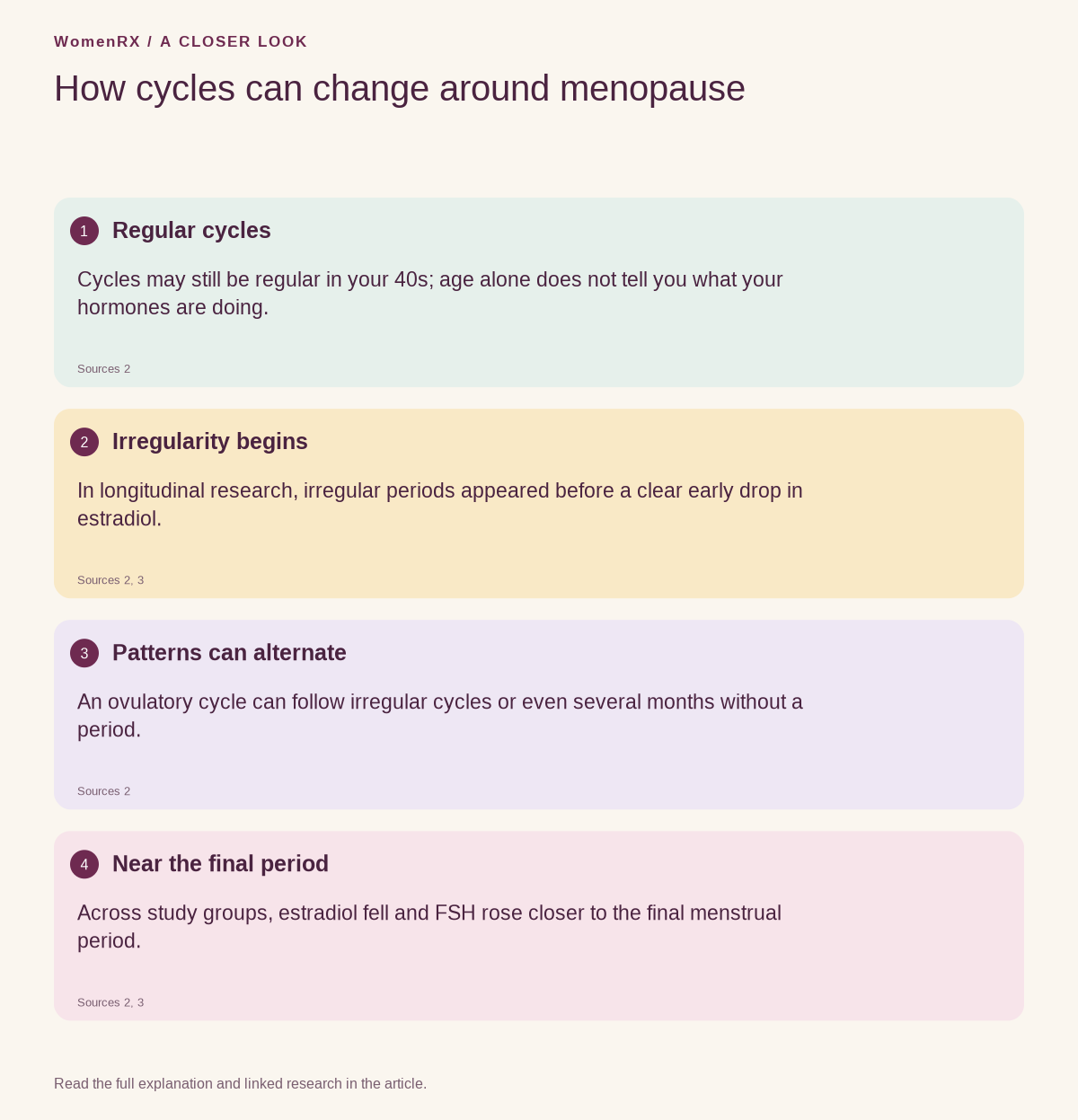
Regular cycles: Cycles may still be regular in your 40s; age alone does not tell you what your hormones are doing.2
Irregularity begins: In longitudinal research, irregular periods appeared before a clear early drop in estradiol.23
Patterns can alternate: An ovulatory cycle can follow irregular cycles or even several months without a period.2
Near the final period: Across study groups, estradiol fell and FSH rose closer to the final menstrual period.23
Read the figure as text
These are possible patterns across the transition, not steps every woman experiences or a way to predict the date of her final period.- Regular cycles: Cycles may still be regular in your 40s; age alone does not tell you what your hormones are doing.2
- Irregularity begins: In longitudinal research, irregular periods appeared before a clear early drop in estradiol.23
- Patterns can alternate: An ovulatory cycle can follow irregular cycles or even several months without a period.2
- Near the final period: Across study groups, estradiol fell and FSH rose closer to the final menstrual period.23
Sources you can check
- Heavy periods - NHSAccessed 2026-09-25Return to first citation
- The menopausal transition--endocrinology.Burger H. · The journal of sexual medicine · 2008Return to first citation
- A review of hormonal changes during the menopausal transition: focus on findings from the Melbourne Women's Midlife Health Project.Burger HG, Hale GE, Robertson DM, Dennerstein L. · Human reproduction update · 2007Return to first citation
- Menopause transition: Annual changes in serum hormonal patterns over the menstrual cycle in women during a nine-year period prior to menopause.Landgren BM, Collins A, Csemiczky G, Burger HG, Baksheev L, Robertson DM. · The Journal of clinical endocrinology and metabolism · 2004Return to first citation
- Guidelines for the evaluation and treatment of perimenopausal depression: summary and recommendations.Maki PM, Kornstein SG, Joffe H, Bromberger JT, Freeman EW, Athappilly G, Bobo WV, Rubin LH, Koleva HK, Cohen LS, Soares CN, Board of Trustees for The North American Menopause Socie... · Menopause (New York, N.Y.) · 2018Return to first citation