How Perimenopause Is Identified, and When Tests May Be Considered
Changes in your periods and symptoms usually tell more of the story than one hormone result.
Perimenopause is identified mainly through your age, changes in your menstrual pattern, symptoms, and other possible explanations. Hormones fluctuate during this transition, so one follicle-stimulating hormone (FSH) or estradiol result gives only a snapshot. If you have menopause symptoms before 45, a GP may sometimes do blood tests. At least three months after a hysterectomy, repeat FSH with low estradiol may help assess menopausal status when periods cannot provide that clue; it does not identify perimenopause. Hormonal contraception can also make the usual menstrual clues harder to interpret.415
If your periods have become less predictable and you’re wondering whether perimenopause has started, you may expect a blood test to settle it. Often, the more useful starting point is the pattern over time: what’s changed, which symptoms have appeared, your age, and whether something else could explain those changes.42
Why your menstrual pattern carries weight
Perimenopause is the transition around the final menstrual period. Its hallmark is progressive menstrual irregularity alongside hormonal fluctuations. A period that arrives earlier than usual, followed by a much longer gap, can tell a clinician something that a blood sample taken on either day cannot: your pattern is changing. Menopause itself is identified after 12 consecutive months without a period in the usual clinical situation, not predicted by one test beforehand.45
Symptoms add context. Hot flashes can occur as estrogen levels change, but a symptom alone doesn’t establish the cause.3 For example, if your periods have changed and you’re also having hot flashes, those pieces fit together differently than an isolated missed period would. Pregnancy, hormonal contraception, and thyroid problems are among the other possible explanations for irregular periods.2
What an FSH or estradiol result can, and can’t, tell you
FSH and estradiol measure hormones at the time your blood is drawn. That’s a narrower question than “Am I in perimenopause?” Hormone levels fluctuate during the transition, while the menstrual pattern unfolds over time. A single result therefore needs to be interpreted alongside your history rather than treated as a verdict on where you are in the transition.4
There’s also a distinction between perimenopause and menopause. A clinical guideline for the usual situation after age 45 describes menopause as a diagnosis made retrospectively after 12 months without periods; it does not recommend hormone testing to make that diagnosis. That guideline addresses menopause diagnosis, not a testing rule for identifying perimenopause. It should not be stretched into a claim that hormone tests are never useful for someone with symptoms at a younger age or an unusual history.51
When the assessment may look different
If you’re under 45: Menopause symptoms or periods becoming irregular or stopping deserve a closer look. Menopause before 45 is described as early; before 40, as premature. If you’re under 45 and having menopause symptoms, a GP may sometimes do blood tests. One result alone cannot establish why your periods changed or identify perimenopause.14
If you’ve had a hysterectomy: Without periods to use as a clue, menopausal status can be harder to assess. At least three months after the procedure, repeat FSH together with low estradiol may help orient that assessment. This is not a test to identify perimenopause.5
If you use hormonal contraception: Your bleeding pattern may reflect the contraception rather than your natural cycle. A guideline addressing menopause diagnosis says hormone assays are not recommended to establish menopause or decide when to stop contraception for people using several hormonal methods, including pills, implants, and levonorgestrel intrauterine devices. The practical point is to tell the clinician exactly what you use before interpreting either bleeding or lab results. Don’t use an at-home hormone result as a reason to stop contraception.25
If you have bleeding that doesn’t fit your usual pattern: Don’t automatically put it down to perimenopause. Bleeding between periods, periods lasting longer than seven days, or a noticeable change in your normal pattern warrants an assessment of possible causes.2
What to bring to the conversation
You don’t need a perfect symptom diary. A brief account of when your period pattern changed, whether you’ve had hot flashes, what contraception you use, and any test results you already have gives the clinician more to work with than an isolated FSH number. If pregnancy is possible after a missed period, say so; it’s another possible explanation that changes what needs to be considered.24
The useful question isn’t simply, “Can I get my hormones checked?” It’s, “What would this test help distinguish in my situation?” For someone with a typical transition in her late 40s, the history may be more informative. For someone with menopause symptoms before 45, a GP may sometimes do blood tests; that differs from relying on a single FSH or estradiol value to identify perimenopause. Age and context matter as much as the number on a lab report.415
What changes the assessment?
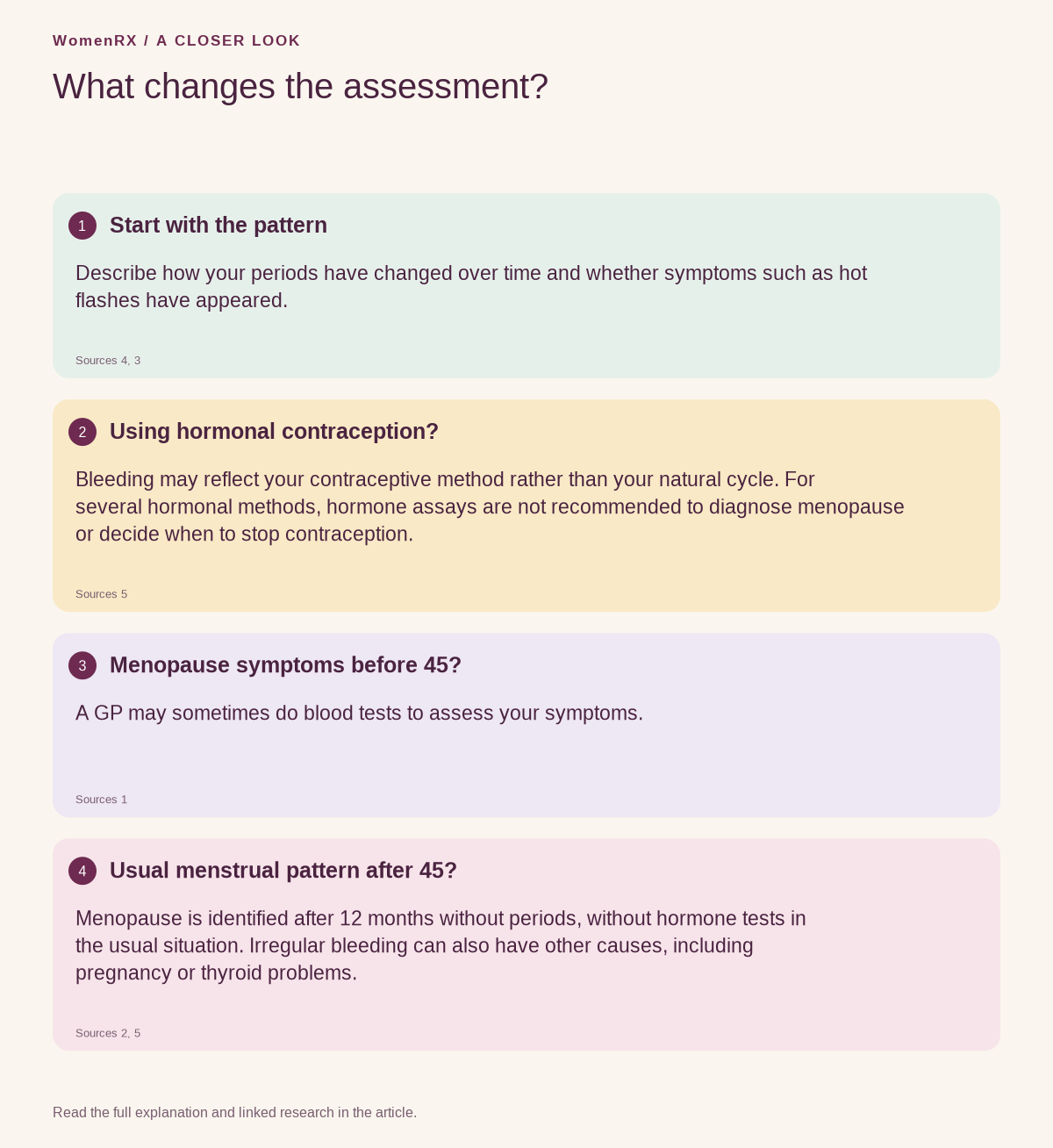
Start with the pattern: Describe how your periods have changed over time and whether symptoms such as hot flashes have appeared.43
Using hormonal contraception?: Bleeding may reflect your contraceptive method rather than your natural cycle. For several hormonal methods, hormone assays are not recommended to diagnose menopause or decide when to stop contraception.5
Menopause symptoms before 45?: A GP may sometimes do blood tests to assess your symptoms.1
Usual menstrual pattern after 45?: Menopause is identified after 12 months without periods, without hormone tests in the usual situation. Irregular bleeding can also have other causes, including pregnancy or thyroid problems.25
Read the figure as text
Start with changes in your periods, then follow the path that fits: hormonal contraception, symptoms before 45, or a usual menstrual pattern after 45.- Start with the pattern: Describe how your periods have changed over time and whether symptoms such as hot flashes have appeared.43
- Using hormonal contraception?: Bleeding may reflect your contraceptive method rather than your natural cycle. For several hormonal methods, hormone assays are not recommended to diagnose menopause or decide when to stop contraception.5
- Menopause symptoms before 45?: A GP may sometimes do blood tests to assess your symptoms.1
- Usual menstrual pattern after 45?: Menopause is identified after 12 months without periods, without hormone tests in the usual situation. Irregular bleeding can also have other causes, including pregnancy or thyroid problems.25
More questions, answered
Can a hormone test tell me when to stop contraception?
Don’t rely on an FSH or estradiol result for that decision. A menopause diagnosis guideline does not recommend hormone assays to decide when to stop several types of hormonal contraception. The answer depends on your contraception and clinical situation, not just a lab number.5
Sources you can check
- Early or premature menopause - NHSAccessed 2026-09-25Return to first citation
- Irregular periods - NHSAccessed 2026-09-25Return to first citation
- CLIMARA (ESTRADIOL) PATCH [BAYER HEALTHCARE PHARMACEUTICALS INC.] | US prescribing information and patient instructionsAccessed 2026-09-25Return to first citation
- Perimenopause as an obesogenic sensitive period: Contributions to elevated cardiovascular risk.Manning ME, Stockman SL, Zanni MV. · American journal of preventive cardiology · 2026Return to first citation
- [How to diagnose menopause? Postmenopausal women management: CNGOF and GEMVi clinical practice guidelines].Rousset-Jablonski C. · Gynecologie, obstetrique, fertilite & senologie · 2021Return to first citation