Perimenopause, Menopause, and Postmenopause, Explained
These terms describe changes in menstrual history, not a symptom-by-symptom schedule.
Perimenopause is the transition that begins with changing menstrual cycles and ends with the final menstrual period. Menopause is identified retrospectively after 12 months without menstruation; postmenopause is the time afterward. Symptoms don’t reliably identify a stage. If you use hormonal contraception, have had a hysterectomy, or have long had irregular bleeding, that calendar-based description may be harder to apply. 1 2 4
The stages are defined by menstrual history
The terms can sound like three sharply separated chapters. Clinically, they’re better understood as a transition and the period that follows it. A widely used staging framework describes perimenopause as beginning when menstrual cycles become irregular and ending with the final menstrual period. Menopause is recognized retrospectively, after 12 months without menstruation. Postmenopause means the time after that 12-month point. 1
That means you usually can’t identify the exact day menopause begins. The 12-month rule is a definition based on menstrual history, not a prediction of when symptoms will start or stop. Because these definitions use menstrual history, the same timeline may not answer every individual situation. 1
| Term | What it means |
|---|---|
| Perimenopause | The transition, beginning with menstrual-cycle irregularity and ending at the final menstrual period. 1 |
| Menopause | The point identified retrospectively after 12 months without menstruation. 1 |
| Postmenopause | The period after that 12-month mark. 1 |
Symptoms don’t follow a stage-by-stage script
Cycle patterns help define reproductive stages; symptoms don’t provide the same clear dividing line. During the transition, ovarian hormone levels fluctuate, and symptoms associated with reproductive aging can include hot flashes or other vasomotor symptoms, sleep disruption, sexual concerns, and cognitive changes. The timing and mix of symptoms aren’t a dependable way to label your stage. 1
Symptoms can also differ between people. In a study of app users who weren’t taking hormonal contraception or hormone therapy, the perimenopause group reported more psychological symptoms on average than the premenopause group. Scores also differed across countries. That comparison describes groups, not what any one woman will experience or when a symptom must occur. 3
So, for example, sleep problems or a change in mood may be part of what you’re experiencing during the transition, but neither one confirms perimenopause on its own. The menstrual pattern is the framework; symptoms help describe what’s happening for you, rather than set the stage label. 1
When the timeline needs more context
If you use hormonal contraception, note whether the cycle change you’re trying to interpret happened while you were using it. Hormonal contraceptives are used in perimenopause care, when symptom concerns and contraception needs may overlap. But a bleeding history recorded during their use needs that context; the cycle-based stage definitions alone don’t explain how to interpret each contraceptive method. 1 4
If you’ve had surgery, the type matters. After a hysterectomy, you can’t use the usual 12-month absence-of-periods marker to date menopause. Ovary removal is a separate part of surgical history, not another name for hysterectomy. A study of people with endometriosis assessed hysterectomy, oophorectomy, and surgical menopause separately; it did not establish a single staging rule for everyone who has had surgery. 1 2
If your bleeding was irregular before these symptoms appeared, a newly noticed irregular cycle may be less useful for locating the start of a transition. Abnormal uterine bleeding can also be a concern during perimenopause, but the bleeding pattern and a menopause stage aren’t interchangeable descriptions. 1 4
Use the labels as context, not a score
The useful question is whether your menstrual history gives you a clear timeline. If it doesn’t, you may not be able to place yourself neatly on this diagram. You can still describe the symptoms you’re having without treating them as proof of a particular stage. 1
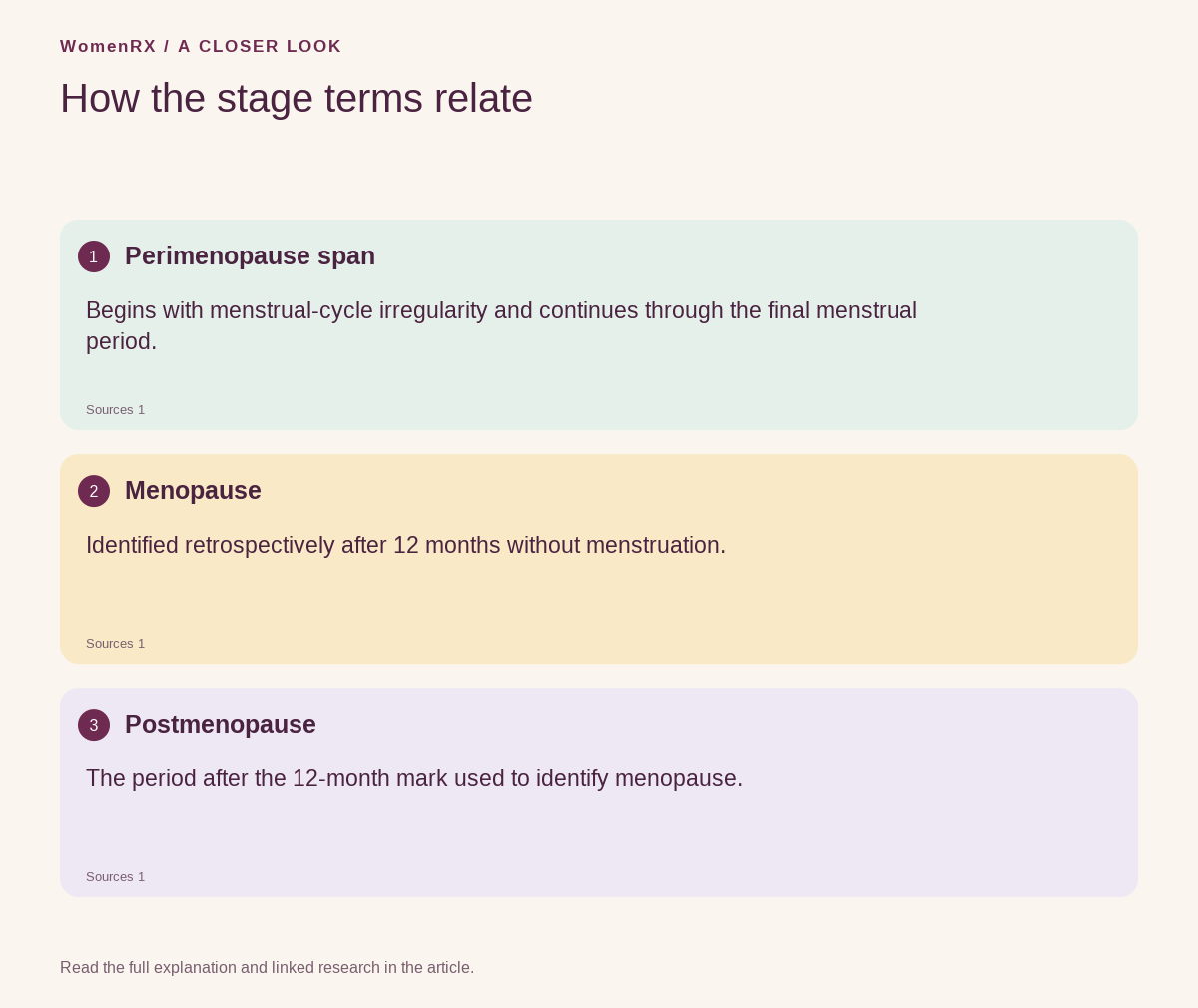
How the stage terms relate
Perimenopause span: Begins with menstrual-cycle irregularity and continues through the final menstrual period.1
Menopause: Identified retrospectively after 12 months without menstruation.1
Postmenopause: The period after the 12-month mark used to identify menopause.1
Read the figure as text
Perimenopause spans the transition from cycle irregularity through the final menstrual period. Menopause is identified afterward from the 12-month mark; symptoms don’t mark these boundaries.More questions, answered
Does menopause mean symptoms have stopped?
No. Menopause names the point identified retrospectively after 12 months without menstruation; it doesn’t mean symptoms must have ended. Symptoms associated with reproductive aging can occur during the transition, and stage labels don’t predict an individual symptom’s timing or course. 1
Can symptoms alone tell me which stage I’m in?
Not reliably. The staging framework is based mainly on menstrual history, while symptoms can vary and overlap. When menstrual history is difficult to interpret, symptoms still don’t provide a precise substitute for that timeline. 1
Sources you can check
- A systematic review on the bidirectional relationship between trauma-related psychopathology and reproductive aging.Arnold AR, Prochaska T, Fickenwirth M, Powers A, Smith AK, Chahine EB, Stevens JS, Michopoulos V. · Journal of mood and anxiety disorders · 2024Return to first citation
- Rates of premature ovarian insufficiency and surgical menopause in patients with endometriosis.Simko S, Gwizdala J, Cooley N, Novak D, Porche MV, Ge S, Cruz J, Stuparich M, Nahas S. · Journal of gynecology obstetrics and human reproduction · 2026Return to first citation
- Psychological symptoms during perimenopause: a global perspective.Cunningham AC, Hedges MS, Hewings-Martin Y, Castaneda R, Karam J, Zhaunova L, Faubion SS, Shufelt CL. · Menopause (New York, N.Y.) · 2026Return to first citation
- Hormonal Options for Perimenopause: A Clinician Toolkit.Piasta J, Zewail A. · Obstetrics and gynecology · 2026Return to first citation