How Long Does the Menopause Transition Last?
The transition can last several years, but the final period and the time symptoms last are different parts of the story.
For natural cycles, perimenopause can last several years. Menopause is identified only after 12 months without a period, if you’re not using hormonal contraception; the final menstrual period is the last one before that stretch. Postmenopause is the stage afterward. Symptoms have their own timetable and may continue well beyond the final period. 869
Three meanings of “how long”
When someone asks how long menopause lasts, she might mean the years of changing periods, the wait to know whether a period was her last, or the years she has symptoms. Those aren’t the same measure.
Perimenopause, also called the menopause transition, is the time leading up to the final menstrual period. It usually begins in the 40s, can begin earlier, and can last several years. During this time, changes in ovarian hormones can affect both cycles and symptoms. Periods may become irregular, lighter, or heavier. 89
The final menstrual period is one period, not a year-long event. If you’re not using hormonal contraception, menopause is identified after you’ve gone 12 months without another period. That means you can recognize which period was the last only by looking back. The time after menopause is called postmenopause; it isn’t a phase with a set end date. 69
For example, if you’ve missed a few periods and then have another one, that earlier period wasn’t your final menstrual period. Changing cycle lengths can offer clues that menopause is approaching, but they can’t give you an exact date. In a study of 326 menstruating women ages 44 to 56, measures of menstrual variability helped predict proximity to menopause. The study didn’t establish how long each woman’s full transition would last. 5
Why symptoms don’t fit neatly on that timeline
Hot flashes, night sweats, sleep problems, and mood changes can start before periods stop. Symptoms can also continue afterward, and their intensity and duration differ from person to person. So reaching the 12-month mark doesn’t mean you should expect every symptom to disappear. 69
One US longitudinal study shows why it helps to keep symptom duration separate from transition length. Among 1,449 women who reported frequent hot flashes or night sweats, the median duration of those symptoms was 7.4 years. Among the 881 in that analysis whose final menstrual period could be observed, frequent symptoms continued for a median of 4.5 years after that period. Those figures describe a group with frequent symptoms, not the length of perimenopause or a prediction for any one woman. 4
Different symptoms may also call for different decisions. Hot flashes or night sweats that disrupt sleep are one concern; vaginal dryness that continues after periods stop is another. You don’t have to wait for your final period to discuss relief for bothersome symptoms. Hormone therapy is an effective treatment for hot flashes and night sweats, and evidence-supported nonhormone options are available too. The right choice depends on your symptoms and health history. 1239
When the last-period rule doesn’t tell the whole story
The 12-month rule is most useful when you have natural periods to observe. Hormonal contraception can change bleeding patterns and make it harder to tell whether you’ve reached menopause. If you’ve had a hysterectomy, there’s no menstrual pattern to use as a marker; clinical guidance instead considers the combination of symptoms. 17
Menopause can also happen earlier because of surgery to remove the ovaries or other medical treatment. In those circumstances, a timeline based on years of naturally changing cycles may not describe what you’re experiencing. If treatment that could cause menopause is being planned, a discussion beforehand can cover likely symptoms and fertility questions. 67
One distinction is worth acting on: irregular bleeding can occur during perimenopause, but any vaginal bleeding after you’ve gone more than 12 months without a period should be checked. That isn’t something to assume is simply the transition continuing. 9
The useful answer, then, isn’t one countdown. For natural cycles, the transition may take several years; the final period becomes clear only in retrospect; and symptoms may follow a longer, changing course of their own. 869
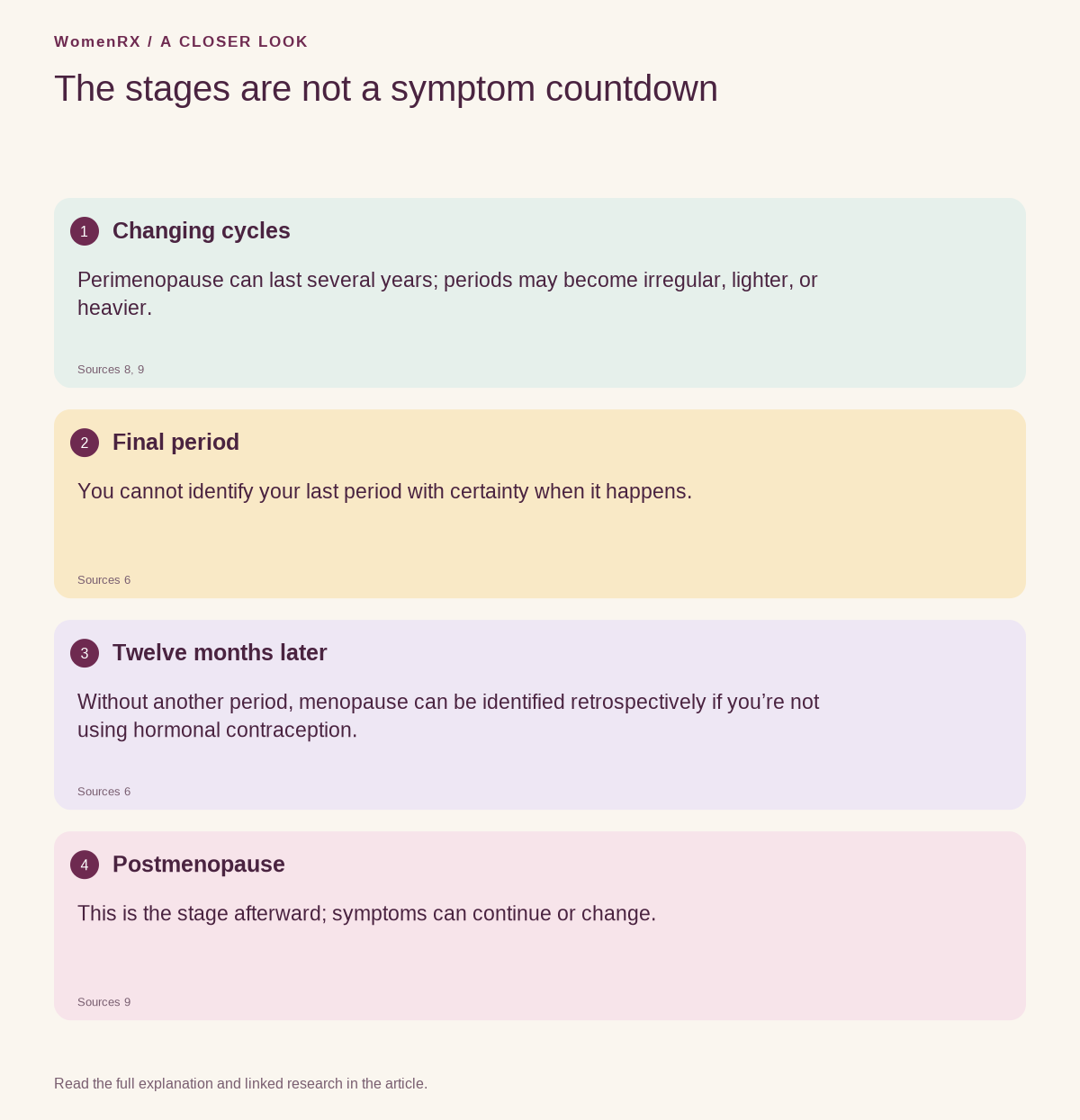
The stages are not a symptom countdown
Changing cycles: Perimenopause can last several years; periods may become irregular, lighter, or heavier.89
Final period: You cannot identify your last period with certainty when it happens.6
Twelve months later: Without another period, menopause can be identified retrospectively if you’re not using hormonal contraception.6
Postmenopause: This is the stage afterward; symptoms can continue or change.9
Read the figure as text
This sequence describes natural menstrual timing. Symptoms may begin before the final period and continue afterward.- Changing cycles: Perimenopause can last several years; periods may become irregular, lighter, or heavier.89
- Final period: You cannot identify your last period with certainty when it happens.6
- Twelve months later: Without another period, menopause can be identified retrospectively if you’re not using hormonal contraception.6
- Postmenopause: This is the stage afterward; symptoms can continue or change.9
Sources you can check
- When to take hormone replacement therapy (HRT) - NHSAccessed 2026-09-25Return to first citation
- The 2022 hormone therapy position statement of The North American Menopause Society.“The 2022 Hormone Therapy Position Statement of The North American Menopause Society” Advisory Panel. · Menopause (New York, N.Y.) · 2022Return to first citation
- The 2023 nonhormone therapy position statement of The North American Menopause Society.Menopause (New York, N.Y.) · 2023Return to first citation
- Duration of menopausal vasomotor symptoms over the menopause transition.Avis NE, Crawford SL, Greendale G, Bromberger JT, Everson-Rose SA, Gold EB, Hess R, Joffe H, Kravitz HM, Tepper PG, Thurston RC, Study of Women's Health Across the Nation. · JAMA internal medicine · 2015Return to first citation
- Menopausal transition: predicting time to menopause for women 44 years or older from simple questions on menstrual variability.Taylor SM, Kinney AM, Kline JK. · Menopause (New York, N.Y.) · 2004Return to first citation
- What are menopause and perimenopause? - NHSAccessed 2026-09-25Return to first citation
- Recommendations | Menopause: identification and management | Guidance | NICEAccessed 2026-09-25Return to first citation
- Menopause | Menopause Symptoms | MedlinePlusAccessed 2026-09-25Return to first citation
- Symptoms of menopause and perimenopause - NHSAccessed 2026-09-25Return to first citation