Urinary Leakage After Menopause: When to Get Assessed
The situations that bring on leakage can point to different patterns, and any ongoing urine loss is worth discussing with a clinician.
If urine leaks when you cough, laugh, or exercise, that fits a stress pattern; a sudden, hard-to-delay urge followed by leakage fits an urgency pattern. Some women have both. Leakage that affects your routines, or frequent small dribbles with a feeling that your bladder won’t empty, deserves assessment rather than guesswork. Incontinence isn’t an inevitable part of aging. 12
Start with what happens just before the leak
The trigger can help describe the kind of leakage you’re having. Stress incontinence means urine escapes when pressure rises, such as during a cough, laugh, or exercise. “Stress” here means physical pressure, not emotional strain. The amount is often small, though it can be larger when the bladder is very full. 2
Urgency incontinence means a sudden, intense need to urinate comes first, and you can’t delay long enough to reach the toilet. You might also notice frequent trips to the bathroom or getting up at night. Mixed incontinence means both pressure-related leaks and urgency-related leaks happen. 12
A different pattern is frequent small trickles alongside difficulty emptying your bladder, a slow stream, or a sense that urine remains after you go. This can fit a problem with bladder emptying, rather than the usual stress or urgency pattern, so include it when you describe your symptoms. 2
Menopause may be part of the picture, not the whole explanation
Urinary leakage can happen after menopause, but it isn’t an unavoidable consequence of aging. Pregnancy and vaginal birth can also affect the muscles involved in preventing leaks. The pattern itself matters: a leak with a cough and a leak after a sudden urge point to different bladder or pelvic-floor issues, and may call for different approaches. 1
If you also have vaginal or other urinary changes associated with menopause, mention those too. A menopause position statement discusses low-dose vaginal estrogen for bothersome genitourinary symptoms, but that recommendation does not establish it as a treatment for every kind of urine leakage. In one randomized trial of 86 postmenopausal women, vaginal estradiol did not significantly improve the study’s main measure of urinary storage symptoms at 12 weeks, although urgency-related leakage improved. That’s a reason to ask whether a menopause-related treatment fits your overall symptoms, not to assume it will address any leakage. 35
When an assessment is useful
Guidance recommends seeking assessment for urinary incontinence, rather than waiting until it becomes severe. That’s especially practical if leaks are changing what you do, if you’re arranging your day around toilets, or if you’re avoiding exercise or other activities. You don’t need to decide whether the amount is “bad enough” before raising it. 12
Assessment is also useful when the pattern is unclear or changing, when urgency comes with frequent or nighttime urination, or when you have dribbling and trouble emptying. A clinician can ask about your symptoms and may suggest a diary of drinks and bathroom trips. An examination or referral for further tests may be considered depending on what you report. 12
A short description can make the conversation easier: “I leak when I cough,” “I leak on the way to the bathroom after a sudden urge,” or “I have both.” Add how often it happens and whether you feel fully emptied afterward. Those details help distinguish the patterns without requiring you to diagnose yourself.
Ask what fits your pattern
Treatment isn’t one-size-fits-all. Ask which pattern your symptoms suggest and what options address that pattern. You can ask whether pelvic-floor muscle training is appropriate for your symptoms. A small randomized trial in postmenopausal women with stress incontinence studied pelvic-floor training alongside vaginal androgen; because both groups received training, it doesn’t show how training alone compares with no treatment. 4
If symptoms remain difficult to manage, ask what non-surgical options may apply. Medicines may be considered when symptoms aren’t manageable, and procedures are among the options for some cases of urgency incontinence. The best next question is which option fits your specific pattern, rather than whether one treatment is best for all postmenopausal leakage. 1
You can also ask what improvement to look for and when to revisit the plan. If your symptoms include both urgency and pressure-related leaks, say so; treating one part may not address the other. 12
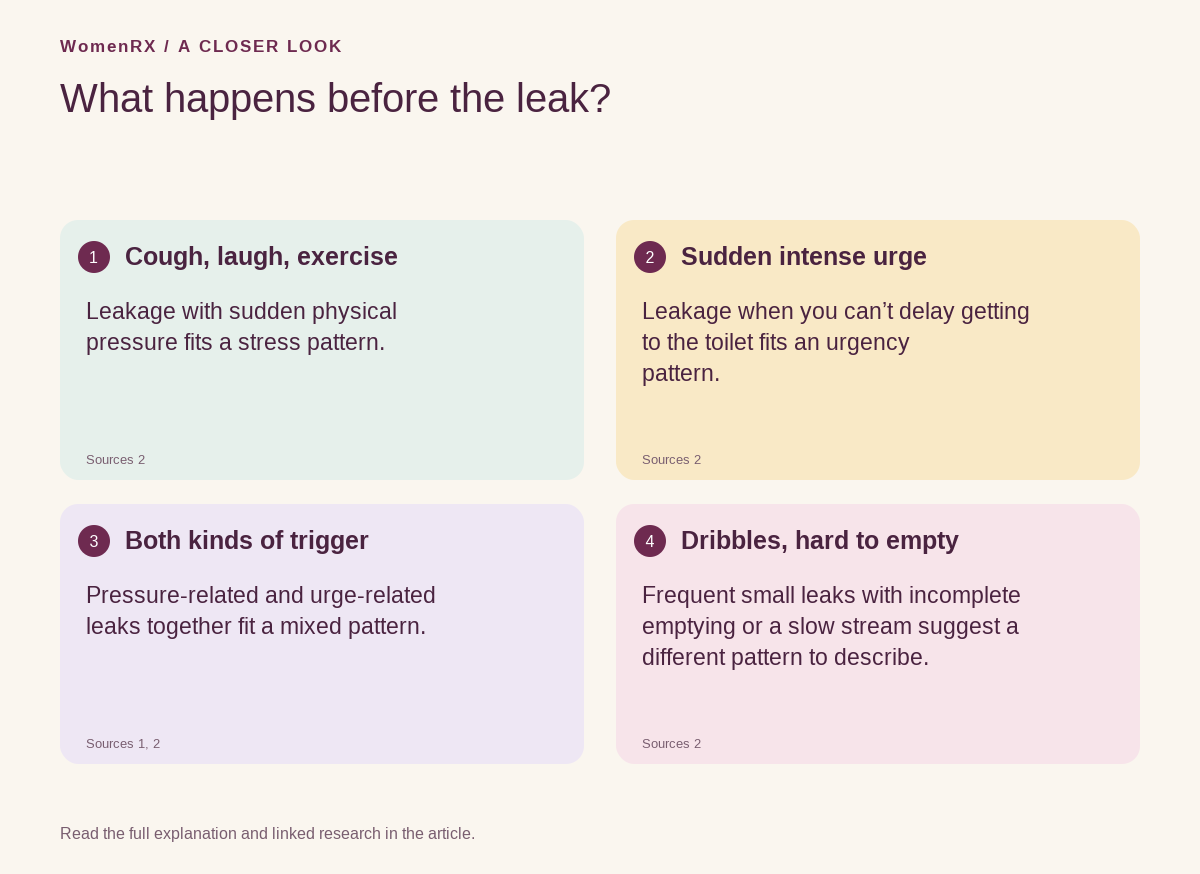
What happens before the leak?
Cough, laugh, exercise: Leakage with sudden physical pressure fits a stress pattern.2
Sudden intense urge: Leakage when you can’t delay getting to the toilet fits an urgency pattern.2
Both kinds of trigger: Pressure-related and urge-related leaks together fit a mixed pattern.12
Dribbles, hard to empty: Frequent small leaks with incomplete emptying or a slow stream suggest a different pattern to describe.2
Read the figure as text
The trigger and what you notice afterward can help you describe the pattern at an assessment.- Cough, laugh, exercise: Leakage with sudden physical pressure fits a stress pattern.2
- Sudden intense urge: Leakage when you can’t delay getting to the toilet fits an urgency pattern.2
- Both kinds of trigger: Pressure-related and urge-related leaks together fit a mixed pattern.12
- Dribbles, hard to empty: Frequent small leaks with incomplete emptying or a slow stream suggest a different pattern to describe.2
More questions, answered
Does leaking urine mean menopause is the cause?
Not necessarily. Leakage can occur after menopause, but aging doesn’t make it inevitable, and factors such as pregnancy and vaginal birth can also matter. The trigger for the leak helps describe the pattern. 12
What details should I tell a clinician?
Describe what you were doing just before a leak, whether a sudden urge came first, how often it happens, and whether you feel your bladder empties fully. A diary of bathroom trips and fluid intake may also be suggested. 12
Sources you can check
- Urinary incontinence - NHSAccessed 2026-09-25Return to first citation
- Urinary incontinence - Symptoms - NHSAccessed 2026-09-25Return to first citation
- The 2022 hormone therapy position statement of The North American Menopause Society.“The 2022 Hormone Therapy Position Statement of The North American Menopause Society” Advisory Panel. · Menopause (New York, N.Y.) · 2022Return to first citation
- Efficacy of vaginal androgen combined with pelvic floor muscle training for stress urinary incontinence in postmenopausal women: a randomized-controlled trial.Chen Y, Ren Z, Yan J, Yu Y. · The Canadian journal of urology · 2026Return to first citation
- Efficacy of vaginal 17β-estradiol on the urinary storage symptoms in postmenopausal women: a randomized double-blind, placebo-controlled study.Harncharoenkul P, Wattanayingcharoenchai R, Pongchaikul P, Aimjirakul K, Chinthakanan O, Manonai J. · Scientific reports · 2026Return to first citation