Urinary Leakage in Perimenopause: What Might Help?
When and how urine leaks can point to different bladder or pelvic-floor patterns, each with options worth discussing.
Leaking with a cough, laugh, or exercise fits a stress pattern; leaking after a sudden, hard-to-delay urge fits an urgency pattern. Some women have both. Perimenopause can coincide with urinary and pelvic-floor changes, but leakage isn’t an inevitable part of menopause. Naming your pattern helps a clinician assess possible causes and discuss options such as pelvic-floor exercises, bladder training, or treatment for vaginal symptoms when those are also present. 1245
Start with what happens just before the leak
The word “stress” in stress incontinence means pressure on the bladder, not emotional stress. A small leak during a cough, sneeze, laugh, jump, or run fits this pattern. It can happen when the muscles and other structures that help hold urine back aren’t supporting the bladder and urethra well enough. 12
With urgency incontinence, a sudden, intense need to urinate comes first, and urine leaks before you can reach a toilet. Frequent urination or waking at night to urinate can occur alongside urgency. Mixed incontinence means both patterns: for example, leakage with a cough and leakage after a sudden urge. 12
These descriptions help you explain what’s happening; they don’t establish a diagnosis. Frequent dribbling or a sense that your bladder never empties is a different pattern worth mentioning, because leakage can also occur when the bladder doesn’t empty fully. 2
Why it may show up around midlife
Pelvic-floor symptoms can reflect more than one influence, including age and the effects of pregnancy or childbirth. Menopause-related estrogen changes can also be associated with genitourinary symptoms. That doesn’t mean every leak is caused by perimenopause, or that leakage is something you simply have to accept. 4
Pay attention to whether you also have vaginal dryness or irritation. These symptoms can occur with genitourinary syndrome of menopause (GSM), which can include urinary complaints as well. Their presence gives a clinician another part of the picture; it doesn’t prove that GSM is the sole cause of leakage. 35
Match the conversation to the pattern
A clinician can ask when leakage happens, how often you urinate, and whether you feel able to empty your bladder. An assessment may include a pelvic examination. A short record of leaks, urgency, urination, and relevant drinks can also make the pattern easier to describe. 12
For leakage with exertion, ask whether pelvic-floor exercises are a reasonable option for your symptoms. These exercises strengthen the muscles used to help control urination. 1
For urgency, ask about bladder training, which involves learning ways to wait longer between the urge to urinate and going to the toilet. Caffeine and alcohol can contribute to urine production or bladder irritation for some people, so it may be useful to discuss whether your intake is relevant rather than making broad changes on your own. 1
If both patterns are present, describe both. The options above address different parts of the problem, and an assessment can help decide what fits. If you have vaginal dryness or irritation as well, ask whether treatment for GSM is appropriate. Vaginal estrogen is used for menopause-related vaginal dryness and irritation; a review also describes local estrogen as a treatment for GSM that may include urinary symptoms. It should not be assumed to treat every type of leakage. 35
A useful way to describe it
Try a plain-language account: “I leak when I cough,” “I leak when an urgent need hits,” or “Both happen.” Add how often it occurs, whether you’re urinating more often or at night, and whether you feel fully emptied afterward. If dryness or irritation is also present, mention that too. Urinary leakage is common enough to be familiar in care, and discussing it is a practical first step toward finding a management approach. 123
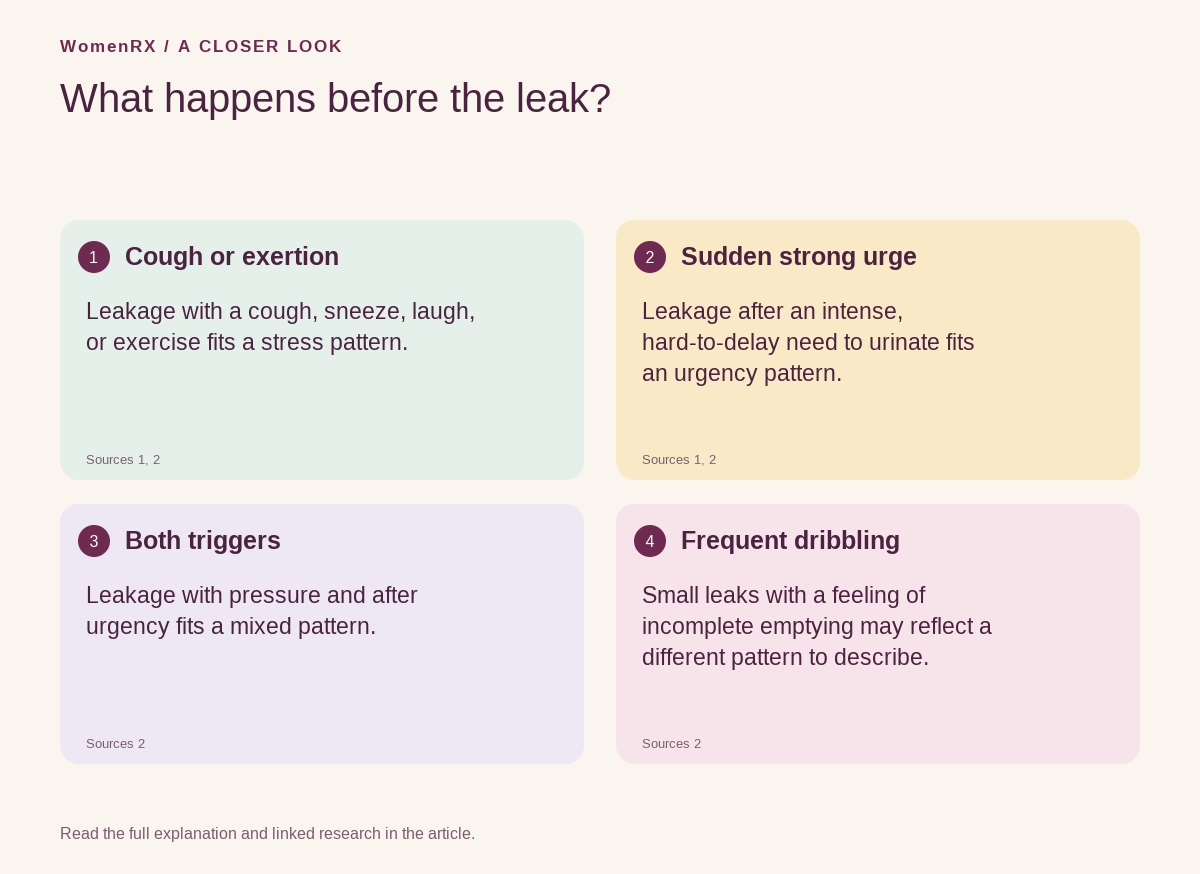
What happens before the leak?
Cough or exertion: Leakage with a cough, sneeze, laugh, or exercise fits a stress pattern.12
Sudden strong urge: Leakage after an intense, hard-to-delay need to urinate fits an urgency pattern.12
Both triggers: Leakage with pressure and after urgency fits a mixed pattern.2
Frequent dribbling: Small leaks with a feeling of incomplete emptying may reflect a different pattern to describe.2
Read the figure as text
The trigger can help you describe whether leakage follows pressure, a sudden urge, or both.- Cough or exertion: Leakage with a cough, sneeze, laugh, or exercise fits a stress pattern.12
- Sudden strong urge: Leakage after an intense, hard-to-delay need to urinate fits an urgency pattern.12
- Both triggers: Leakage with pressure and after urgency fits a mixed pattern.2
- Frequent dribbling: Small leaks with a feeling of incomplete emptying may reflect a different pattern to describe.2
More questions, answered
Does vaginal estrogen treat urinary leakage?
Not necessarily. Vaginal estrogen is used for menopause-related vaginal dryness and irritation. GSM may also involve urinary symptoms, but leakage can have different patterns and causes, so discuss the combination of symptoms rather than assuming vaginal estrogen will address every leak. 35
What if I leak both with coughing and with urgency?
That combination fits mixed incontinence. Tell the clinician about both triggers, since stress and urgency patterns have different features and may lead to different management options. 2
Sources you can check
- Urinary incontinence - NHSAccessed 2026-09-25Return to first citation
- Urinary incontinence - Symptoms - NHSAccessed 2026-09-25Return to first citation
- About vaginal oestrogen - NHSAccessed 2026-09-25Return to first citation
- Do We Have the Evidence to Produce Tools to Enable the Identification and Personalization of Management of Women's Pelvic Floor Health Disorders Through the Perinatal and Perimenopausal Periods? ICI-RS 2024.Kearney R, Salvatore S, Khullar V, Chapple C, Taithongchai A, Uren A, Abrams P, Wein A. · Neurourology and urodynamics · 2025Return to first citation
- Urinary manifestations of genitourinary syndrome of menopause: a review of the pathophysiology, clinical presentation, and management.Saad JC, Brandon CA. · Gynecology and pelvic medicine · 2026Return to first citation