Urinary Leakage in Perimenopause: Which Pattern Fits?
A leak during a cough calls for a different conversation than a leak that follows a sudden, hard-to-delay urge.
Leakage with coughing, laughing, or exercise fits a stress-incontinence pattern. Leakage after a sudden, intense urge fits urgency incontinence; you can also have both. The pattern helps guide the discussion, but it doesn’t prove the cause. Leakage isn’t an inevitable part of aging, and how long it lasts depends in part on what’s causing it. 123
Start with what happened just before the leak
If you leak when you cough, sneeze, laugh, or exercise, the extra physical pressure on your bladder points toward stress incontinence. Here, “stress” doesn’t mean emotional stress. Pelvic-floor muscles or the muscle that keeps the urethra closed may not be providing enough support against that pressure. 13
If you suddenly need to urinate and leak before you reach the toilet, that points toward urgency incontinence. You might also urinate frequently or wake to go at night. The bladder muscle can contract too often, although why that happens isn’t always clear. 13
Some women experience both: a leak during exercise on one day and a leak after an intense urge on another. That’s called mixed incontinence. Frequent small drips along with a feeling that you can’t fully empty your bladder suggest a different possibility, such as overflow incontinence. These descriptions are clues, not a way to diagnose yourself. 123
Why it can show up in midlife
Urinary leakage becomes more common in middle age, but perimenopause doesn’t explain every leak. Pregnancy and childbirth can affect the muscles that control urine flow. Certain medicines can also disrupt how urine is stored or passed, and bladder muscle activity or another condition may be involved. Leakage is common, but it isn’t inevitable with age. 12
There’s no single timetable for when perimenopausal leakage will stop. Some causes of incontinence lead to short-term problems; others can last longer. Treating a cause may resolve the leakage, which is why identifying the pattern and considering other contributors is more useful than waiting for menopause to end. 1
What each pattern suggests discussing
When pressure triggers leakage: Pelvic-floor muscle training aims to strengthen the muscles involved in urine control and improve how they work. In a 2025 analysis of five randomized trials involving postmenopausal women, training improved incontinence symptoms compared with control approaches, though results varied substantially between studies. A broader review found that evidence for pelvic-floor physiotherapy across the different types of postmenopausal incontinence was not yet strong enough for a definitive conclusion. Those findings make training a reasonable option to discuss, not a promise of a particular result in perimenopause. 267
When urgency comes first: Bladder training is an option that works on delaying urination rather than rushing to the toilet at the first urge. Caffeine and alcohol can increase urine production or irritate the bladder, so consider whether either seems connected to your symptoms. Cutting back shouldn’t mean going without enough fluid during the day. 2
When you have both patterns: Name both. Pelvic-floor exercises and bladder training address different parts of the problem, so describing only the exercise leaks or only the sudden urges could leave out something useful for the assessment. 23
If you also have vaginal dryness, burning, or pain during sex, bring that up separately. Low-dose vaginal estrogen is an option for bothersome menopausal vaginal symptoms. It shouldn’t be assumed to address a pressure-triggered leak or a sudden-urge leak simply because those symptoms happen at the same time. Ask which symptom each proposed treatment is meant to help. 45
A few details can make the conversation more precise: what you were doing when you leaked, whether an urge came first, whether you feel fully empty afterward, and any medicines you take. An assessment may include questions, an examination, or a record of fluid intake and urination. You don’t have to wait for leakage to become severe to raise it. 123
What happens before the leak?
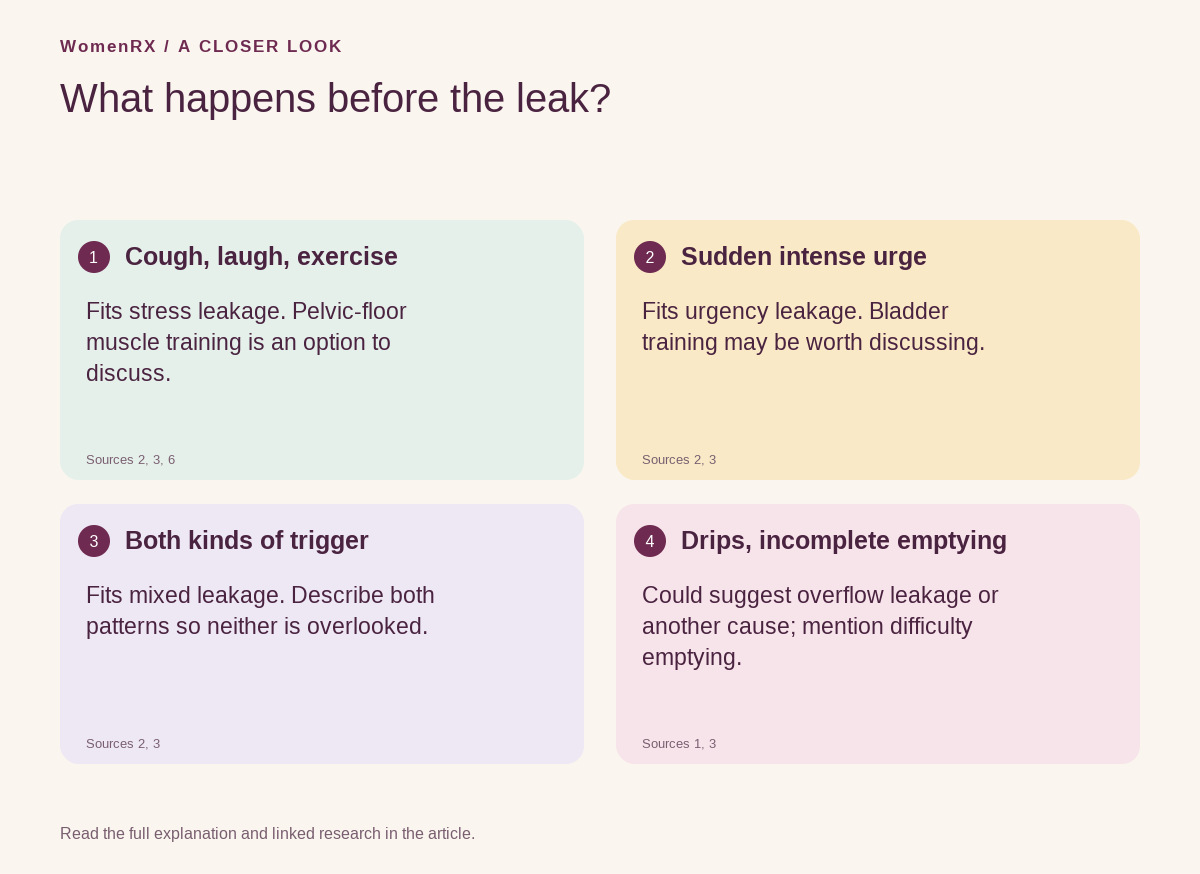
Cough, laugh, exercise: Fits stress leakage. Pelvic-floor muscle training is an option to discuss.236
Sudden intense urge: Fits urgency leakage. Bladder training may be worth discussing.23
Both kinds of trigger: Fits mixed leakage. Describe both patterns so neither is overlooked.23
Drips, incomplete emptying: Could suggest overflow leakage or another cause; mention difficulty emptying.13
Read the figure as text
The trigger can help you describe your symptoms and identify a relevant care discussion.- Cough, laugh, exercise: Fits stress leakage. Pelvic-floor muscle training is an option to discuss.236
- Sudden intense urge: Fits urgency leakage. Bladder training may be worth discussing.23
- Both kinds of trigger: Fits mixed leakage. Describe both patterns so neither is overlooked.23
- Drips, incomplete emptying: Could suggest overflow leakage or another cause; mention difficulty emptying.13
More questions, answered
Does leaking when I cough mean I have stress incontinence?
It fits the stress-incontinence pattern, especially if laughing, sneezing, or exercise also triggers leaks. The trigger is a useful clue, but it doesn’t establish the cause on its own. 13
Does vaginal estrogen treat urinary leakage?
Low-dose vaginal estrogen is an option for menopausal vaginal symptoms such as dryness, burning, and pain during sex. Don’t assume it will treat stress or urgency leakage; ask whether it’s being suggested for vaginal symptoms, leakage, or both. 45
Sources you can check
- Urinary incontinence - Causes - NHSAccessed 2026-09-25Return to first citation
- Urinary incontinence - NHSAccessed 2026-09-25Return to first citation
- Urinary incontinence - Symptoms - NHSAccessed 2026-09-25Return to first citation
- Types of hormone replacement therapy (HRT) - NHSAccessed 2026-09-25Return to first citation
- The 2022 hormone therapy position statement of The North American Menopause Society.“The 2022 Hormone Therapy Position Statement of The North American Menopause Society” Advisory Panel. · Menopause (New York, N.Y.) · 2022Return to first citation
- Effect of pelvic floor muscle training on urinary incontinence symptoms in postmenopausal women: A systematic review and meta-analysis.Marcellou EG, Stasi S, Giannopapas V, Bø K, Bakalidou D, Konstadoulakis M, Papathanasiou G. · European journal of obstetrics, gynecology, and reproductive biology · 2025Return to first citation
- A review of the role for pelvic floor physiotherapy in postmenopausal women with urinary incontinence.Walgren LA, Wade C, Dessaulles M, Martin Ginis K, Locke J. · Post reproductive health · 2024Return to first citation