Irregular Periods in Perimenopause: What Needs Checking?
Cycles can become less predictable during perimenopause, but heavy, prolonged, or between-period bleeding shouldn’t automatically be written off as hormonal change.
In perimenopause, periods may become irregular or occasionally skip, especially later in the transition. A change in timing alone can fit this pattern, but bleeding between periods, bleeding that lasts longer than seven days, or flow that is unusually heavy or disrupts daily life deserves assessment. Pregnancy, contraception, and other causes can also matter, so compare changes with your usual pattern rather than assuming every change is menopause. 1 3 4
What can change as the transition progresses
Perimenopause is the stretch of time when menstrual changes begin through the year after the final period. A common pattern is moving from regular cycles to less predictable ones. Skipped periods become more common later in the transition, when cycles without ovulation are more frequent. 2 4
That makes a change in timing understandable, but it doesn’t make every kind of bleeding automatically normal. Menstrual changes can involve how often bleeding happens, how regular it is, how long it lasts, or how heavy it is. The most useful comparison is with your own usual pattern: note what changed, when it changed, and whether it is affecting your day-to-day life. 3
When a change is worth checking
Contact a clinician about a new or ongoing change in your usual bleeding pattern, especially if you have bleeding between periods or a period lasts longer than seven days. Flow that feels unusually heavy or interferes with daily activities also deserves attention. Heavy bleeding can occur around perimenopause, but it shouldn’t simply be assumed to be a normal effect of the transition; heavy bleeding can also be associated with problems in the uterus. 1 3 4
Seek urgent assessment for sudden, excessive bleeding. Clinical guidance distinguishes this kind of acute bleeding from a longer-running pattern because it may require immediate intervention. 3
There can be causes besides the menopausal transition. Examples include thyroid problems, polycystic ovary syndrome, changes in ovulation, uterine growths such as fibroids or polyps, and bleeding related to hormone medication. These are possibilities, not a way to diagnose the cause from a pattern alone. 1 3
If pregnancy is possible, mention that when you seek advice rather than assuming the bleeding is perimenopause. Abnormal uterine bleeding is defined separately from bleeding in pregnancy, and hormone medication can also be relevant to a bleeding change. 3
Keep a simple record of what changed
A period app or diary can make an irregular pattern easier to describe. Mark the first day of each period, when bleeding ends, and any bleeding between periods. Add whether the flow was lighter or heavier than usual and whether it disrupted normal activities. Include contraception or hormone medication and any possibility of pregnancy, since these can affect how the pattern is interpreted. 1 3
Bring the record if you contact a clinician. Evaluation is guided by the details and may include a history and examination, lab tests, imaging, or sampling of the uterine lining when indicated. Not everyone needs every test; the aim is to work out whether the change fits the transition or needs another explanation. 3
A record is useful, but it isn’t a reason to wait if bleeding is sudden and excessive or a concerning change is already happening. The practical distinction is this: less predictable timing can occur in perimenopause, while prolonged, between-period, unusually heavy, or acutely excessive bleeding calls for closer attention. 1 3 4
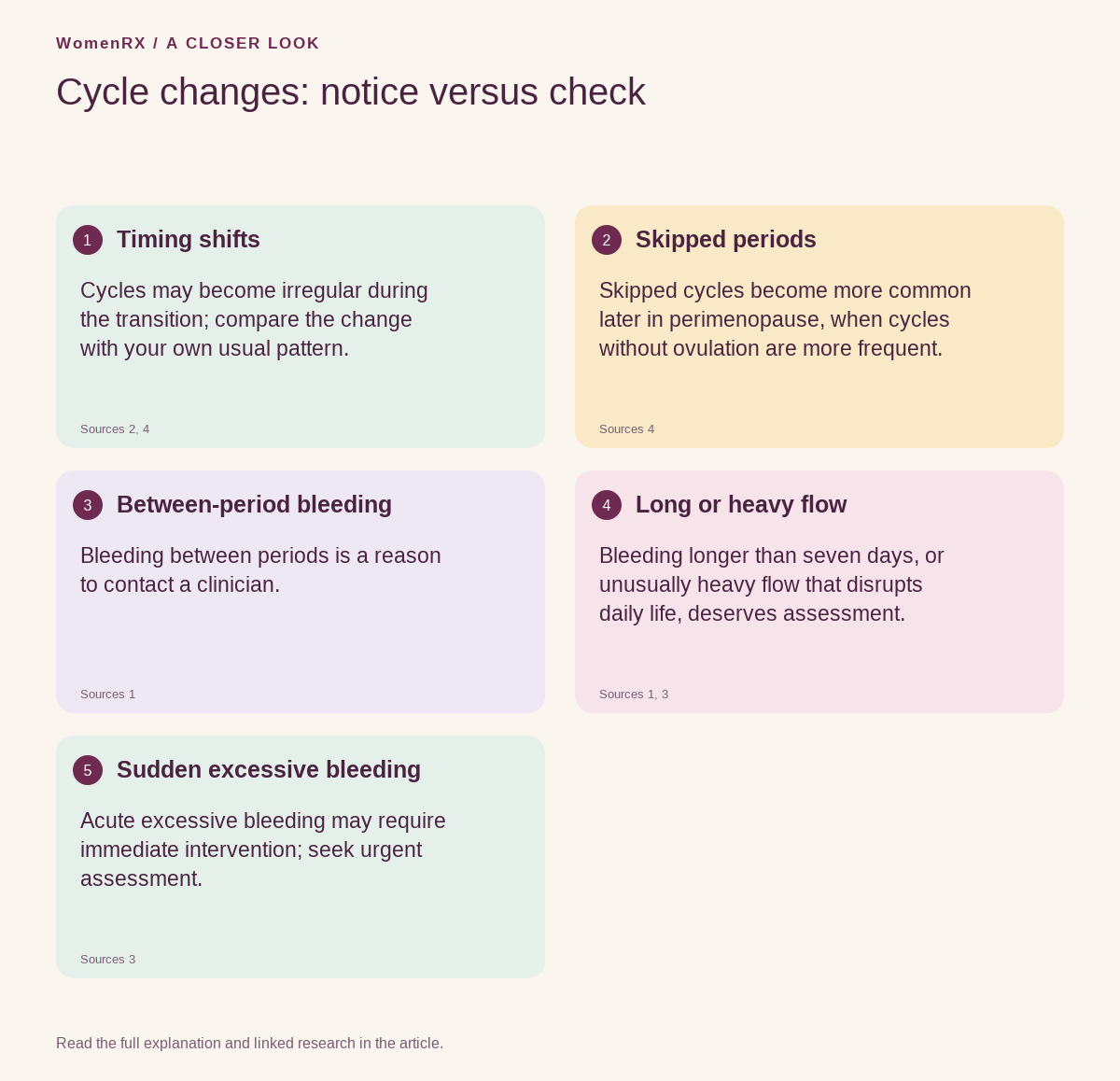
Cycle changes: notice versus check
Timing shifts: Cycles may become irregular during the transition; compare the change with your own usual pattern.24
Skipped periods: Skipped cycles become more common later in perimenopause, when cycles without ovulation are more frequent.4
Between-period bleeding: Bleeding between periods is a reason to contact a clinician.1
Long or heavy flow: Bleeding longer than seven days, or unusually heavy flow that disrupts daily life, deserves assessment.13
Sudden excessive bleeding: Acute excessive bleeding may require immediate intervention; seek urgent assessment.3
Read the figure as text
Timing can become less predictable during perimenopause, while certain bleeding features deserve assessment rather than assumption.- Timing shifts: Cycles may become irregular during the transition; compare the change with your own usual pattern.24
- Skipped periods: Skipped cycles become more common later in perimenopause, when cycles without ovulation are more frequent.4
- Between-period bleeding: Bleeding between periods is a reason to contact a clinician.1
- Long or heavy flow: Bleeding longer than seven days, or unusually heavy flow that disrupts daily life, deserves assessment.13
- Sudden excessive bleeding: Acute excessive bleeding may require immediate intervention; seek urgent assessment.3
More questions, answered
Does an irregular period mean I’m in perimenopause?
It can be part of the transition, but irregular periods have other possible causes, including thyroid problems and polycystic ovary syndrome. A new or persistent change is worth discussing rather than using cycle timing alone to identify the cause. 1 2
What should I write down about my bleeding?
Record the first and last day of bleeding, any bleeding between periods, and whether the flow was lighter or heavier than usual or disrupted daily life. Note contraception or hormone medication and whether pregnancy could be possible. 1 3
Sources you can check
- Irregular periods - NHSAccessed 2026-09-25Return to first citation
- Position of the Spanish Menopause Society regarding the management of perimenopause.Mendoza N, Sánchez-Borrego R, Cancelo MJ, Calvo A, Checa MA, Cortés J, Elorriaga MA, Díaz T, González JV, Lete I, Lobo P, Martínez-Astorquiza T, Nieto A, Olalla MA, Pérez-Campos E,... · Maturitas · 2013Return to first citation
- Abnormal Uterine BleedingMikes BA, Vadakekut ES, Sparzak PB. · 2025Return to first citation
- Genitourinary symptoms in the menopausal transition.Van Voorhis BJ. · The American journal of medicine · 2005Return to first citation