Oral estradiol for menopause: what the pill does, and what route changes
Oral estradiol can ease menopause symptoms, but the choice between a pill and a skin-applied form also involves how each is absorbed, your uterus status, and your individual risk profile.
Oral estradiol is a systemic menopause treatment, often considered for bothersome hot flashes and other symptoms. A short randomized trial found similar symptom relief with oral and transdermal estradiol, but it cannot answer long-term safety questions. If you have a uterus, systemic estrogen generally needs progestogen for endometrial protection, whichever route you use. 4 5 2
What taking oral estradiol involves
Oral estradiol is swallowed as a pill. The schedule depends on the prescription and whether another hormone, such as a progestogen, is part of the treatment. In a randomized study of recently menopausal women, the oral-treatment group took estradiol valerate daily for 24 weeks; both the oral and transdermal groups also received micronized progesterone. That was a study regimen, not a dose or schedule for everyone. 5
The oral route takes estradiol through the digestive system and liver before it reaches the bloodstream. A skin patch delivers estradiol through the skin and avoids this first-pass metabolism. That changes how the body absorbs the hormone, but it does not by itself show that one route is the safer choice for every person. 2
Systemic hormone therapy is most often considered for bothersome symptoms such as hot flashes and night sweats. The North American Menopause Society also identifies prevention of bone loss and treatment of genitourinary symptoms among hormone therapy’s effects. If vaginal or urinary symptoms are your only concern, ask whether a local treatment is a better fit: for some people without a reason to use systemic therapy, the statement recommends considering low-dose vaginal estrogen or other options for bothersome genitourinary symptoms not relieved by over-the-counter treatments. 4
What the route comparison can tell you
A randomized trial assigned 257 recently menopausal women to transdermal estradiol or oral estradiol valerate, with progesterone included in both groups, and followed them for 24 weeks. Symptoms improved in both groups, with little difference in overall symptom relief. The study also reported no difference between groups in the incidence of adverse effects during that period. 5
That is useful evidence that either route can work for symptoms in the studied population. It is not a long-term comparison of serious outcomes, and it does not establish that oral and transdermal treatment have identical long-term risks. Nor does it support calling one route universally safer. Hormone therapy’s risks vary with factors including formulation, route, timing, duration, and whether a progestogen is used. 4 5
The uterus question is separate from the route
If you have a uterus, taking systemic estrogen without adequate endometrial protection can increase the risk of endometrial hyperplasia, which can precede endometrial cancer. A progestogen is generally used with systemic estrogen to help protect the uterine lining. If your uterus has been removed, estrogen-only treatment may be an option; whether that applies depends on your own situation. Switching from a pill to a patch does not remove the need to discuss protection if you have a uterus. 2 3
Bleeding after menopause, or persistent or recurring unusual bleeding while using estrogen, needs evaluation rather than being assumed to be a routine treatment effect. Product information advises diagnostic assessment when indicated to rule out a serious cause. 2
Put timing and personal risks on the table
The menopause society statement says the benefit-risk balance is generally favorable for women younger than 60 or within 10 years of menopause onset who have no contraindications and are treating bothersome symptoms or preventing bone loss. For people who start later than that, the balance appears less favorable because the absolute risks of coronary heart disease, stroke, venous thromboembolism, and dementia are higher. These are broad guidance points, not a personal risk calculation or a reason to assume a particular outcome. 4
A useful conversation is specific: Which symptom are you treating, and how much improvement would make treatment worthwhile? Does your uterus remain, and if so, what is the plan for endometrial protection? How do your age, time since menopause, medical history, and preferences affect the route and formulation? Revisit those questions periodically, since the balance of benefit and risk can change over time. 4
Hormone therapy is not used to prevent heart disease or dementia. If symptom relief is the goal, the choice is about matching a treatment’s expected benefit and practical fit to your circumstances, then reviewing whether it is still helping. 1 2 4
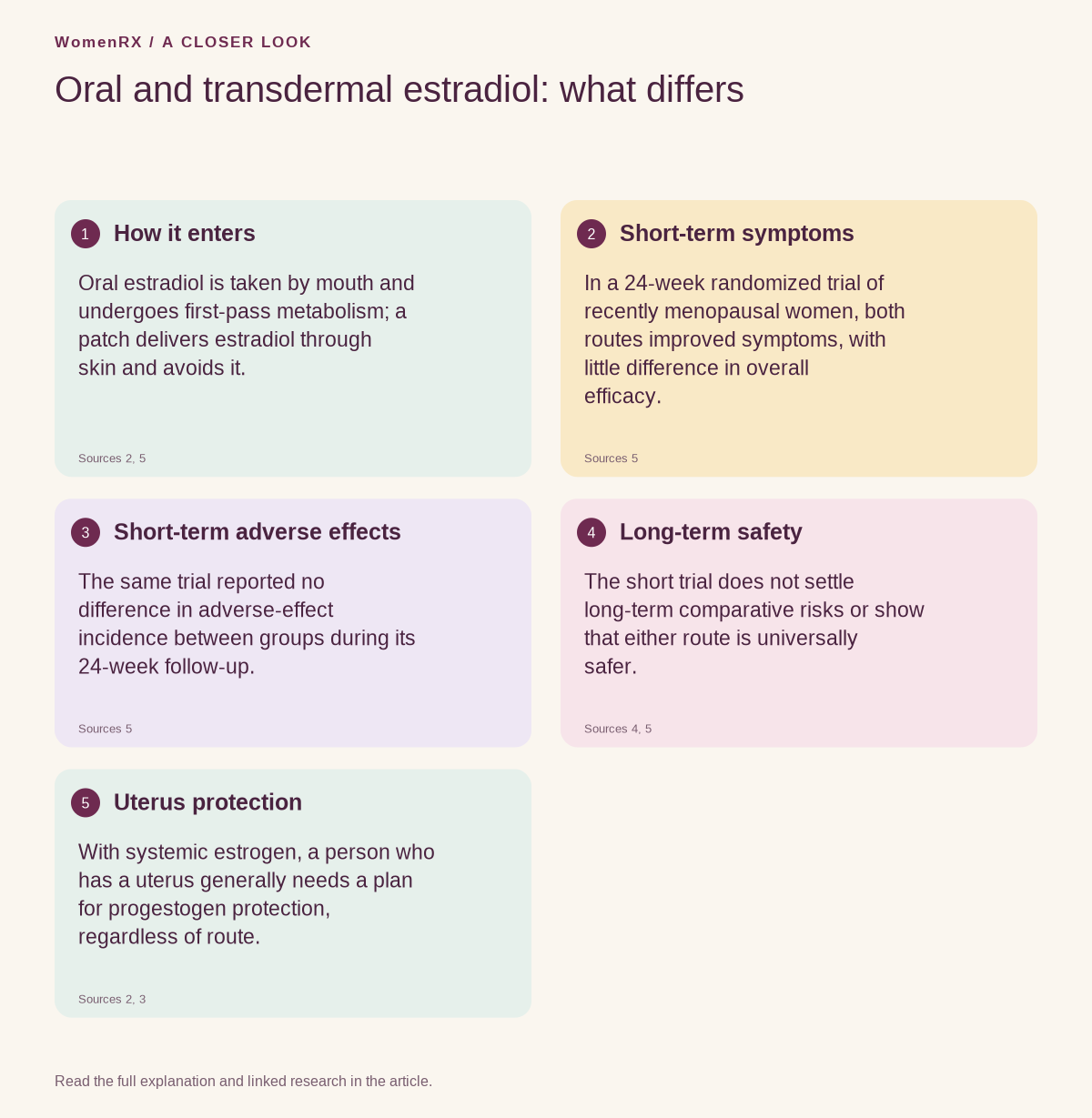
Oral and transdermal estradiol: what differs
How it enters: Oral estradiol is taken by mouth and undergoes first-pass metabolism; a patch delivers estradiol through skin and avoids it.25
Short-term symptoms: In a 24-week randomized trial of recently menopausal women, both routes improved symptoms, with little difference in overall efficacy.5
Short-term adverse effects: The same trial reported no difference in adverse-effect incidence between groups during its 24-week follow-up.5
Long-term safety: The short trial does not settle long-term comparative risks or show that either route is universally safer.45
Uterus protection: With systemic estrogen, a person who has a uterus generally needs a plan for progestogen protection, regardless of route.23
Read the figure as text
The routes differ in how estradiol is delivered, while available short-term trial findings show similar symptom relief. Route choice does not replace the separate question of uterine protection.- How it enters: Oral estradiol is taken by mouth and undergoes first-pass metabolism; a patch delivers estradiol through skin and avoids it.25
- Short-term symptoms: In a 24-week randomized trial of recently menopausal women, both routes improved symptoms, with little difference in overall efficacy.5
- Short-term adverse effects: The same trial reported no difference in adverse-effect incidence between groups during its 24-week follow-up.5
- Long-term safety: The short trial does not settle long-term comparative risks or show that either route is universally safer.45
- Uterus protection: With systemic estrogen, a person who has a uterus generally needs a plan for progestogen protection, regardless of route.23
More questions, answered
Does a patch avoid the need for progestogen if I have a uterus?
No. The route changes how estradiol enters the body, but systemic estrogen can still affect the uterine lining. If you have a uterus, discuss endometrial protection with your clinician even if you use a patch rather than a pill. 2 3
Sources you can check
- CLIMARA PRO (ESTRADIOL AND LEVONORGESTREL) PATCH [BAYER HEALTHCARE PHARMACEUTICALS INC.] | US prescribing information and patient instructionsAccessed 2026-09-25Return to first citation
- CLIMARA (ESTRADIOL) PATCH [BAYER HEALTHCARE PHARMACEUTICALS INC.] | US prescribing information and patient instructionsAccessed 2026-09-25Return to first citation
- Effects of early estradiol valerate administration on bone turnover markers in surgically induced menopausal women.Vatrasresth J, Suwan A, Panyakhamlerd K. · BMC women's health · 2021Return to first citation
- The 2022 hormone therapy position statement of The North American Menopause Society.“The 2022 Hormone Therapy Position Statement of The North American Menopause Society” Advisory Panel. · Menopause (New York, N.Y.) · 2022Return to first citation
- Changes in menopausal symptoms comparing oral estradiol versus transdermal estradiol.Tang R, Xie Z, Ruan X, Zhang Z, Ren M, Wu J, Shu K, Shi H, Xie M, Lv S, Yang X, Chen R, Yu Q. · Climacteric : the journal of the International Menopause Society · 2024Return to first citation