Hormonal IUD or Pill in Perimenopause: What Changes?
Both can provide contraception, but bleeding goals, daily upkeep, and whether a pill contains estrogen make the choice more personal.
A hormonal IUD and a contraceptive pill can both prevent pregnancy during perimenopause. An IUD works without a daily step, while a pill must be taken every day. A hormonal IUD may also treat heavy bleeding, depending on the product; combined pills can improve bleeding irregularity. Hot flashes and your health history are separate parts of the decision, especially when a pill contains estrogen. 126
Start with the job you need it to do
Perimenopause can bring irregular periods while pregnancy prevention still matters. The useful first question is whether you mainly want contraception, help with bleeding, or both. Then consider whether hot flashes are also part of what you want to address. Those goals don't point automatically to the same method. A systematic review of hormonal contraception in perimenopause found potential symptom benefits but too few comparative studies to identify one best regimen. 4
For contraception, compare the routine as well as the method
A hormonal IUD is placed in the uterus and doesn't require you to remember a pill each day. Fewer than 1 in 100 IUD users become pregnant during the first year of typical use, according to CDC guidance covering IUDs as a group. That figure isn't a hormonal-IUD-versus-pill pregnancy-rate comparison. Pills provide contraception too, but taking one every day is part of using the method. 27
That difference may matter more than it sounds. If remembering a daily medication would be difficult, an IUD removes that daily task. If you'd rather avoid an insertion procedure, a pill may fit your preference better. Neither preference settles the bleeding or symptom questions on its own. 27
For bleeding, the particular IUD or pill matters
If heavy bleeding is the main problem, ask about the specific IUD. Mirena, a levonorgestrel IUD, is indicated to treat heavy menstrual bleeding for up to five years in people who choose it for contraception. Spotting or irregular bleeding is common in its first months, so it may not give you predictable bleeding right away. Persistent or unusual bleeding also deserves assessment rather than being assumed to be perimenopause. 1
“The pill” isn't one formulation. Pills may contain progestin alone or both estrogen and progestin. Combined oral contraceptives can improve bleeding irregularity in middle age, while progestin-only pills may themselves cause bleeding problems. That makes the comparison more specific than IUD versus pill: it's the IUD you're considering versus the pill formulation you're considering, with some allowance for how your bleeding pattern may change after starting. 26
Hot flashes are a different question
A bleeding treatment and a hot-flash treatment aren't necessarily the same thing. Menopausal hormone therapy has evidence for treating bothersome hot flashes, and its benefits and risks depend on the regimen and the person using it. 3 A review of perimenopausal contraception found limited, positive evidence for a levonorgestrel IUD paired with low-dose menopausal estrogen for disruptive perimenopausal symptoms. The review's abstract doesn't identify hot flashes as the outcome, and that pairing is different from choosing an IUD by itself. 4 Combined oral contraceptives may reduce some menopausal-transition symptoms, but a contraceptive pill shouldn't be treated as interchangeable with menopausal hormone therapy. 63
For example, if your priority is heavy bleeding and you also have disruptive hot flashes, choosing a contraceptive method answers only part of your question. Name both concerns when you discuss options, rather than assuming that good bleeding control will address the hot flashes too. 13
Check whether the specific pill fits your health history
Combined pills contain estrogen; progestin-only pills do not. This distinction matters in perimenopause because cardiovascular safety is a major consideration in contraceptive choice after 40, and reviews describe greater cardiovascular concerns with combined pills than with progestin-only pills. It doesn't mean every person over 40 must avoid a combined pill. 256
For example, if you smoke or have migraine, bring that up when discussing which formulation fits your health history. Age alone, or the word “pill” alone, isn't enough to settle the choice. This comparison doesn't establish smoking- or migraine-specific eligibility rules.
The practical comparison is this: an IUD offers contraception without a daily pill and, in Mirena's case, an established heavy-bleeding use; a combined pill may offer bleeding and symptom benefits, but its estrogen component changes the health-history discussion. A progestin-only pill is another option with a different risk and bleeding profile. Which tradeoff works best depends on the formulation, your symptoms, and your preferences. 12456
Four questions, two contraceptive approaches
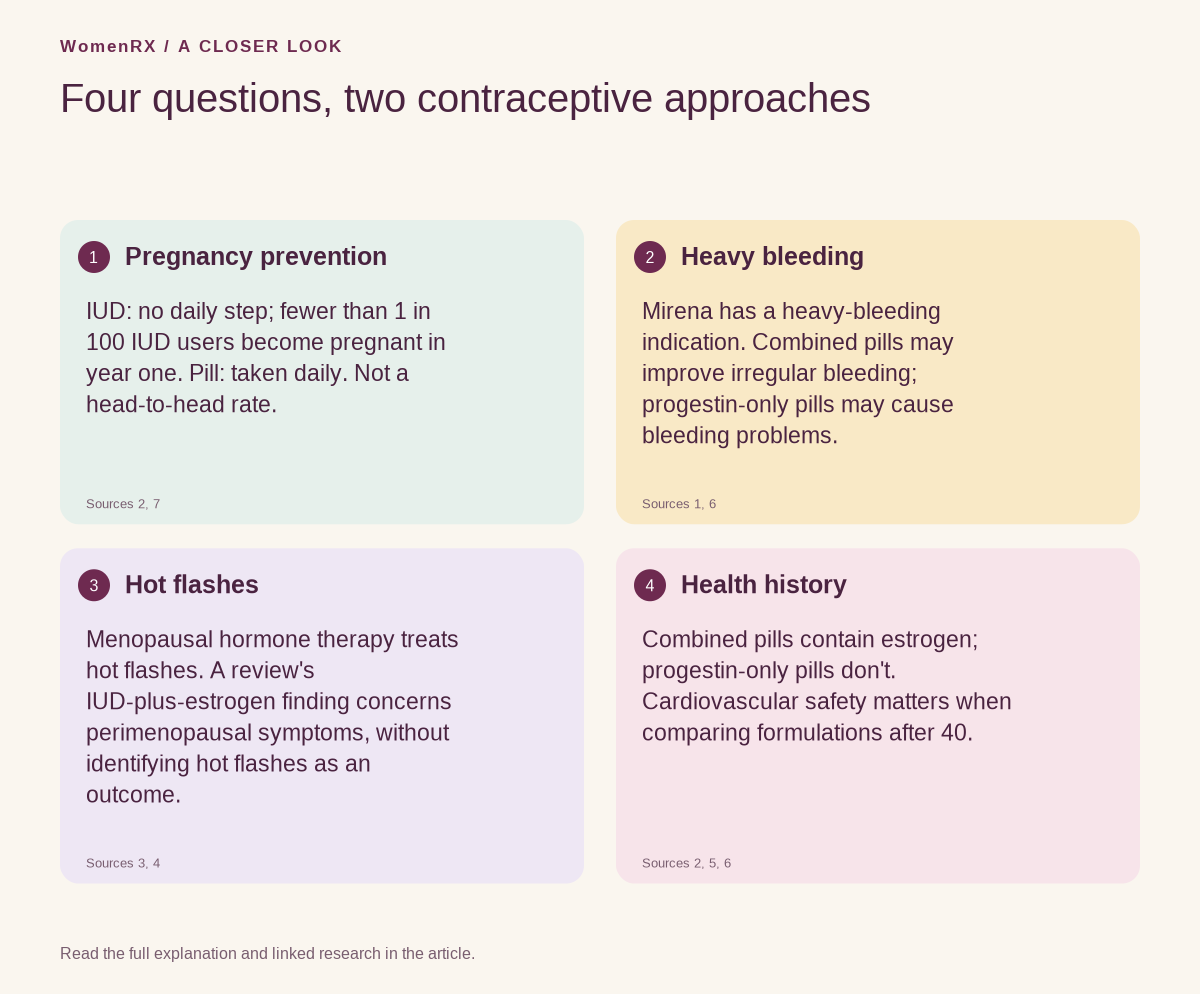
Pregnancy prevention: IUD: no daily step; fewer than 1 in 100 IUD users become pregnant in year one. Pill: taken daily. Not a head-to-head rate.27
Heavy bleeding: Mirena has a heavy-bleeding indication. Combined pills may improve irregular bleeding; progestin-only pills may cause bleeding problems.16
Hot flashes: Menopausal hormone therapy treats hot flashes. A review's IUD-plus-estrogen finding concerns perimenopausal symptoms, without identifying hot flashes as an outcome.34
Health history: Combined pills contain estrogen; progestin-only pills don't. Cardiovascular safety matters when comparing formulations after 40.256
Read the figure as text
Compare the purpose of each method before weighing which routine and formulation fit you.- Pregnancy prevention: IUD: no daily step; fewer than 1 in 100 IUD users become pregnant in year one. Pill: taken daily. Not a head-to-head rate.27
- Heavy bleeding: Mirena has a heavy-bleeding indication. Combined pills may improve irregular bleeding; progestin-only pills may cause bleeding problems.16
- Hot flashes: Menopausal hormone therapy treats hot flashes. A review's IUD-plus-estrogen finding concerns perimenopausal symptoms, without identifying hot flashes as an outcome.34
- Health history: Combined pills contain estrogen; progestin-only pills don't. Cardiovascular safety matters when comparing formulations after 40.256
Sources you can check
- MIRENA (LEVONORGESTREL) INTRAUTERINE DEVICE [BAYER HEALTHCARE PHARMACEUTICALS INC.] | US prescribing information and patient instructionsAccessed 2026-09-25Return to first citation
- Birth Control | Contraception | Contraceptives | MedlinePlusAccessed 2026-09-25Return to first citation
- The 2022 hormone therapy position statement of The North American Menopause Society.“The 2022 Hormone Therapy Position Statement of The North American Menopause Society” Advisory Panel. · Menopause (New York, N.Y.) · 2022Return to first citation
- Use of hormonal contraceptives in perimenopause: A systematic review.Guerin J, Engelmann A, Mattamana M, Borgelt LM. · Pharmacotherapy · 2022Return to first citation
- Consensus conference results on contraception in women beyond 40 years of age.Cagnacci A, Fruzzetti F, Bruni V, Gambera A, Guida M, Bonaccorsi G, Londero AP, Italian Society of Contraception (S.I.C.). · The European journal of contraception & reproductive health care : the official journal of the European Society of Contraception · 2025Return to first citation
- Oral contraception for women of middle age.Ruan X, Mueck AO. · Maturitas · 2015Return to first citation
- CDC: Intrauterine contraception and copper IUD bleedingAccessed 2026-09-25Return to first citation