Heavy Menstrual Bleeding: What to Track and How Treatments Differ
A useful bleeding record includes more than product counts: note how long bleeding lasts, how it affects your life, and any symptoms that could point to anemia.
Heavy bleeding is worth discussing when it disrupts your daily life; you don’t need to wait until you’ve counted a particular number of pads or tampons. Track how many days you bleed, changes in your usual pattern, product changes, and the effect on work, sleep, or activities. Fatigue, dizziness, feeling cold, headaches, or shortness of breath are also worth mentioning because they can occur with anemia. 34
When bleeding deserves a closer look
A product count by itself won’t describe how bleeding affects you. A clinical guideline describes heavy menstrual bleeding in terms of blood loss that negatively affects quality of life. That might mean planning work or exercise around your period, losing sleep, or changing activities because you’re worried about bleeding. Those effects count, even if you haven’t measured how much blood you lose. 46
A change in your usual pattern is useful information too. Record how many days bleeding lasts, whether it is regular from cycle to cycle, and whether bleeding happens between periods. The guideline defines abnormal uterine bleeding using features such as frequency, regularity, duration, and volume, so a description of the pattern can help frame an evaluation. 4
A simple log to bring with you
For each cycle, jot down:
- Start and end: the first and last day of bleeding, including days of spotting if you can distinguish them.
- Product changes: what you use and how often you change it, plus any leaks or overnight changes. This is a record of your experience, not a stand-alone diagnostic test.
- Daily impact: missed work or plans, interrupted sleep, or activities you changed because of bleeding.
- Other symptoms: cramps, bleeding between periods, or symptoms such as fatigue, dizziness, feeling cold, headache, or shortness of breath.
- Life-stage details: when heavy bleeding began, whether the pattern has changed, and whether you might be pregnant or are using a hormonal method.
If heavy bleeding began around your first periods, include that timing rather than assuming it explains the bleeding. If it began after years of a different pattern, say what changed. This log helps describe either history; it isn’t a separate guide to evaluating bleeding in adolescents, and it can’t tell you why you’re bleeding. Bleeding after menopause needs a different conversation, even if it’s light. 1
Ask whether anemia needs checking
Heavy periods can contribute to anemia through blood loss. Anemia can cause tiredness, feeling cold, dizziness, irritability, headaches, or shortness of breath; these symptoms can have other causes too. A blood test is used to diagnose anemia, so symptoms alone can’t confirm it. 3
If testing finds iron-deficiency anemia, treating the anemia is a separate part of care from addressing the bleeding. Iron treatment is among the approaches described for iron-deficiency anemia associated with heavy bleeding, while reducing menstrual blood loss addresses an ongoing source of loss. Which approach fits depends on the findings; there isn’t one treatment plan for everyone. 5
Treatment choices have different aims
One useful distinction is whether a treatment aims to reduce menstrual blood loss, treat iron deficiency, or do both jobs alongside contraception. The bleeding treatments below are not interchangeable, and this comparison cannot rank how well each would work for you. 25
Levonorgestrel intrauterine system (IUS): In the United States, Mirena is indicated for heavy menstrual bleeding for up to five years in women who choose to use intrauterine contraception. It is therefore an option that combines the aim of reducing bleeding with a contraceptive method. Bleeding or spotting days may increase in the initial months, while blood loss per cycle generally becomes lower with continued use. That early adjustment is a relevant tradeoff to discuss. 2
Combined oral contraceptives: These are hormonal contraceptives listed among treatments for heavy menstrual bleeding. They offer a different form of contraception from an IUS while aiming to reduce bleeding. A review reports reduced blood loss with hormonal contraceptives broadly, but it does not establish how combined pills compare with an IUS or which would suit you better. 5
Tranexamic acid: This is listed as a nonhormonal medicine for heavy menstrual bleeding. Its aim is to address bleeding without choosing a hormonal contraceptive for that purpose. The available comparison here does not establish whether it would reduce your bleeding more or less than the hormonal options. 5
Iron treatment: Iron addresses iron deficiency or iron-deficiency anemia, not the source of menstrual bleeding itself. If anemia is present, a clinician may consider its type and severity alongside steps to reduce ongoing blood loss. 35
Treatment should not substitute for looking into possible causes. Evaluation of abnormal uterine bleeding may consider conditions such as polyps, fibroids, endometrial changes, or malignancy; the cause and appropriate assessment depend on the person’s circumstances. 4
Bleeding after menopause is different
Bleeding after menopause is not a period. The NHS advises getting any bleeding after menopause checked, even if it happens only once. Possible causes include thinning of the vaginal or uterine lining and polyps; less commonly, bleeding can be related to cancer. The cause determines what assessment or treatment is appropriate. 1
For a useful first conversation, bring your log and describe what has changed and what the bleeding prevents you from doing. Those details can help distinguish the amount of bleeding from its real effect on your health and daily life.
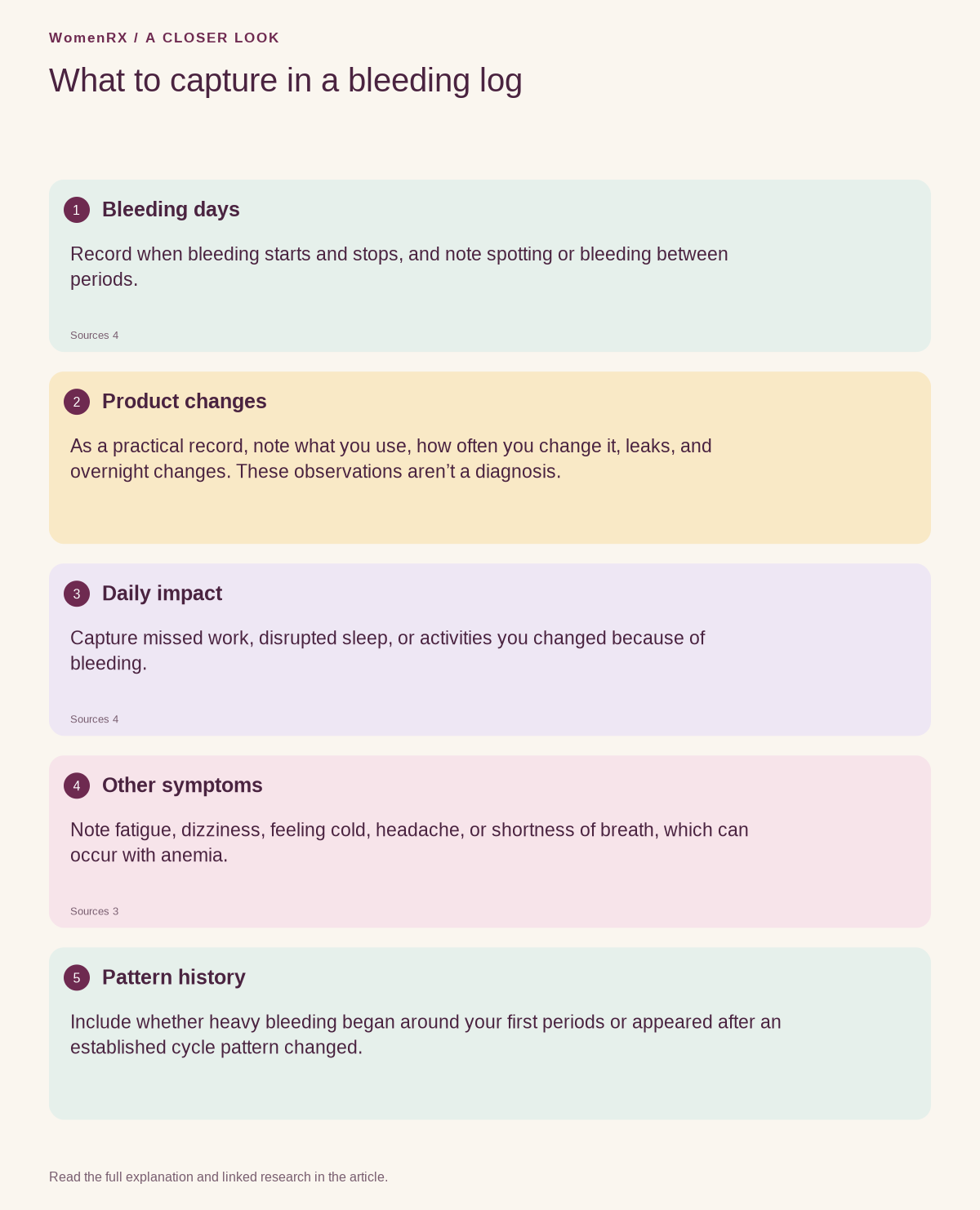
What to capture in a bleeding log
Bleeding days: Record when bleeding starts and stops, and note spotting or bleeding between periods.4
Product changes: As a practical record, note what you use, how often you change it, leaks, and overnight changes. These observations aren’t a diagnosis.
Daily impact: Capture missed work, disrupted sleep, or activities you changed because of bleeding.4
Other symptoms: Note fatigue, dizziness, feeling cold, headache, or shortness of breath, which can occur with anemia.3
Pattern history: Include whether heavy bleeding began around your first periods or appeared after an established cycle pattern changed.
Read the figure as text
Use these prompts to describe the pattern and its effect. The log organizes observations; it does not diagnose heavy bleeding or anemia.- Bleeding days: Record when bleeding starts and stops, and note spotting or bleeding between periods.4
- Product changes: As a practical record, note what you use, how often you change it, leaks, and overnight changes. These observations aren’t a diagnosis.
- Daily impact: Capture missed work, disrupted sleep, or activities you changed because of bleeding.4
- Other symptoms: Note fatigue, dizziness, feeling cold, headache, or shortness of breath, which can occur with anemia.3
- Pattern history: Include whether heavy bleeding began around your first periods or appeared after an established cycle pattern changed.
Sources you can check
- Postmenopausal bleeding - NHSAccessed 2026-09-25Return to first citation
- MIRENA (LEVONORGESTREL) INTRAUTERINE DEVICE [BAYER HEALTHCARE PHARMACEUTICALS INC.] | US prescribing information and patient instructionsAccessed 2026-09-25Return to first citation
- Anemia | MedlinePlusAccessed 2026-09-25Return to first citation
- Visually directed hysteroscopic biopsy in the evaluation of abnormal uterine bleeding and postmenopausal bleeding: a Joint Society Practice Guideline. Joint Society Practice Guideline from AAGL-ESGE-GCH. · Facts, views & vision in ObGyn · 2026Return to first citation
- A scoping review on heavy menstrual bleeding and anemia: A less explored phenomenon.Pandey G, Yadav K, Kaur R, Bairwa M, Khanam A, Nair N. · Journal of family medicine and primary care · 2026Return to first citation
- Cost-effectiveness of first-line IV vs oral iron for iron-deficiency anemia in women with heavy menstrual bleeding.Wang D, Sra M, Ito S, Ng DQ, Glaeser-Khan S, Wang DY, Hirniak S, Lee AI, Cuker A, Goshua G. · Blood advances · 2026Return to first citation