Heavy Periods: Causes and Treatment Choices
The right approach depends on what may be causing the bleeding, whether you want contraception, and whether you may want to become pregnant.
Heavy periods can be treated with medicines, hormonal contraception, or procedures, but the best fit depends on symptoms, possible causes, and your reproductive plans. Tranexamic acid and anti-inflammatory medicines are among the options aimed at reducing bleeding; hormonal methods can also provide contraception. If fibroids or another condition may be involved, evaluation can shape the choice, especially when future pregnancy matters. 14
Start with the goal, then consider the cause
Treatment isn’t one-size-fits-all. You might want less bleeding without hormones, bleeding control alongside contraception, treatment for a cause such as fibroids, or a lasting option when you don’t want to carry a pregnancy in the future. Those goals can point to different choices, and no option is automatically best for everyone.
Assessment helps put the choices in context. Heavy bleeding can occur at different life stages, including when periods first begin or as menopause approaches. Fibroids and some medicines, including anticoagulants, can also be involved. A clinician may check for iron-deficiency anemia with blood tests. If fibroids are suspected, ultrasound can help show their location and size. In adolescents, heavy bleeding from the first periods onward can also be a sign of an inherited bleeding disorder. 146
If your main goal is less bleeding
Tranexamic acid is a nonhormonal medicine used to reduce bleeding during heavy periods. If you also want pregnancy prevention, ask which contraceptive method fits your needs. If you take combined hormonal contraception, discuss tranexamic acid with your prescriber: NHS guidance notes a very small increased risk of deep vein thrombosis when the two are used together. 3
Anti-inflammatory medicines, including prescription naproxen or mefenamic acid, are also listed as treatments for heavy periods. They may not be suitable for everyone. For example, a review on inherited bleeding disorders says NSAIDs are excluded from the treatment strategies it discusses. If you have a diagnosed bleeding disorder or a history of unusual bleeding, that detail can change which options are considered. 15
Hormonal contraception may be an option if you want bleeding treatment and contraception together. NHS guidance lists the combined contraceptive pill and an intrauterine system (IUS) among treatments for heavy periods. The better fit depends on your preferences and medical circumstances. 1
A levonorgestrel IUS is a specific type of IUS. In the United States, Mirena’s prescribing information indicates it for heavy menstrual bleeding for up to five years for women who choose it as their intrauterine contraceptive method. Spotting or irregular bleeding can occur in the first months. Persistent or unusual bleeding should be evaluated before insertion. 2
If a condition such as fibroids may be driving it
Medicines can reduce bleeding symptoms without removing fibroids. If a fibroid is thought to be causing the problem, options may include a procedure to remove it. The choice depends partly on where the fibroid is and whether it is causing other symptoms; a fibroid found on an exam or scan isn’t necessarily the cause of the bleeding. 14
For some people with symptomatic fibroids, specialist options also include uterine artery embolization or other procedures. The evidence summarized in a review describes several approaches, but it does not make them interchangeable: location, symptoms, and future pregnancy plans matter. 4
Future pregnancy changes the procedure discussion
If you may want to carry a pregnancy, say so before discussing procedures. Endometrial ablation removes the lining of the uterus and is not suitable when future fertility is desired. Hysterectomy removes the uterus and is not fertility-sparing. 14
Myomectomy removes fibroids while preserving the uterus and is described as a fertility-sparing option. It can still involve risks such as adhesions, and may affect the route or timing of a future delivery. For uterine artery embolization, the effect on fertility is unclear in the review; don’t assume it has the same reproductive implications as myomectomy. 4
These differences can help make a discussion specific: “Is this treatment intended to reduce bleeding, address a suspected cause, provide contraception, or do more than one of those?” If a procedure is being considered, add: “How could this affect my ability to carry a pregnancy?”
What to bring into the decision
A useful comparison is to name your top priority first: fewer bleeding days or less flow, contraception, avoiding hormones, treating a suspected cause, or keeping the possibility of pregnancy open. Then ask what assessment is appropriate and what the option can and cannot do for that goal. If you have bleeding between periods or after sex, severe period pain, or heavy bleeding that affects daily life, those are reasons to seek an evaluation rather than choosing a treatment based on bleeding alone. 1
If treatments don’t help, or a clinician suspects an underlying condition, further testing or specialist care may be considered. Heavy periods can also lead to iron-deficiency anemia, so ask whether checking for it makes sense in your situation. 1
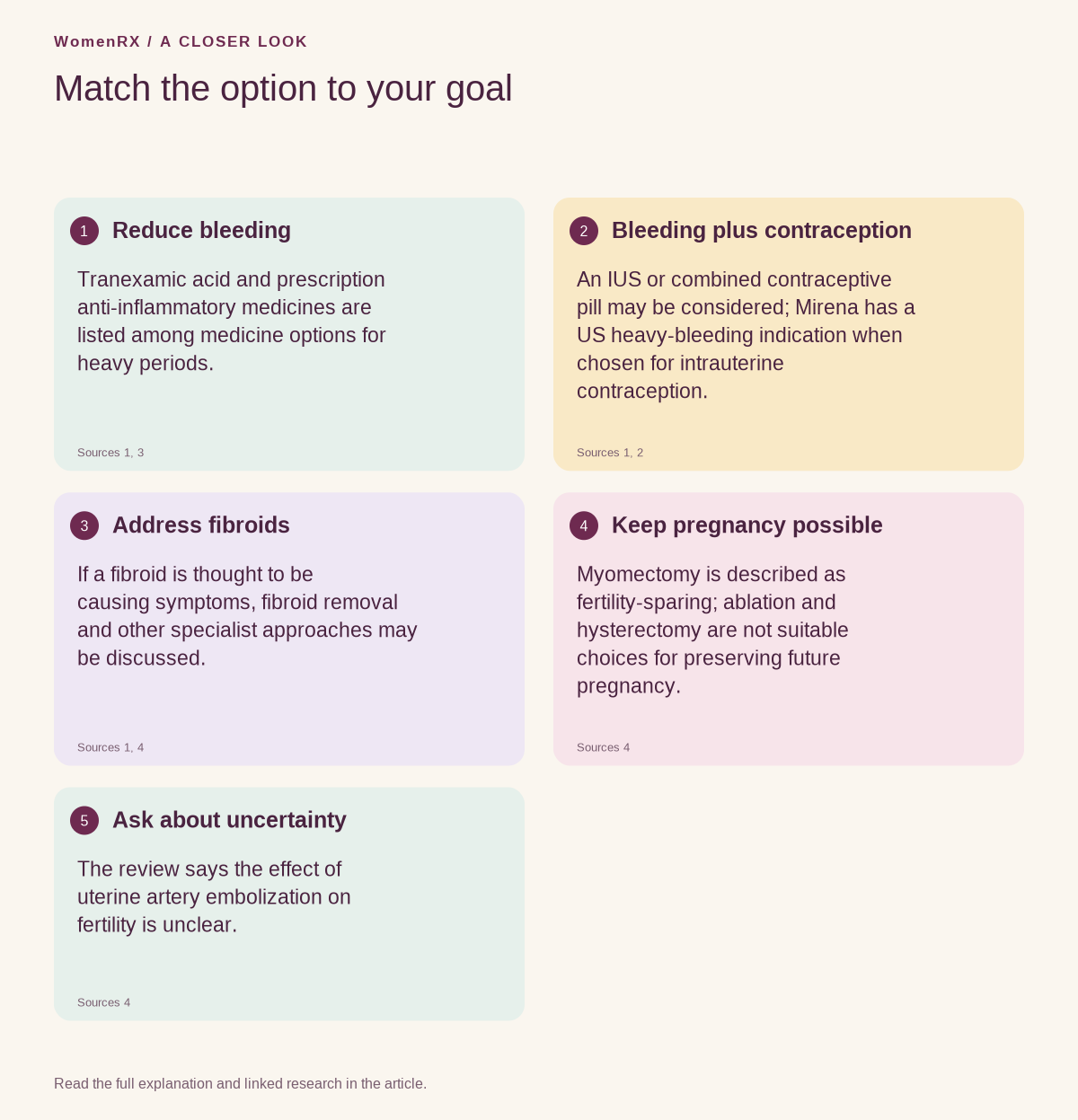
Match the option to your goal
Reduce bleeding: Tranexamic acid and prescription anti-inflammatory medicines are listed among medicine options for heavy periods.13
Bleeding plus contraception: An IUS or combined contraceptive pill may be considered; Mirena has a US heavy-bleeding indication when chosen for intrauterine contraception.12
Address fibroids: If a fibroid is thought to be causing symptoms, fibroid removal and other specialist approaches may be discussed.14
Keep pregnancy possible: Myomectomy is described as fertility-sparing; ablation and hysterectomy are not suitable choices for preserving future pregnancy.4
Ask about uncertainty: The review says the effect of uterine artery embolization on fertility is unclear.4
Read the figure as text
These broad categories can overlap. The choice depends on the suspected cause, your priorities, and whether future pregnancy matters.- Reduce bleeding: Tranexamic acid and prescription anti-inflammatory medicines are listed among medicine options for heavy periods.13
- Bleeding plus contraception: An IUS or combined contraceptive pill may be considered; Mirena has a US heavy-bleeding indication when chosen for intrauterine contraception.12
- Address fibroids: If a fibroid is thought to be causing symptoms, fibroid removal and other specialist approaches may be discussed.14
- Keep pregnancy possible: Myomectomy is described as fertility-sparing; ablation and hysterectomy are not suitable choices for preserving future pregnancy.4
- Ask about uncertainty: The review says the effect of uterine artery embolization on fertility is unclear.4
More questions, answered
Can a fibroid found on a scan be the cause of heavy periods?
It may be, but not every fibroid causes symptoms. Ultrasound can help show a fibroid’s location and size, and those details can help determine whether it may be contributing to bleeding. 4
What if heavy periods started with my first periods?
Heavy bleeding in adolescents can be related to ovulatory changes, and it can also be a sign of an inherited bleeding disorder. That possibility is worth raising during an evaluation, especially when heavy bleeding has been present from the start of menstruation. 6
Sources you can check
- Heavy periods - NHSAccessed 2026-09-25Return to first citation
- MIRENA (LEVONORGESTREL) INTRAUTERINE DEVICE [BAYER HEALTHCARE PHARMACEUTICALS INC.] | US prescribing information and patient instructionsAccessed 2026-09-25Return to first citation
- About tranexamic acid - NHSAccessed 2026-09-25Return to first citation
- The efficacy of medical management of leiomyoma-associated heavy menstrual bleeding: a mini review.Barseghyan M, Chae-Kim J, Catherino WH. · F&S reports · 2024Return to first citation
- Heavy menstrual bleeding in women with inherited bleeding disorders.Djambas Khayat C, Gouider E, von Mackensen S, Abdul Kadir R. · Haemophilia : the official journal of the World Federation of Hemophilia · 2020Return to first citation
- Call to action: identifying an underlying bleeding disorder in adolescents with heavy menstrual bleeding.Gupta S, Castaman G, Funkhouser K, Lewandowska M, Weyand AC, Di Michele S, Fulghesu AM, Gaudreau H, Shapiro AD. · Research and practice in thrombosis and haemostasis · 2026Return to first citation