Estradiol patch, pill, or gel: what differences matter when choosing a route?
The best route depends on how you’ll use it, your health history, and whether your uterus needs protection, not on a one-size-fits-all ranking.
Pills are taken by mouth and pass through the digestive system and liver; patches and gels deliver estradiol through the skin. That difference can matter when weighing clot risk, but route is only one part of the decision. Practical fit matters too: patches use adhesive, while gel can transfer through skin contact. If you have a uterus, systemic estrogen generally needs progestogen for endometrial protection, whichever route you use. 1 3 4 5 6 7
The route changes the path, not the whole risk picture
Oral estradiol is absorbed through the digestive system and reaches the liver before entering general circulation. Estradiol delivered through a patch or gel crosses the skin and avoids that first-pass route through the liver. This affects how the body processes estrogen, but it does not by itself determine whether hormone therapy is a good fit for you. 1 2 4 5
Blood-clot risk is one reason route comes up in treatment discussions. A 2025 systematic review looked at menopause hormone therapy in women with risk factors for venous blood clots. Across 10 included studies, transdermal estrogen was not associated with increased clot risk in the higher-risk population studied, while oral estrogen with a progestogen was associated with increased relative risk. The studies differed in their populations, treatments, and methods, so the finding does not establish zero risk or prove that every patch or gel is suitable for every person. 7
Overall risks also depend on factors such as the treatment, timing, duration, and whether a progestogen is used. The North American Menopause Society recommends individualizing hormone therapy and periodically reassessing its benefits and risks. 6
What each format asks of your routine
A pill is taken by mouth, so it avoids patch adhesive and handling gel. Its route does involve digestion and first-pass liver metabolism. When considering a pill, think about whether taking it by mouth fits comfortably into your regular routine. 4 5
A patch is an adhesive system worn on intact skin. Patch schedules vary by product: the Climara label describes continuous estradiol delivery over a seven-day treatment period, but that schedule shouldn’t be assumed for every patch. Skin sensitivity, adhesive comfort, and whether wearing a patch fits your routine are reasonable practical questions to consider. 1
A gel is applied to the skin rather than swallowed or worn as an adhesive. It may suit someone who prefers not to wear a patch, but it introduces a transfer consideration: a small hospital-based study measured estradiol contamination after skin contact with gel-treated skin. The study measured skin contamination, not health effects in people exposed through contact. Ask about the handling and contact precautions for the specific product you’re considering, especially if close skin contact is part of your daily routine. 3
The dose isn’t a simple route-to-route swap
The number printed on an oral product, patch, or gel is not a reliable do-it-yourself conversion between routes. The patch label describes a product-specific delivery rate, while a pharmacokinetic study of 10 postmenopausal women found that gel doses produced different estradiol blood levels. Those findings show that delivery depends on the formulation and dose; they do not provide a conversion formula. 1 2
If symptoms aren’t improving or side effects are troublesome, that’s a reason to revisit the treatment plan rather than assume another route can be substituted at the same number of milligrams. The intended treatment, formulation, and response all matter.
Your uterus is a separate part of the decision
If you have a uterus, systemic estrogen generally needs progestogen to protect the uterine lining. A patch or gel doesn’t remove that consideration just because it bypasses the digestive system. Treatment plans may use separate estrogen and progestogen medicines. If you’ve had a hysterectomy, estrogen-alone treatment may be considered, but your personal risks and treatment goals still matter. 4 5
A useful way to choose
Think about the choice in two layers. First, discuss whether systemic estradiol fits your health history, symptoms, and goals, including any clot-risk concerns and whether you need endometrial protection. Then compare the routines: swallowing a pill, wearing an adhesive patch, or applying gel with attention to possible skin transfer. Ask how the risks of the specific treatment relate to your circumstances, and what to do if the chosen format is hard to use or doesn’t help enough. No route is best for everyone; the choice should be individualized and revisited over time. 3 4 5 6 7
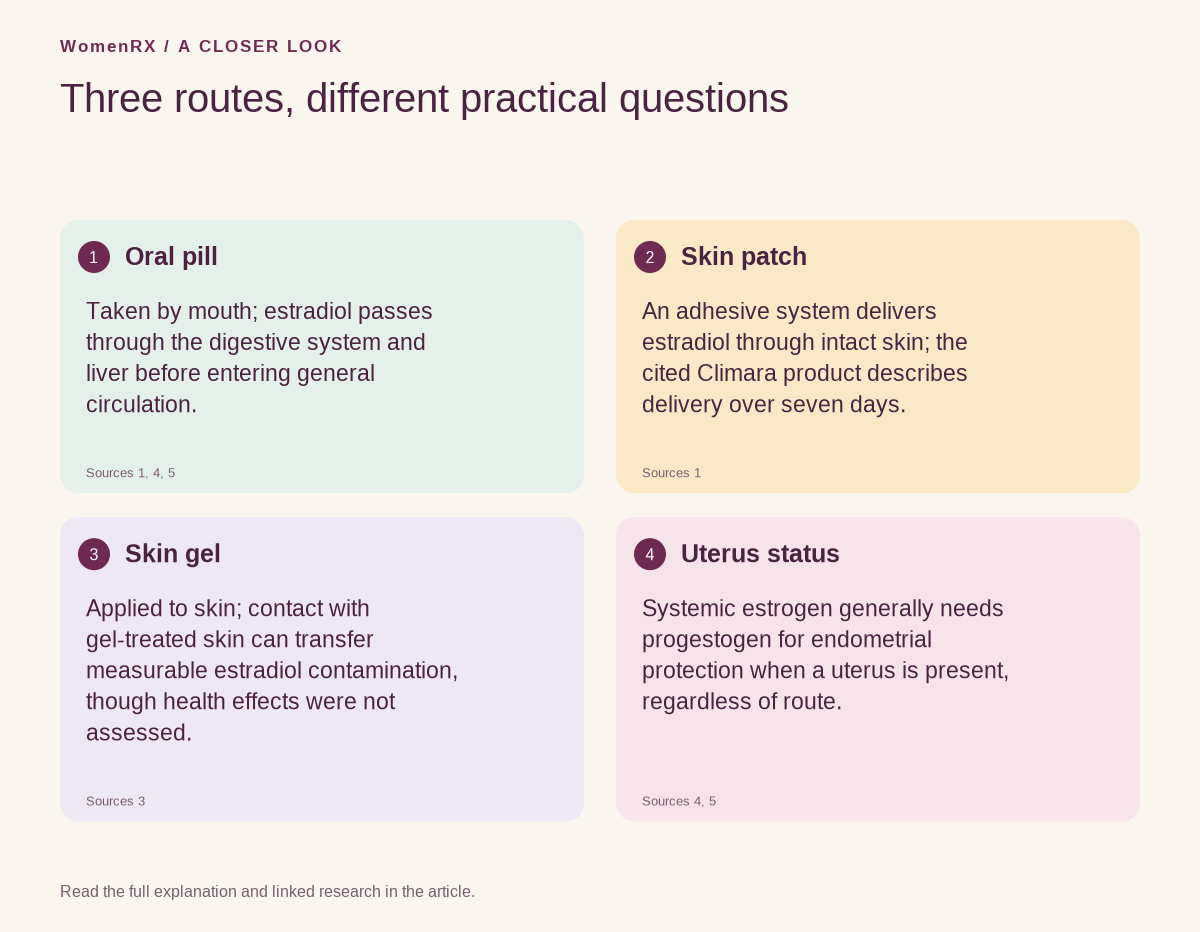
Three routes, different practical questions
Oral pill: Taken by mouth; estradiol passes through the digestive system and liver before entering general circulation.145
Skin patch: An adhesive system delivers estradiol through intact skin; the cited Climara product describes delivery over seven days.1
Skin gel: Applied to skin; contact with gel-treated skin can transfer measurable estradiol contamination, though health effects were not assessed.3
Uterus status: Systemic estrogen generally needs progestogen for endometrial protection when a uterus is present, regardless of route.45
Read the figure as text
Route affects how estradiol is delivered and what to consider in daily use; it does not replace a personal risk assessment or the question of uterine protection.- Oral pill: Taken by mouth; estradiol passes through the digestive system and liver before entering general circulation.145
- Skin patch: An adhesive system delivers estradiol through intact skin; the cited Climara product describes delivery over seven days.1
- Skin gel: Applied to skin; contact with gel-treated skin can transfer measurable estradiol contamination, though health effects were not assessed.3
- Uterus status: Systemic estrogen generally needs progestogen for endometrial protection when a uterus is present, regardless of route.45
More questions, answered
Can I switch from a pill to a patch or gel using the same dose number?
Don’t assume the numbers are interchangeable. A patch has a product-specific delivery rate, and a small gel study found that different gel doses produced different blood levels. Ask for a route-specific treatment plan rather than converting the number yourself. 1 2
Does using estradiol through the skin mean there’s no clot risk?
No. A systematic review found no increased venous-clot risk with transdermal estrogen in the higher-risk populations studied, but the studies differed in their populations and treatments. That finding doesn’t establish zero risk for every person or product. Your overall risk still needs to be considered individually. 6 7
Sources you can check
- CLIMARA (ESTRADIOL) PATCH [BAYER HEALTHCARE PHARMACEUTICALS INC.] | US prescribing information and patient instructionsAccessed 2026-09-25Return to first citation
- Study on the Pharmacokinetics and Pharmacodynamics of Transdermal Estradiol Gel Administered Repeatedly in Postmenopausal Women.Sirviö J, Ahtola-Sätilä T, Kirjavainen M, Rytilä P. · Drugs in R&D · 2026Return to first citation
- Avoiding touching until 60 min-contamination of transdermal estradiol gel after physical contact.Cao Y, Zhang L, Wei J, Liao J. · Frontiers in endocrinology · 2025Return to first citation
- The Effects of Menopausal Hormone Therapy on Serum Level of C-reactive Protein in Postmenopausal Korean Women.Shin W, Kim SE, Lee JY, Seo JW, Hyun HS, Suh JH, Choi D, Yoon BK. · Journal of menopausal medicine · 2019Return to first citation
- Effects of Hormone Therapy on Serum Lipid Levels in Postmenopausal Korean Women.Lee JY, Hyun HS, Park HG, Seo JH, Lee EY, Lee JS, Lee DY, Choi DS, Yoon BK. · Journal of menopausal medicine · 2015Return to first citation
- The 2022 hormone therapy position statement of The North American Menopause Society.“The 2022 Hormone Therapy Position Statement of The North American Menopause Society” Advisory Panel. · Menopause (New York, N.Y.) · 2022Return to first citation
- Safety of menopause hormone therapy in postmenopausal women at higher risk of venous thromboembolism: a systematic review.Hicks A, Robson D, Tellis B, Smith S, Dunkley S, Baber R. · Climacteric : the journal of the International Menopause Society · 2025Return to first citation