Perimenopause vs Menopause: What’s the Difference?
Perimenopause is the transition; menopause is identified after 12 months without a period, when menstrual history can be used reliably.
Perimenopause is the transition when menstrual cycles change. In a typical situation, the last menstrual period is identified as the final one only retrospectively, after 12 consecutive months without another period in a compatible age group, generally after 45. A period-free interval alone doesn’t establish why periods stopped. Hormonal contraception, hysterectomy, and some cancer treatments can make bleeding history unreliable. 2 3
The difference is a transition versus a milestone
Perimenopause is the transition during which menstrual cycles change. Menopause is identified retrospectively: in a typical situation, the last menstrual period is recognized as the final one only after 12 consecutive months have passed without another period, in a compatible age group, generally after age 45. 2 3
That means one missed period doesn’t establish menopause. If bleeding returns before 12 months have passed, the usual 12-month count has not yet been met. And even a full year without bleeding doesn’t, by itself, explain why periods stopped; the calendar rule applies when the menstrual history fits a typical menopause transition. Symptoms can happen during the transition, but they don’t tell you the date of your final menstrual period.
When the calendar can’t identify the final period
The 12-month rule depends on being able to use natural menstrual history. Some situations make that difficult or impossible:
- Hormonal contraception: Some hormonal methods are specifically included in menopause-diagnosis guidance because bleeding history may not establish whether natural menopause has occurred. The cited guideline says hormone tests and pelvic ultrasound aren’t recommended to diagnose menopause in people using the hormonal methods it discusses, or to decide when to stop contraception. 2
- Hysterectomy: If the uterus has been removed, there’s no menstrual bleeding to track. The guideline describes repeat FSH and estradiol testing as a possible way to orient assessment in this situation, rather than applying the standard calendar rule. 2
- Cancer treatment that affects ovarian function: After gonadotoxic treatment, the guideline says 12 months without periods can’t establish menopause with certainty; it also says no further examination can be recommended to make a definite diagnosis in that situation. 2
These are reasons to interpret the pattern in context, not to treat any single test as a universal answer. In a typical situation after age 45, menopause is a clinical diagnosis and hormone testing or imaging isn’t indicated to make it. 2
What bleeding after menopause means
If bleeding occurs after menopause has been established from reliable menstrual history, don’t assume it’s simply a return of irregular cycles. Even a single episode of spotting or pink or brown discharge after menopause should be checked. 1
The practical distinction is timing and context: bleeding that returns before the 12 months are complete means the usual definition hasn’t yet been met. If a typical menstrual history has established menopause, later bleeding is a different situation and warrants evaluation. A 12-month gap that can’t reliably be interpreted as menopause needs clinical context before that postmenopausal label applies. 1 2
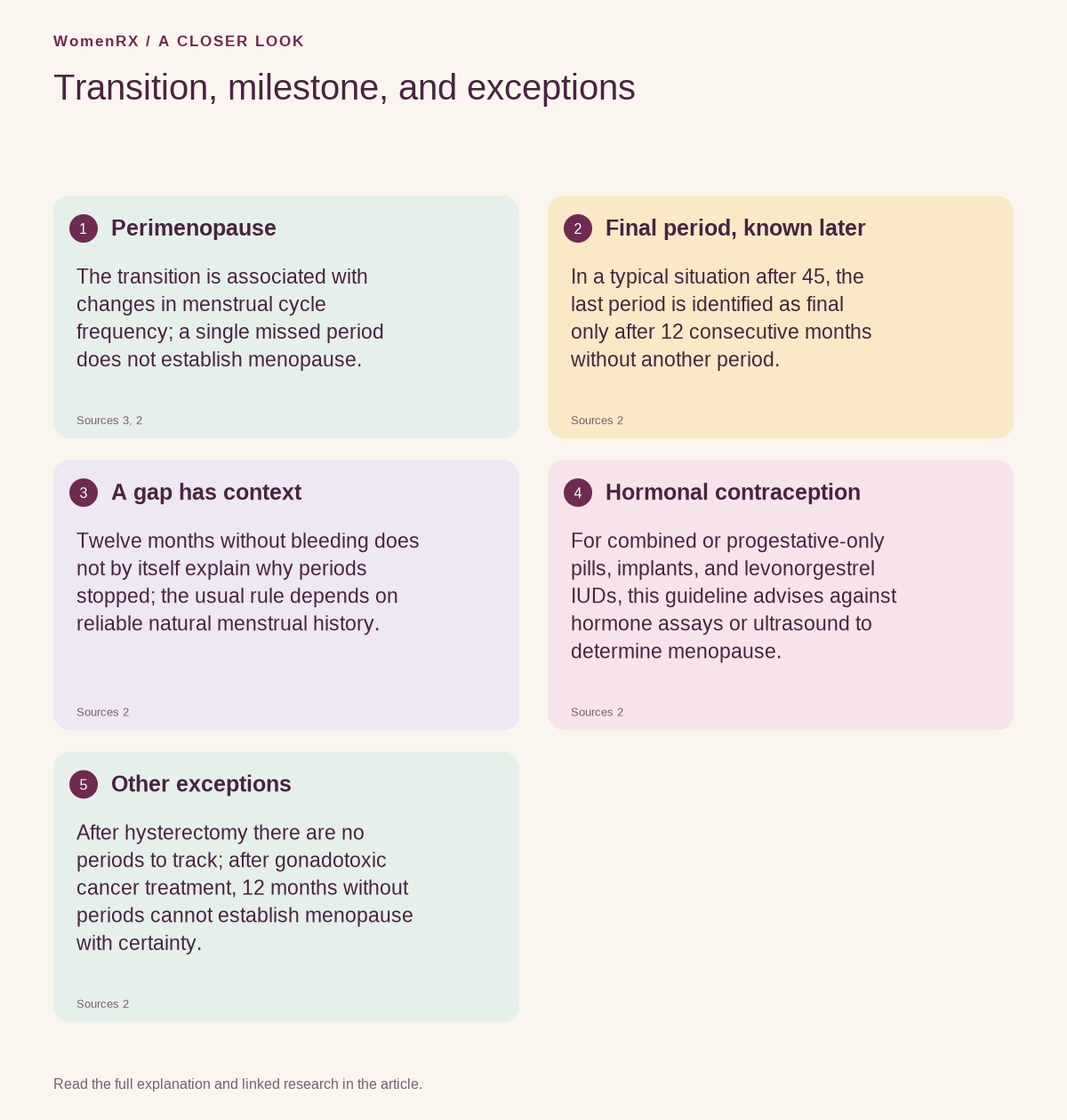
Transition, milestone, and exceptions
Perimenopause: The transition is associated with changes in menstrual cycle frequency; a single missed period does not establish menopause.32
Final period, known later: In a typical situation after 45, the last period is identified as final only after 12 consecutive months without another period.2
A gap has context: Twelve months without bleeding does not by itself explain why periods stopped; the usual rule depends on reliable natural menstrual history.2
Hormonal contraception: For combined or progestative-only pills, implants, and levonorgestrel IUDs, this guideline advises against hormone assays or ultrasound to determine menopause.2
Other exceptions: After hysterectomy there are no periods to track; after gonadotoxic cancer treatment, 12 months without periods cannot establish menopause with certainty.2
Read the figure as text
The 12-month rule is useful when natural menstrual history can be followed. These distinctions show when that calendar does and doesn’t answer the question.- Perimenopause: The transition is associated with changes in menstrual cycle frequency; a single missed period does not establish menopause.32
- Final period, known later: In a typical situation after 45, the last period is identified as final only after 12 consecutive months without another period.2
- A gap has context: Twelve months without bleeding does not by itself explain why periods stopped; the usual rule depends on reliable natural menstrual history.2
- Hormonal contraception: For combined or progestative-only pills, implants, and levonorgestrel IUDs, this guideline advises against hormone assays or ultrasound to determine menopause.2
- Other exceptions: After hysterectomy there are no periods to track; after gonadotoxic cancer treatment, 12 months without periods cannot establish menopause with certainty.2
More questions, answered
Does one FSH test tell me that I’m in menopause?
Not in a typical situation after age 45. The cited guideline describes menopause as a clinical diagnosis based on 12 consecutive months without periods and says hormone testing isn’t indicated for that usual diagnosis. Special circumstances, such as hysterectomy, need separate interpretation. 2
What if bleeding returns after 12 months without a period?
If reliable menstrual history has established menopause, bleeding afterward should be checked, even if it’s only one episode of spotting. If periods stopped for a reason that makes the calendar rule unreliable, the 12-month gap alone doesn’t establish postmenopausal bleeding, so the situation needs clinical interpretation. 1 2
Sources you can check
- Postmenopausal bleeding - NHSAccessed 2026-09-25Return to first citation
- [How to diagnose menopause? Postmenopausal women management: CNGOF and GEMVi clinical practice guidelines].Rousset-Jablonski C. · Gynecologie, obstetrique, fertilite & senologie · 2021Return to first citation
- Prevalence and severity of symptoms across the menopause transition: cross-sectional findings from the Australian Women's Midlife Years (AMY) Study.Islam RM, Bond M, Ghalebeigi A, Wang Y, Walker-Bone K, Davis SR. · The lancet. Diabetes & endocrinology · 2025Return to first citation