Perimenopause: What Changes and What Comes Next
Perimenopause is a transition in reproductive aging, usually recognized through changing period patterns rather than one hormone test.
Perimenopause is the time around the final menstrual period when ovarian function and menstrual cycles are changing. In reproductive staging, it includes the menopause transition and the first year after the final period. Changes in cycle timing are a more useful guide than a single FSH or estradiol result, but symptoms and circumstances vary. Pregnancy can still be possible, and menopause hormone therapy isn’t contraception. 34813
Start with the pattern, not a symptom list
Perimenopause doesn’t begin with one particular hot flash, mood change, or birthday. It describes a stage of reproductive aging around the final menstrual period. Researchers primarily identify the transition by changes in bleeding patterns, with hormone measurements playing a supporting role. That makes your cycle history more informative than a snapshot of how you feel on any one day. 3
In the early menopause transition, the length of successive cycles begins to differ persistently. The STRAW+10 staging criteria define that pattern as a difference of at least seven days between consecutive cycles that recurs within ten cycles. The late transition is marked by a stretch of at least 60 days without a period. These are descriptions of reproductive stages, not a home diagnostic score: a change in bleeding still needs to be understood in the context of your health and any contraception or treatment you use. 3
The terminology can be surprising. In STRAW+10, perimenopause includes both the transition before the final menstrual period and the first year afterward. You only know which period was the final one in hindsight. 3 There’s no single experience or duration that applies to everyone. 13
Why a hormone test may not settle it
Estradiol and follicle-stimulating hormone, usually shortened to FSH, change during this transition. A single result can be difficult to interpret because levels fluctuate across cycles. Hormone measurements may add context in some assessments, but they don’t replace the history of changing periods. That’s why a result that looks ordinary on one day doesn’t necessarily answer the question, “Am I in perimenopause?” 34
Symptoms can add another piece of the picture without defining the stage on their own. Some women report forgetfulness or trouble concentrating. A review found that cognitive experiences vary, and that sleep problems, depression, and hot flashes may be associated with cognitive difficulties. That doesn’t mean every lapse in concentration is caused by perimenopause or that hormone therapy has been shown to treat it. 25
Sleep is another example of why the distinction matters. Night sweats may wake you, but insomnia can also occur without them. Treating hot flashes may help sleep when the two are connected, yet it may not address every reason you’re awake. Research directly comparing approaches for insomnia specifically in perimenopausal women is still developing; a published study protocol is a plan to test treatments, not evidence that one worked better. 6
Two questions that change the next step
Could pregnancy still matter to you? Irregular or widely spaced periods don’t by themselves mean pregnancy is no longer possible. Menopause hormone therapy does not act as contraception. If avoiding pregnancy matters, keep that discussion separate from decisions about symptom treatment rather than assuming one will take care of the other. 8
Is the bleeding unexplained? Cycle timing can change during the transition. If you have unexplained vaginal bleeding, raise it before starting systemic estrogen treatment. 9 After menopause, vaginal bleeding should be checked whether or not you use estrogen; don’t assume it’s part of the transition. 13
For example, if your periods are farther apart and you’re considering treatment for night sweats, those are two related but different conversations. The cycle pattern helps place you in the transition; the effect of the night sweats on your life helps clarify what you want treatment to address. If pregnancy prevention matters, that needs its own plan. 368
Treatment depends on the problem you want to solve
You don’t need one treatment for every possible perimenopause symptom. If hot flashes are the main problem, systemic estrogen is one treatment to discuss. 11 If night sweats are waking you, consider the sleep problem too: addressing symptoms that wake you may not resolve every cause of insomnia. 6 Whether you have a uterus changes the estrogen discussion: estrogen used without a progestogen increases the risk of changes to the uterine lining, while adding a progestogen helps protect it. Your medical history matters too; estrogen treatment isn’t suitable for everyone. 19
If vaginal dryness or irritation is the main concern, vaginal estrogen is a more targeted option. It acts primarily in the vagina and is used to relieve those local symptoms. That’s a different decision from taking systemic hormone therapy for symptoms such as hot flashes. Neither choice substitutes for contraception. 108
If sleep or concentration is the concern, it’s worth getting specific about what happens. Are you waking with night sweats, having trouble falling asleep, or struggling to focus after poor sleep? Those distinctions can point toward different discussions. Evidence on cognitive changes during perimenopause is mixed across studies, and a review reports that hormone therapy is not recommended specifically to treat cognitive problems. 625
This overview also has a boundary: the gradual, cycle-based transition isn’t the same as having both ovaries removed before natural menopause. That surgery causes surgical menopause and can have different effects on sleep, sexual function, mood, and bone health. If that’s your situation, a standard account of increasingly irregular periods won’t describe your path. 7
For further reading, choose the subject that fits your question. If you’re trying to place yourself in the transition, that subject is changing period patterns. 3 If pregnancy prevention matters, explore contraception during perimenopause separately from symptom treatment: menopause hormone therapy isn’t contraception. 8 For symptom relief, follow the problem you most want to improve: hot flashes and night sweats may lead to a discussion of systemic estrogen for hot flashes 11 and of how night sweats affect sleep 6; insomnia deserves attention even when night sweats aren’t involved 6; and vaginal dryness or irritation has a local treatment option that doesn’t treat hot flashes or sleep problems. 12 If you have vaginal bleeding after menopause, seek assessment whether or not you use estrogen. 13
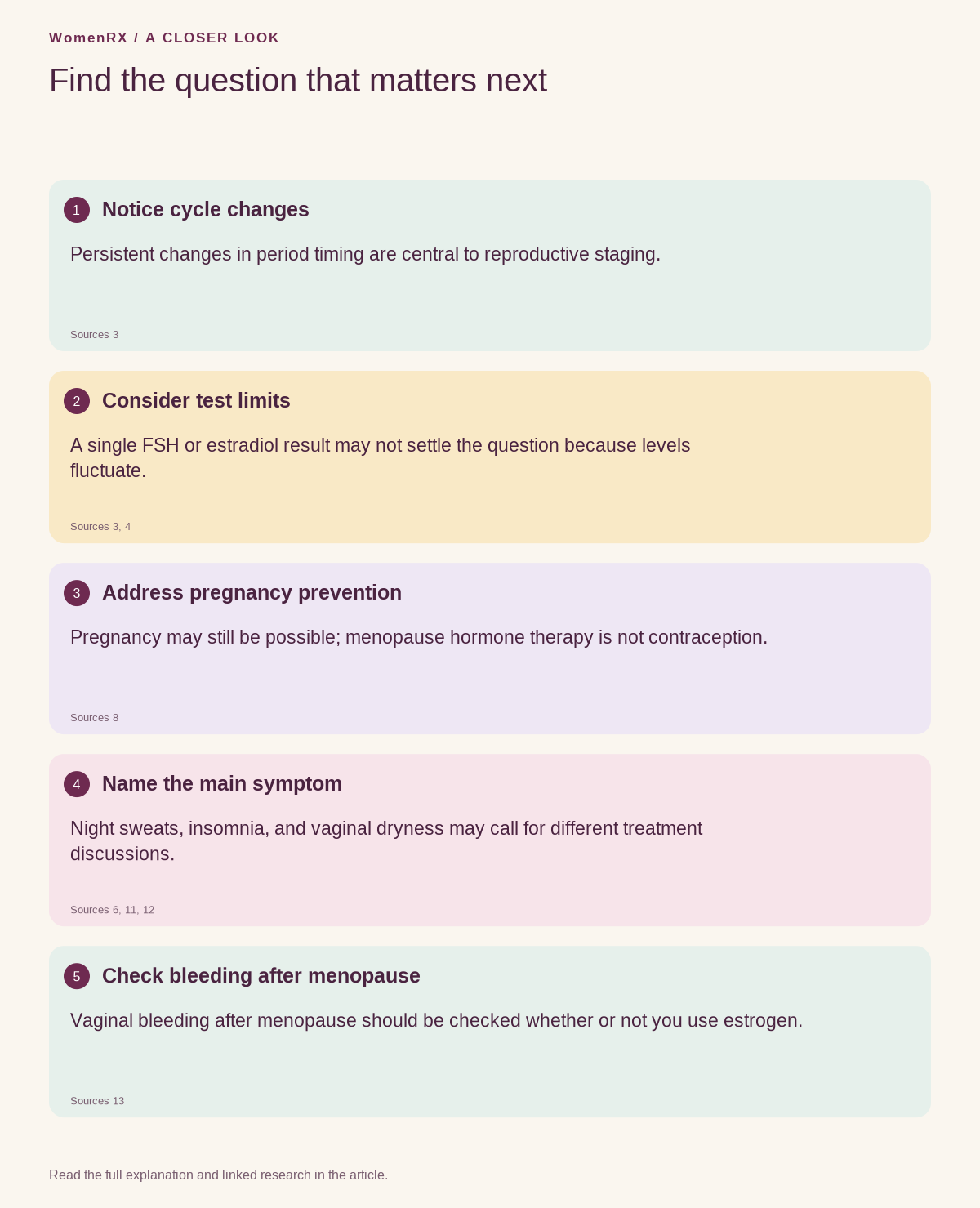
Find the question that matters next
Notice cycle changes: Persistent changes in period timing are central to reproductive staging.3
Consider test limits: A single FSH or estradiol result may not settle the question because levels fluctuate.34
Address pregnancy prevention: Pregnancy may still be possible; menopause hormone therapy is not contraception.8
Name the main symptom: Night sweats, insomnia, and vaginal dryness may call for different treatment discussions.61112
Check bleeding after menopause: Vaginal bleeding after menopause should be checked whether or not you use estrogen.13
Read the figure as text
Cycle changes can help identify the transition, but pregnancy prevention and symptom treatment are separate decisions.- Notice cycle changes: Persistent changes in period timing are central to reproductive staging.3
- Consider test limits: A single FSH or estradiol result may not settle the question because levels fluctuate.34
- Address pregnancy prevention: Pregnancy may still be possible; menopause hormone therapy is not contraception.8
- Name the main symptom: Night sweats, insomnia, and vaginal dryness may call for different treatment discussions.61112
- Check bleeding after menopause: Vaginal bleeding after menopause should be checked whether or not you use estrogen.13
More questions, answered
Can regular periods rule out perimenopause?
If your periods remain consistently regular, the STRAW+10 bleeding criteria do not identify you as being in the menopause transition. Symptoms alone cannot establish that stage. STRAW+10 also includes the first year after the final menstrual period in its definition of perimenopause. 3
Will an FSH or estradiol test confirm it?
Usually, one measurement won’t give a definitive answer because hormone levels fluctuate. Bleeding history is the primary basis of STRAW+10 staging, with hormone results serving as supporting information. 34
Sources you can check
- CLIMARA PRO (ESTRADIOL AND LEVONORGESTREL) PATCH [BAYER HEALTHCARE PHARMACEUTICALS INC.] | US prescribing information and patient instructionsAccessed 2026-09-25Return to first citation
- Cognitive functioning in perimenopause: An updated systematic review and meta-analysis.Bangle A, Williams D, Walters J, Nguyen L. · Psychology and aging · 2026Return to first citation
- Considerations and practical recommendations for identifying perimenopause in longitudinal research.Huibregtse ME, Taylor L, Prochaska T, Arnold AR, Epperson CN, Chahine EB, Smith AK, Powers A, Michopoulos V, Stevens JS. · Psychoneuroendocrinology · 2026Return to first citation
- Clinical Indicators for Perimenopausal Hormone Replacement Therapy: An Evidence-Based Narrative Review.Luo Y, Liang M, Gao Y, Wang X, Li Y. · Nigerian journal of clinical practice · 2026Return to first citation
- Cognitive Problems in Perimenopause: A Review of Recent Evidence.Metcalf CA, Duffy KA, Page CE, Novick AM. · Current psychiatry reports · 2023Return to first citation
- No more sleepless nights in perimenopause-an open-label, randomized, parallel-group, active controlled intervention study in perimenopausal women with vasomotor symptoms and insomnia to investigate the efficacy of hormone replacement therapy and cognitive behavioral therapy for the treatment of insomnia: study protocol.Pavicic E, Stute P, Rudzik F, Urech A, Lozza-Fiacco S. · Trials · 2025Return to first citation
- What Happens After Menopause (WHAM)? A Progress Report of a Prospective Controlled Study of Women After Pre-Menopausal Risk-Reducing Bilateral Salpingo-Oophorectomy.Price SAL, Maki PM, El Khoudary SR, Brand A, Islam RM, Domchek SM, Joffe H, Mishra GD, Moss KM, Baker FC, Braat S, Wark JD, Hickey M. · BJOG : an international journal of obstetrics and gynaecology · 2025Return to first citation
- Pregnancy, breastfeeding and fertility while taking or using oestrogen tablets, patches, gel and spray - NHSAccessed 2026-09-25Return to first citation
- Who can and cannot take or use oestrogen tablets, patches, gel and spray - NHSAccessed 2026-09-25Return to first citation
- Common questions about vaginal oestrogen - NHSAccessed 2026-09-25Return to first citation
- About oestrogen tablets, patches, gel and spray - NHSAccessed 2026-09-25Return to first citation
- About vaginal oestrogen - NHSAccessed 2026-09-25Return to first citation
- Menopause basics | Office on Women's HealthAccessed 2026-09-25Return to first citation