Perimenopause Stages: What Your Cycles Can Tell You
Stage labels describe broad menstrual-pattern changes, not a personal timetable for symptoms or what will happen next.
In the STRAW+10 research framework, early transition is marked by a persistent difference of at least seven days between consecutive cycle lengths; late transition by an interval of 60 days or more without a period. Menopause is identified only after 12 months without menstruation. These patterns help describe reproductive aging, but they cannot predict an individual’s symptom schedule. 1 4
Stages describe patterns, not a countdown
STRAW+10 is a framework for describing reproductive aging in research and clinical settings. It organizes the transition using menstrual patterns and, in some contexts, hormonal and ovarian markers. The goal is to make stages easier to compare, not to tell you exactly when a symptom will start or when your final period will happen. The framework was developed through expert consensus, and its authors noted that important knowledge gaps remain. 4
The menstrual thresholds can still offer a useful broad map. In a study that applied STRAW+10, researchers described regular cycles as premenopause, early transition as a persistent difference of at least seven days between consecutive cycle lengths, late transition as an interval of 60 days or more without a period, and postmenopause as 12 or more months since the last period. 1
That means a single unusually short or long cycle does not, by itself, establish early transition: the difference needs to be persistent. And a stretch of missed periods can mark late transition, but it does not tell you exactly how many periods remain. The 12-month mark identifies menopause retrospectively. 1
Why symptoms don’t follow the stage labels
The stages are anchored mainly to menstrual change, not to a checklist of symptoms. A stage label therefore cannot tell you when you’ll have hot flashes, sleep changes, or mood changes. Even for one specific symptom, experiences don’t necessarily rise and fall in step with stage boundaries: in a longitudinal study of 1,178 Korean women, adjusted analyses found no significant increase in depressive symptoms as women moved between menopausal stages, and researchers observed different symptom trajectories among participants. This finding is about depressive symptoms in that study, not a prediction for every symptom or every woman. 3
So if you recognize a stage pattern, treat it as context rather than a forecast. Your cycle history may suggest where you are in the transition, while your symptoms and their effect on daily life deserve attention in their own right.
When bleeding history is hard to interpret
The bleeding thresholds work best when menstrual patterns can be read clearly. If hormonal contraception or a health condition changes or suppresses bleeding, those patterns may not provide a straightforward basis for assigning a stage. STRAW+10 considered reproductive aging in the context of chronic illness and endocrine disorders, while also acknowledging remaining gaps. 4
That limitation shows up in research design, too. A Brazilian study evaluating STRAW+10 in women with HIV excluded participants using hormonal contraception or hormone replacement therapy, as well as those with ovarian disorders. Its findings therefore do not establish how to classify people in those situations. 2
When your bleeding pattern is not interpretable, don’t force it into a stage label. Symptoms can help describe what you’re experiencing, but they do not replace the cycle-pattern criteria. The framework is most useful when it clarifies a pattern; it is less useful when the pattern has another explanation or is obscured.
A practical way to use the map
If your cycles are still occurring, look for a repeated change in the spacing between them rather than reading meaning into one cycle. If you go 60 days or longer without a period, that fits the late-transition pattern used in STRAW+10; it does not set a date for your final period. And the 12-month definition of menopause is a marker you reach after the fact, not an advance warning of exactly when it will occur. 1
The most useful question may not be “What stage am I in?” but “What does this stage explain, and what does it leave open?” A stage can summarize a broad pattern. It cannot determine your individual symptom course, and it should not be treated as a precise clock.
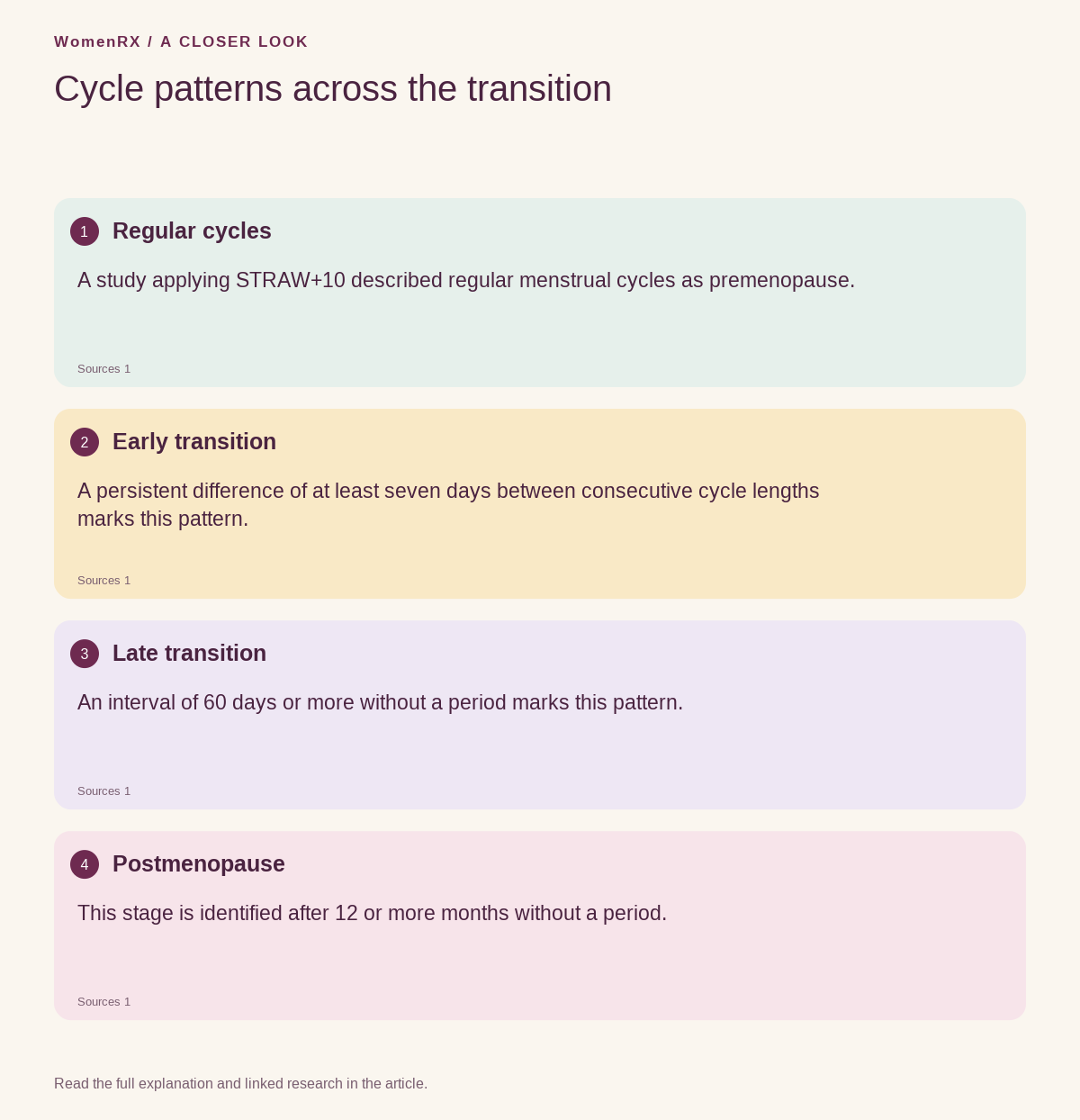
Cycle patterns across the transition
Regular cycles: A study applying STRAW+10 described regular menstrual cycles as premenopause.1
Early transition: A persistent difference of at least seven days between consecutive cycle lengths marks this pattern.1
Late transition: An interval of 60 days or more without a period marks this pattern.1
Postmenopause: This stage is identified after 12 or more months without a period.1
Read the figure as text
This map shows the broad menstrual patterns used in STRAW+10. The thresholds describe research stages, not a schedule for symptoms or a personal countdown.- Regular cycles: A study applying STRAW+10 described regular menstrual cycles as premenopause.1
- Early transition: A persistent difference of at least seven days between consecutive cycle lengths marks this pattern.1
- Late transition: An interval of 60 days or more without a period marks this pattern.1
- Postmenopause: This stage is identified after 12 or more months without a period.1
Sources you can check
- Menopausal stages and non-alcoholic fatty liver disease in middle-aged women.Ryu S, Suh BS, Chang Y, Kwon MJ, Yun KE, Jung HS, Kim CW, Kim BK, Kim YJ, Choi Y, Ahn J, Cho YK, Kim KH, Ahn Y, Park HY, Chung EC, Shin H, Cho J. · European journal of obstetrics, gynecology, and reproductive biology · 2015Return to first citation
- Evaluating the menopausal transition with the STRAW + 10 in a Brazilian cohort of women with HIV, 2015-2016.Jalil EM, Domingues RM, Derrico M, Dias MB, Andrade ACV, Rocha VSO, Nazer S, Feitosa M, Cardoso SW, Veloso VG, Friedman RK, Grinsztejn B. · Climacteric : the journal of the International Menopause Society · 2021Return to first citation
- Longitudinal patterns and group heterogeneity of depressive symptoms during menopausal transition in middle-aged Korean women.Jang Y, Chang Y, Park J, Jeon SW, Seo B, Park JH, Kang J, Kwon R, Lim GY, Kim KH, Kim H, Hong YS, Park J, Zhao D, Cho J, Guallar E, Ryu S. · Epidemiology and psychiatric sciences · 2025Return to first citation
- Executive summary of the Stages of Reproductive Aging Workshop + 10: addressing the unfinished agenda of staging reproductive aging.Harlow SD, Gass M, Hall JE, Lobo R, Maki P, Rebar RW, Sherman S, Sluss PM, de Villiers TJ, STRAW + 10 Collaborative Group. · Fertility and sterility · 2012Return to first citation