Perimenopause Stages and Symptoms: A Flexible Timeline
Cycle changes can offer clues about the menopause transition, but symptoms don’t follow a set schedule.
The menopause transition unfolds in the years leading up to your final menstrual period, but it doesn’t follow a fixed order. You can identify that period as final only after 12 months without another one. In an Australian study’s analysis of women without hot flashes or night sweats, researchers grouped regular periods with changed flow separately from cycles varying by at least 7 days. Those are research categories, not a personal forecast. 2 3
Think patterns, not fixed stages
Perimenopause can feel confusing because there isn’t one symptom or calendar pattern that announces it. Menstrual patterns are used to describe the transition, but research categories aren’t checkpoints every woman passes through in the same order. 2 3
In an Australian survey of women aged 40 to 69, an analysis of 1,039 respondents who reported no hot flashes or night sweats found that a change in menstrual flow by itself wasn’t a clear sign that the menopause transition had begun. Researchers distinguished regular cycles with changed flow from cycles with variation of at least 7 days, which they classified as perimenopausal. These are ways to describe groups in that analysis, not a universal threshold or a test for diagnosing your personal stage. 3
Cycle patterns and symptoms don’t share one schedule
Your periods may stay regular while the flow changes. A difference in flow can happen without establishing that the transition has begun. In the analysis above, regular periods with changed flow were a separate pattern from the group with cycle variation of at least 7 days. 3
Cycle length may vary. In that analysis, researchers used cycle variation of at least 7 days as their definition of a perimenopausal pattern. It gives a concrete example of how researchers describe menstrual changes, but it can’t tell you precisely where you are or when your final period will happen. 3
Symptoms may overlap with menstrual changes. Hot flashes and night sweats can start before the final period and may continue afterward. Earlier research summarized in a SWAN-related paper describes these symptoms appearing about two years before the final menstrual period and persisting as long as eight to ten years beyond it. That’s a range reported in prior research, not a schedule you should expect to follow. 1
The final menstrual period is a turning point you can identify only afterward. Menopause is established once 12 months have passed without a period. Until that full year has passed, a period could still occur. After that point, you’re postmenopausal. 2
Symptoms can be broader than hot flashes
Hot flashes and night sweats are familiar examples, but they aren’t the only experiences reported around this transition. In a large international survey of app users aged 35 and older, fatigue, exhaustion, irritability, low mood, sleep problems, digestive issues, and anxiety were commonly reported. Because the survey relied on self-reports from app users, it can describe experiences but can’t show that menopause caused each symptom or tell you what every woman will experience. 4
You can have perimenopause without hot flashes. A study that specifically examined women without vasomotor symptoms, meaning hot flashes or night sweats, still included people with perimenopausal menstrual patterns. Symptoms may add context, but their absence doesn’t settle the question either way. 3
Use your pattern as information, not a forecast
If you want a clearer picture, note when bleeding starts, how long it lasts, and whether the interval between periods is changing. You can also jot down symptoms and when they show up. The point isn’t to assign yourself a stage from a checklist; it’s to see whether cycle changes and symptoms are forming a pattern over time.
If your experience doesn’t match a neat timeline, that doesn’t mean you’re doing perimenopause wrong. Some women have symptoms without hot flashes or without an obvious early pattern. The most useful map is one that leaves room for variation while recognizing the bigger milestone: menopause is confirmed after 12 months without a period. 2 3
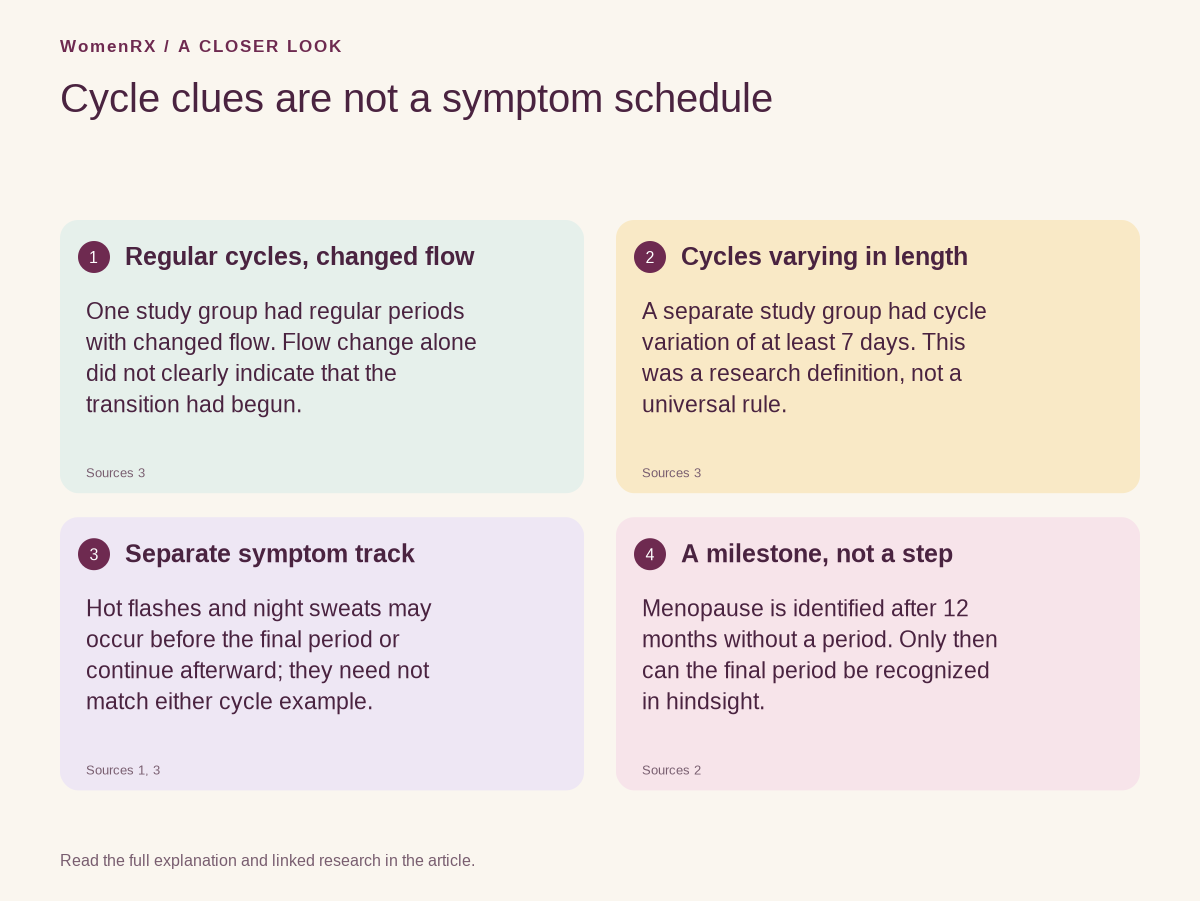
Cycle clues are not a symptom schedule
Regular cycles, changed flow: One study group had regular periods with changed flow. Flow change alone did not clearly indicate that the transition had begun.3
Cycles varying in length: A separate study group had cycle variation of at least 7 days. This was a research definition, not a universal rule.3
Separate symptom track: Hot flashes and night sweats may occur before the final period or continue afterward; they need not match either cycle example.13
A milestone, not a step: Menopause is identified after 12 months without a period. Only then can the final period be recognized in hindsight.2
Read the figure as text
Compare two distinct menstrual patterns, then consider symptoms on a separate, overlapping track. The 12-month milestone identifies menopause afterward; none of these items is a required next step.- Regular cycles, changed flow: One study group had regular periods with changed flow. Flow change alone did not clearly indicate that the transition had begun.3
- Cycles varying in length: A separate study group had cycle variation of at least 7 days. This was a research definition, not a universal rule.3
- Separate symptom track: Hot flashes and night sweats may occur before the final period or continue afterward; they need not match either cycle example.13
- A milestone, not a step: Menopause is identified after 12 months without a period. Only then can the final period be recognized in hindsight.2
More questions, answered
Do you have to have hot flashes to be in perimenopause?
No. Research has identified women with perimenopausal menstrual patterns who did not report hot flashes or night sweats. These symptoms can be part of the picture, but they aren’t required for the transition to be underway. 3
When can you know you’ve reached menopause?
Menopause is identified after 12 months have passed without a period. Before then, a period may still occur, so the final menstrual period can be identified only in hindsight. 2
Sources you can check
- Insulin Levels Early in Perimenopause Inform Vasomotor Symptom Incidence Across the Menopausal Transition.Athar F, Gregory S, Houston EJ, Templeman NM. · The Journal of clinical endocrinology and metabolism · 2026Return to first citation
- Association between vasomotor symptom frequency and weight gain in the Study of Women's Health Across the Nation.Gibson CJ, Shiozawa A, Epstein AJ, Han W, Mancuso S. · Menopause (New York, N.Y.) · 2023Return to first citation
- Symptom profiles in the late reproductive stage, earlier premenopause and early perimenopause in the absence of vasomotor symptoms: a cross-sectional study.Bresolin S, Islam RM, Bond M, Davis SR. · BMJ sexual & reproductive health · 2026Return to first citation
- Global perspectives on perimenopause: a digital survey of knowledge and symptoms using the Flo application.Hedges MS, Hewings-Martin Y, Karam J, Castaneda R, Cunningham AC, Xu Y, Zhaunova L, Faubion SS, Shufelt CL. · Menopause (New York, N.Y.) · 2026Return to first citation