When Perimenopause Starts, and What Can Make It Hard to Tell
Menopause most often happens between 45 and 55, but that age range doesn’t tell you exactly when your own transition began.
There isn’t a single age or date that marks the start of perimenopause. Changes in cycle timing or flow can offer clues, but irregular periods also have other causes, including hormonal contraception, pregnancy, thyroid problems, and PCOS. Menopause usually occurs between 45 and 55; that range doesn’t tell you when perimenopause began. Changes before 45 deserve separate attention. 1 2 4
Menopause age and perimenopause onset are different things
Menopause usually affects women between 45 and 55. Perimenopause is the transition leading up to menopause, but its start varies from person to person. A study of women aged 36 to 45 used reported cycle changes and missed periods to define the start of perimenopause; that was a research definition, not a universal cutoff. 1 4 5
What your menstrual history can tell you
Look for changes from your own usual pattern: whether periods are coming closer together or farther apart, whether flow or duration has changed, or whether periods have stopped. A calendar or diary can help you see the pattern over time. There’s no single cycle change here that proves perimenopause; one study, for example, counted a seven-day change in cycle length, a reported change in flow or duration, or a three-month pause as possible markers. Those were the study’s criteria, not a self-diagnosis rule. 2 5
As an example, someone who notices that cycles have become less predictable can bring a record of start dates and bleeding changes to a medical visit. It can help make the conversation more specific than simply saying, “My periods are irregular.”
Why the pattern may be difficult to read
Irregular periods can happen for reasons other than perimenopause. Pregnancy, hormonal contraception, too much exercise, PCOS, and thyroid problems are among the possibilities identified in clinical guidance. Some hormonal contraceptives, including the progestogen-only pill, injection, and hormonal IUS, can affect bleeding patterns. 2
Surgery matters too, but the details matter: removal of both ovaries can cause surgical menopause. If you’ve had surgery, be specific about what was removed rather than treating every operation as the same. The information here doesn’t establish how other types of surgery affect menstrual-history clues. 1 3
When earlier changes need a closer look
The age definitions here refer to menopause, not the first day of perimenopause. Menopause before 45 is described as early menopause; before 40, it is described as premature menopause. If you’re under 45 and experiencing menopause symptoms or periods stopping, it’s worth discussing the timing with a clinician, since earlier menopause may need separate evaluation. 1
Irregular periods aren’t always a sign of a problem, but a change from your normal pattern is a reasonable reason to seek advice. Guidance also recommends evaluation for bleeding between periods or periods lasting longer than seven days. 2
The practical takeaway: use your cycle history as a clue, not a verdict. Age, bleeding patterns, contraception, possible pregnancy, health conditions, and whether both ovaries were removed can all change how that clue should be interpreted.
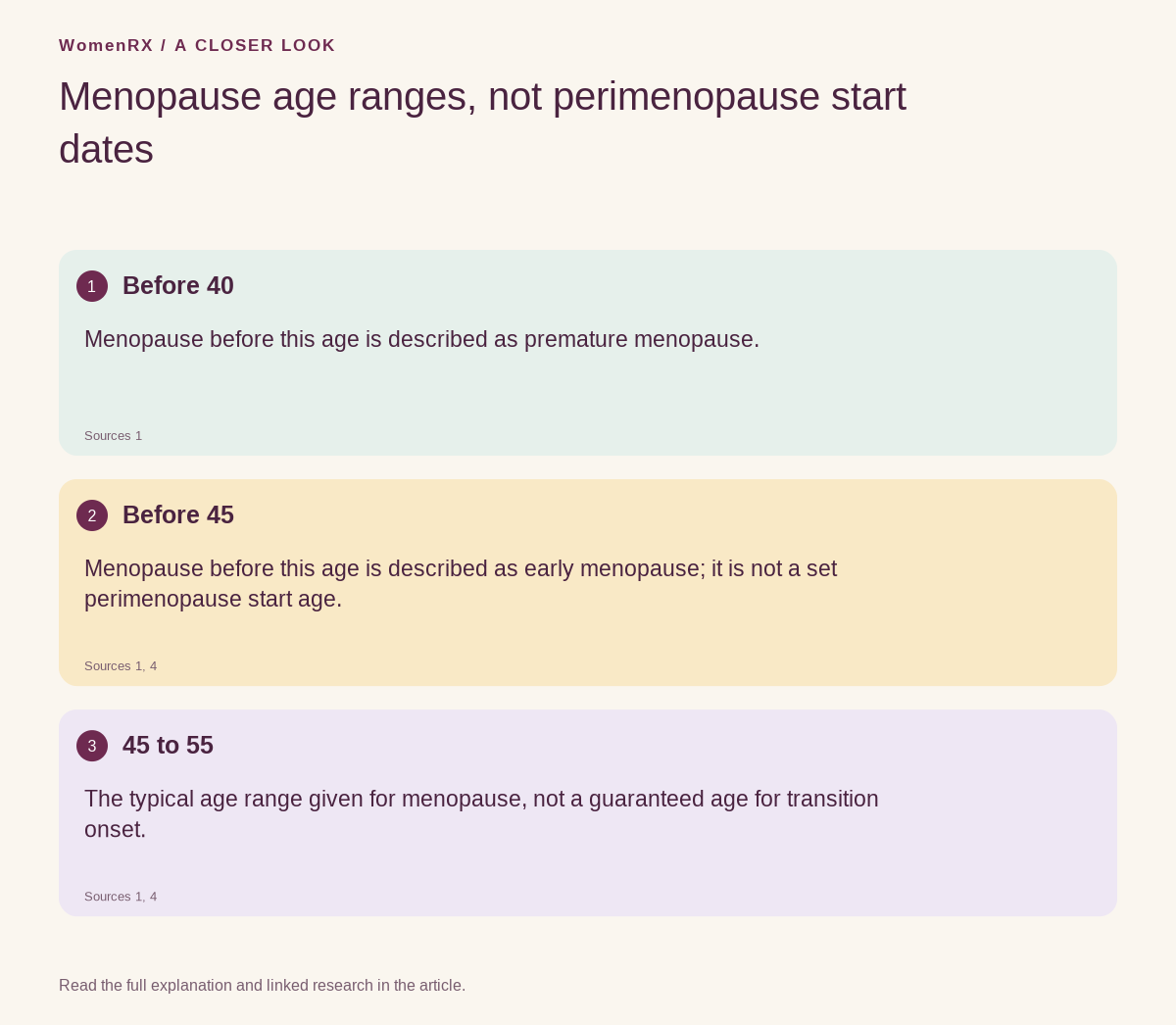
Menopause age ranges, not perimenopause start dates
Before 40: Menopause before this age is described as premature menopause.1
Before 45: Menopause before this age is described as early menopause; it is not a set perimenopause start age.14
45 to 55: The typical age range given for menopause, not a guaranteed age for transition onset.14
Read the figure as text
These age markers distinguish typical, early, and premature menopause without assigning an individual start date to perimenopause.More questions, answered
Does an irregular period mean perimenopause has started?
Not by itself. Irregular periods can occur as menopause approaches, but pregnancy, hormonal contraception, PCOS, thyroid problems, and other factors can also change periods. 2
What counts as early menopause?
Menopause before age 45 is described as early menopause; before age 40, it is described as premature menopause. These ages refer to menopause, not a precise age when perimenopause begins. 1
Sources you can check
- Early or premature menopause - NHSAccessed 2026-09-25Return to first citation
- Irregular periods - NHSAccessed 2026-09-25Return to first citation
- CLIMARA PRO (ESTRADIOL AND LEVONORGESTREL) PATCH [BAYER HEALTHCARE PHARMACEUTICALS INC.] | US prescribing information and patient instructionsAccessed 2026-09-25Return to first citation
- Characteristics of Insurance-Covered Women Newly Diagnosed with Menopause Symptoms and Their Providers in the United States.Sullivan AP, Heo J, Hansen RN, Cameron J, Dow E, Bolling KR, Cameron J, LaRose A, Farej R. · Women's health reports (New Rochelle, N.Y.) · 2026Return to first citation
- Lifetime socioeconomic position in relation to onset of perimenopause.Wise LA, Krieger N, Zierler S, Harlow BL. · Journal of epidemiology and community health · 2002Return to first citation