Perimenopause vs Menopause: How the Stages Differ
Perimenopause is the transition; menopause is identified after 12 months without a period, when menstrual history can be used.
Perimenopause is the transition leading up to menopause, when periods may become irregular or change in flow. Menopause is confirmed retrospectively after 12 months without a period. That calendar definition only works when bleeding history is meaningful: surgery to remove the uterus, some hormonal treatments, or other factors can make periods an unreliable guide. New bleeding after menopause should be evaluated. 1 2 3
The difference is a transition versus a milestone
Perimenopause (also called the menopausal transition) is the time leading up to menopause. Hormone changes during this transition can make periods less predictable: they may come closer together or farther apart, last for a different amount of time, or become lighter or heavier. The transition can last several years. 1
Menopause is a point in time identified after the fact: 12 months have passed without a period. After that point, a person is considered postmenopausal. Menopause is not a single day you can usually identify as it happens; the 12-month mark confirms it retrospectively. 1
What your periods can tell you
Changing periods can fit perimenopause, but a particular change does not tell you exactly when menopause will happen. The menstrual pattern is a record of what your body is doing over time, not a precise countdown. Symptoms such as hot flashes may happen during the transition, too, but symptoms alone don’t establish the date of your final period. 1
A period-free stretch during the transition also doesn’t by itself mean menopause has been reached. The definition depends on completing 12 months without a period, when that history can be interpreted. Menopause timing varies; MedlinePlus says the transition often begins in the 40s and menopause most commonly occurs between ages 45 and 55. 1
When the 12-month rule may not answer the question
The definition relies on being able to track menstrual bleeding. If you’ve had a hysterectomy, you won’t have periods to count, even if your ovaries remain. Removing the uterus alone does not cause menopause; removing both ovaries does. In these situations, menstrual history cannot be used in the usual way, so assessment depends on the surgery and other clinical context. 1
Hormone levels also fluctuate during the transition. A clinical review on contraception in perimenopause says clinical evaluation is relied on to diagnose menopause because of that fluctuation. If hormonal contraception or treatment is affecting whether you bleed, tell your clinician; a period calendar may not settle the question on its own. 2
Bleeding after menopause is different
Once you’ve gone 12 months without a period and menopause has been established, bleeding should not simply be written off as another irregular period. Postmenopausal bleeding is often from a benign cause, but it can sometimes signal a serious uterine problem, so it needs evaluation. Hormone therapy can also be relevant to how bleeding is assessed, so mention it when discussing a new episode. 3
The useful distinction is this: irregular or changing periods can occur during perimenopause; bleeding after established menopause is a new symptom to have assessed. The terms describe different stages, but neither one explains every possible change in bleeding.
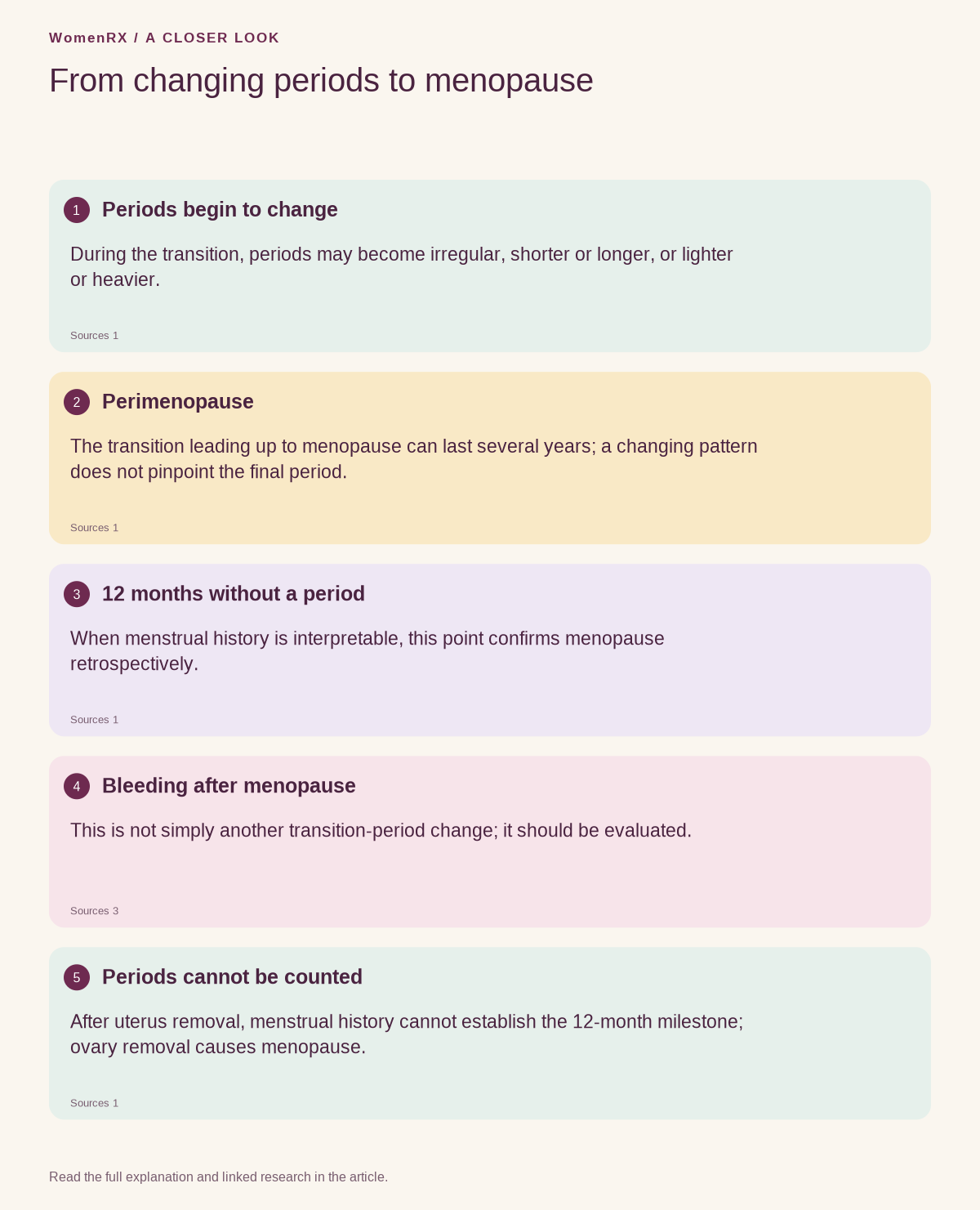
From changing periods to menopause
Periods begin to change: During the transition, periods may become irregular, shorter or longer, or lighter or heavier.1
Perimenopause: The transition leading up to menopause can last several years; a changing pattern does not pinpoint the final period.1
12 months without a period: When menstrual history is interpretable, this point confirms menopause retrospectively.1
Bleeding after menopause: This is not simply another transition-period change; it should be evaluated.3
Periods cannot be counted: After uterus removal, menstrual history cannot establish the 12-month milestone; ovary removal causes menopause.1
Read the figure as text
This timeline separates the years of changing menstrual patterns from the 12-month point used to identify menopause, and shows where that measure may not apply.- Periods begin to change: During the transition, periods may become irregular, shorter or longer, or lighter or heavier.1
- Perimenopause: The transition leading up to menopause can last several years; a changing pattern does not pinpoint the final period.1
- 12 months without a period: When menstrual history is interpretable, this point confirms menopause retrospectively.1
- Bleeding after menopause: This is not simply another transition-period change; it should be evaluated.3
- Periods cannot be counted: After uterus removal, menstrual history cannot establish the 12-month milestone; ovary removal causes menopause.1
More questions, answered
Can you still get pregnant during perimenopause?
Yes. A review on perimenopausal contraception notes that fertility decreases with age but does not disappear until menopause is confirmed. If avoiding pregnancy matters to you, don’t treat irregular periods as proof that pregnancy is no longer possible. 2
Does a hysterectomy always cause menopause?
No. Removing the uterus stops periods, but it does not cause menopause if the ovaries remain. Removing the ovaries does cause menopause. Without periods, the usual 12-month definition cannot be applied using menstrual history. 1
Sources you can check
- Menopause | Menopause Symptoms | MedlinePlusAccessed 2026-09-25Return to first citation
- Contraception and hormonal management in the perimenopause.Long ME, Faubion SS, MacLaughlin KL, Pruthi S, Casey PM. · Journal of women's health (2002) · 2015Return to first citation
- Investigation of women with postmenopausal uterine bleeding: clinical practice recommendations.Munro MG, Southern California Permanente Medical Group’s Abnormal Uterine Bleeding Working Group. · The Permanente journal · 2014Return to first citation