Thyroid Health, Ovulation, and Your Fertility
Clear thyroid dysfunction can disrupt reproductive processes, while a borderline test result needs more context before it can explain trouble conceiving.
Thyroid hormones act in developing ovarian follicles, and clear thyroid dysfunction can disrupt reproductive processes involved in ovulation and conception. A small TSH change is less certain as an explanation for infertility. If you’re trying to conceive, ask how your TSH and thyroid hormone results fit together, whether antibodies add context, and how pregnancy plans affect follow-up. 1345
The difference between thyroid disease and a borderline result
Ovulation depends on an egg developing inside an ovarian follicle before it’s released. Thyroid hormones act in ovarian cells involved in follicle development, and reviews describe clear thyroid dysfunction as affecting reproductive physiology. That gives a reason to assess a known thyroid condition when ovulation is irregular or pregnancy isn’t happening. It doesn’t mean every thyroid abnormality is the cause: thyroid function can also matter at other stages of conception, and fertility problems can have more than one explanation. 3452
The distinction starts with what the tests show together. TSH is usually the first thyroid blood test; T4 and sometimes T3 measure thyroid hormones themselves. A clinician can use that fuller picture to judge whether results indicate clear thyroid dysfunction or a milder change centered on TSH. Reviews describe the reproductive effects of overt thyroid dysfunction more confidently than those of subclinical hypothyroidism, whose role in infertility remains controversial. Thyroid antibodies are another kind of finding: they can help identify autoimmunity, but their presence when thyroid function is otherwise normal does not establish that ovulation is affected. 134
That uncertainty matters because a single TSH cutoff should not be treated as a universal fertility target. A 2026 review notes that levothyroxine has often been started at a TSH of 2.5 mIU/L in preconception care, but says evidence that this threshold improves fertility outcomes is limited. Your result needs interpretation in context, not an automatic treatment decision based on that number alone. 4
What thyroid tests can tell you
TSH is commonly the first blood test used to assess thyroid function. Depending on the result and the question being investigated, testing may also include T4, T3, or thyroid antibodies. Antibody testing can help identify autoimmune thyroid disorders; it does not, by itself, establish that thyroid dysfunction is affecting ovulation. 14
For a useful conversation, bring the actual results and ask what pattern they show: Does testing suggest overt disease, a mild or borderline change, or antibodies with thyroid levels in range? How do your symptoms and medical history fit? If you’re already being treated, ask how your current results relate to your diagnosis and pregnancy plans. The answers may differ from person to person, especially when the test changes are mild. 14
Make pregnancy plans part of the conversation
Tell your care team if you’re trying to conceive or might become pregnant. Thyroid decisions in this setting need to take reproductive context into account, and thyroid dysfunction can also matter for pregnancy outcomes. Ask how your results and care plan should be revisited if you become pregnant, and what follow-up would fit your situation. 34
If you have hyperthyroidism, don’t leave it out of the conversation while focusing on fertility: a 2023 review describes it as needing prompt intervention because of pregnancy-loss concerns. The appropriate approach depends on your individual diagnosis and circumstances, so discuss which treatment and follow-up fit your situation. 3
Keep the fertility question wider than the thyroid
Even when thyroid results are abnormal, other factors may also affect conception. Infertility can involve ovulation, the fallopian tubes or uterus, age-related changes, a partner’s sperm, or more than one factor. If your periods are irregular or you have known fertility concerns, you can raise them before waiting for a thyroid plan to answer every question. MedlinePlus defines infertility as not becoming pregnant after a year of frequent, unprotected sex, or after six months if you’re 35 or older. 2
A useful next step is to ask: “Do my results show a clear thyroid condition, or a borderline finding? How does that relate to my symptoms and plans for pregnancy? What else should we consider about ovulation or fertility?” Those questions keep the focus on your actual health picture rather than on a TSH number alone.
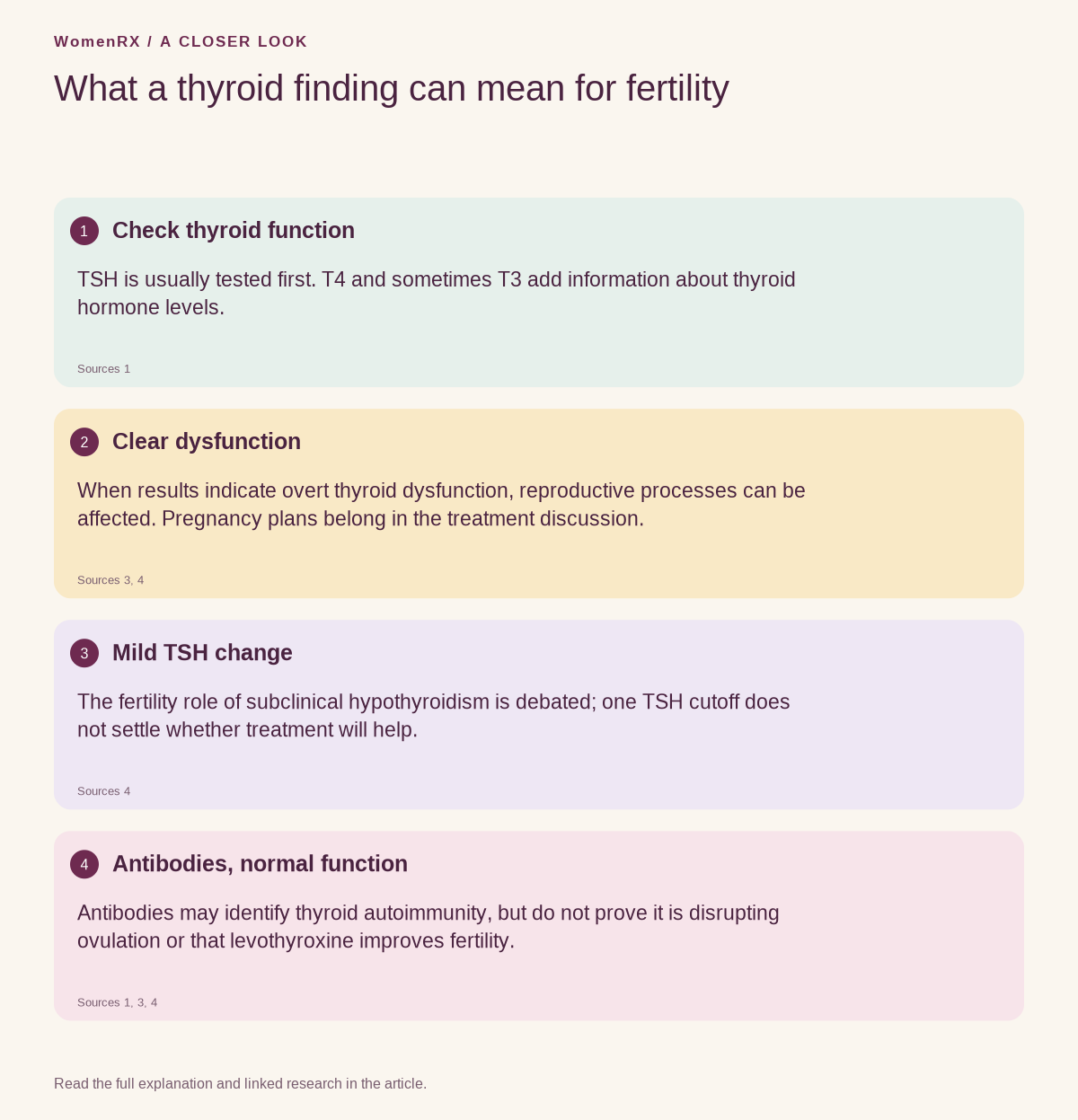
What a thyroid finding can mean for fertility
Check thyroid function: TSH is usually tested first. T4 and sometimes T3 add information about thyroid hormone levels.1
Clear dysfunction: When results indicate overt thyroid dysfunction, reproductive processes can be affected. Pregnancy plans belong in the treatment discussion.34
Mild TSH change: The fertility role of subclinical hypothyroidism is debated; one TSH cutoff does not settle whether treatment will help.4
Antibodies, normal function: Antibodies may identify thyroid autoimmunity, but do not prove it is disrupting ovulation or that levothyroxine improves fertility.134
Read the figure as text
Start with thyroid function tests, then distinguish findings with clearer reproductive relevance from those whose fertility effects are less certain.- Check thyroid function: TSH is usually tested first. T4 and sometimes T3 add information about thyroid hormone levels.1
- Clear dysfunction: When results indicate overt thyroid dysfunction, reproductive processes can be affected. Pregnancy plans belong in the treatment discussion.34
- Mild TSH change: The fertility role of subclinical hypothyroidism is debated; one TSH cutoff does not settle whether treatment will help.4
- Antibodies, normal function: Antibodies may identify thyroid autoimmunity, but do not prove it is disrupting ovulation or that levothyroxine improves fertility.134
More questions, answered
Does a thyroid antibody result mean thyroid treatment will improve fertility?
Not necessarily. Thyroid autoimmunity may be associated with fertility differences, but evidence about outcomes and treatment benefit when thyroid function is normal remains uncertain. An antibody result is one part of the picture, not proof that it is the cause of infertility or that levothyroxine will improve your chances. 34
Which thyroid tests might be discussed?
TSH is usually the first test. T4, T3, or thyroid antibody tests may also be used to assess thyroid function or help identify an autoimmune thyroid disorder, depending on your results and medical context. 1
Sources you can check
- Thyroid Tests: MedlinePlusAccessed 2026-09-25Return to first citation
- Infertility | Infertility Treatments | MedlinePlusAccessed 2026-09-25Return to first citation
- Thyroid dysfunction and female infertility. A comprehensive review.Concepción-Zavaleta MJ, Coronado-Arroyo JC, Quiroz-Aldave JE, Concepción-Urteaga LA, Paz-Ibarra J. · Diabetes & metabolic syndrome · 2023Return to first citation
- Thyroid disorders and female infertility.Unuane D, Velkeniers B, Poppe KG. · The Journal of clinical endocrinology and metabolism · 2026Return to first citation
- Autoimmune Thyroid Disease and Female Fertility: Clinical Evidence on Ovarian Reserve, Infertility Treatment Outcomes, and Pathophysiology.Iwase A, Hasegawa Y, Kitahara Y, Jwa SC, Shirasawa H, Kitajima M, Katagiri Y, Miyuki H, Kazuhiro K, Osuka S. · Reproductive medicine and biology · 2026Return to first citation