Thyroid Conditions: What the Names Mean
Hashimoto’s describes an autoimmune cause, while thyroid blood tests show whether the gland is currently underactive or overactive.
Hypothyroidism means too little thyroid hormone; hyperthyroidism means too much. Hashimoto’s is an autoimmune condition that can lead to hypothyroidism, but antibody results and hormone levels answer different questions. Nodules are lumps assessed with imaging, not a thyroid-function diagnosis. TSH and thyroid hormone blood tests help show how the gland is working, while antibody tests and imaging can help explain why or what else needs assessment. 2 3 4
One gland, two different questions
Thyroid results make more sense when you separate what the gland is doing from what may be causing it. Blood tests such as TSH and T4 assess thyroid function. Antibody tests can help identify an autoimmune condition, and imaging can show the gland’s size, shape, or nodules. These tests are related, but they don’t all measure the same thing. 3
That distinction matters if you have symptoms such as fatigue, weight change, or trouble concentrating. These can occur with hypothyroidism, but they’re nonspecific, so symptoms alone can’t tell you which thyroid condition you have. 4
Underactive thyroid: hypothyroidism
Hypothyroidism means the body isn’t getting enough thyroid hormone. In primary hypothyroidism, a high TSH together with a low free T4 indicates overt underactivity. TSH is made by the pituitary gland and signals the thyroid; when thyroid hormone is low, TSH typically rises as the body tries to prompt more production. 2 4
Hashimoto’s thyroiditis is an autoimmune condition and a common cause of hypothyroidism. But the name “Hashimoto’s” describes the suspected cause, not the current hormone level. Someone can have evidence of thyroid autoimmunity without the same blood-test pattern as someone with overt hypothyroidism. Antibody testing may help identify an autoimmune thyroid disorder; TSH and T4 show how the gland is functioning. 3 4
When hypothyroidism is present, levothyroxine is the first-line treatment described in a 2025 clinical review. Thyroid blood tests are used to guide treatment and avoid too much or too little replacement. 1 4
Overactive thyroid: hyperthyroidism
Hyperthyroidism means the thyroid is producing too much hormone. A low TSH with high T3 and/or T4 commonly points to overactivity, although interpretation depends on the laboratory’s testing method and the person’s circumstances. Symptoms can be part of the assessment, but blood testing is central to confirming the pattern. 2
The next question is often why the thyroid is overactive. Graves’ disease is one common cause; thyroid inflammation can also raise thyroid hormone levels. Antibody tests may help identify Graves’ disease, and a thyroid scan may be used in some cases to investigate the cause or look for nodules. The cause matters because “hyperthyroidism” describes the hormone state, not a single underlying condition. 2 3
Nodules: a finding about structure
A thyroid nodule is a lump in the gland. It isn’t, by itself, a diagnosis of hypothyroidism or hyperthyroidism. Blood tests assess function; ultrasound or a thyroid scan can provide information about the gland’s structure. A scan may also help investigate the cause of hyperthyroidism. 2 3
If a report mentions a nodule, the useful next question is what the imaging showed and what follow-up, if any, is appropriate for that finding. The tests listed here can help assess nodules, but the results need to be interpreted alongside your thyroid function and the specific imaging findings. 3
A practical way to read the labels
Think of the terms as answering separate questions:
- Hypothyroidism: Is thyroid hormone too low?
- Hyperthyroidism: Is thyroid hormone too high?
- Hashimoto’s: Is an autoimmune process a likely cause?
- Nodule: Is there a lump or other structural finding?
More than one description can apply at once. For example, a person may have Hashimoto’s and hypothyroidism, because the autoimmune condition is causing an underactive gland. The labels aren’t interchangeable, though, and one test result may not answer every question. 3 4
What to ask about an abnormal result
A useful discussion starts with the actual numbers and the test names: What were my TSH and free T4 results? Were T3 or thyroid antibodies checked, and what question was each test meant to answer? If imaging found a nodule, what did the report say and what follow-up is recommended?
For women, thyroid conditions can be diagnosed in reproductive years or midlife; symptoms such as menstrual changes can have multiple causes. Hypothyroidism can be associated with menstrual irregularities and reproductive effects, but that doesn’t make those symptoms uniquely thyroid-related or uniquely female. 4
If you’re taking levothyroxine, follow-up blood tests help check whether the amount is right. The clinical review describes checking TSH 6 to 8 weeks after starting or changing treatment, then annually once the level is at goal. Pregnancy can change monitoring needs, so tell the clinician managing your thyroid if you’re pregnant or planning pregnancy. 1 4
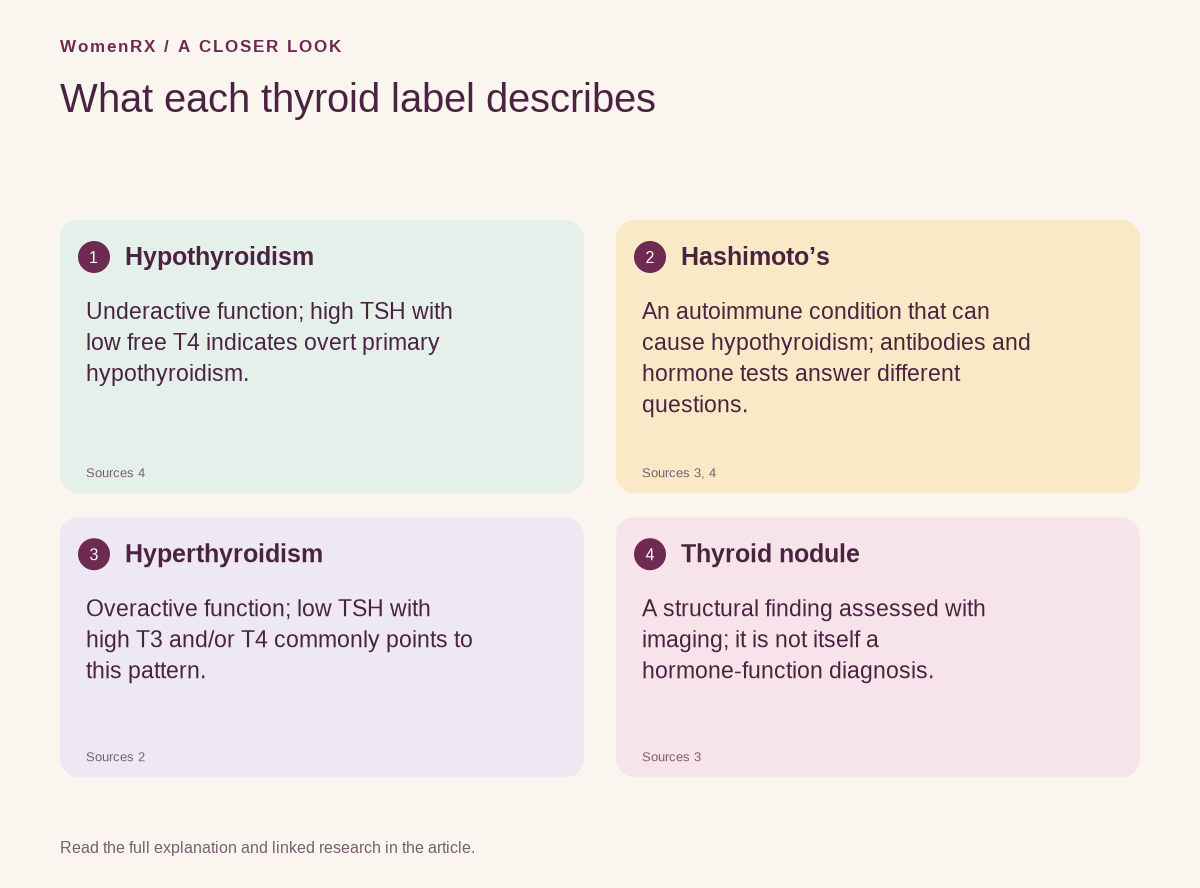
What each thyroid label describes
Hypothyroidism: Underactive function; high TSH with low free T4 indicates overt primary hypothyroidism.4
Hashimoto’s: An autoimmune condition that can cause hypothyroidism; antibodies and hormone tests answer different questions.34
Hyperthyroidism: Overactive function; low TSH with high T3 and/or T4 commonly points to this pattern.2
Thyroid nodule: A structural finding assessed with imaging; it is not itself a hormone-function diagnosis.3
Read the figure as text
The labels refer to different questions: hormone function, autoimmune cause, or gland structure.- Hypothyroidism: Underactive function; high TSH with low free T4 indicates overt primary hypothyroidism.4
- Hashimoto’s: An autoimmune condition that can cause hypothyroidism; antibodies and hormone tests answer different questions.34
- Hyperthyroidism: Overactive function; low TSH with high T3 and/or T4 commonly points to this pattern.2
- Thyroid nodule: A structural finding assessed with imaging; it is not itself a hormone-function diagnosis.3
More questions, answered
Are Hashimoto’s and hypothyroidism the same thing?
No. Hashimoto’s is an autoimmune thyroid condition and a common cause of hypothyroidism. Hypothyroidism describes low thyroid hormone function; TSH and T4 blood tests help show whether that underactivity is present now. 3 4
Can symptoms tell me which thyroid condition I have?
Not reliably. Symptoms can help guide an assessment, but issues such as fatigue or weight change are nonspecific. Thyroid blood tests help distinguish underactivity from overactivity, and other tests may help identify the cause. 2 4
Sources you can check
- Levothyroxine: a medicine for an underactive thyroid (hypothyroidism) - NHSAccessed 2026-09-25Return to first citation
- Overactive thyroid (hyperthyroidism) - Diagnosis - NHSAccessed 2026-09-25Return to first citation
- Thyroid Tests: MedlinePlusAccessed 2026-09-25Return to first citation
- Hypothyroidism: A Review.Chaker L, Papaleontiou M. · JAMA · 2025Return to first citation