Graves’ Disease or Another Cause of High Thyroid Hormone?
Thyroid blood tests can show excess hormone, but finding out why it’s high is what makes the treatment choices clearer.
Graves’ disease is an autoimmune cause of hyperthyroidism, not another name for every high-thyroid-hormone result. Blood tests establish the hormone pattern; antibody tests and sometimes imaging help distinguish Graves’ disease from nodules, thyroiditis, and other causes. Treatment may reduce hormone production, ease symptoms, or address the thyroid gland more permanently. Pregnancy can change both the explanation for a result and the treatment discussion. 1 2 3 5
First, separate the hormone result from the cause
Hyperthyroidism means the thyroid is making more hormone than the body needs. In Graves’ disease, antibodies stimulate the thyroid to make too much. An overactive thyroid nodule can also produce excess hormone. Thyroiditis is different: inflammation can cause hormone already stored in the gland to leak into the blood. Too much thyroid medicine or iodine can be involved as well. These distinctions matter because the same finding of excess circulating hormone doesn’t always call for the same treatment. 1 3 5
Excess thyroid hormone can affect your heart rate, weight, digestion, and mood. A rapid heartbeat or tremor may be a clue, but symptoms alone can’t tell you whether Graves’ disease is the cause. Graves’ disease can also affect the eyes, causing symptoms such as double vision, light sensitivity, or eye pain. Mention new eye symptoms when you discuss your thyroid results. 1
What each test can tell you
TSH is usually the first thyroid blood test ordered. A low TSH together with high T3 and/or T4 usually indicates an overactive thyroid. Those numbers answer what is happening with your hormone levels; they don’t necessarily answer why. 2 4
A thyroid antibody test can help identify an autoimmune cause such as Graves’ disease. If the cause remains unclear, a thyroid scan or radioactive iodine uptake test may help assess thyroid activity or identify nodules. The useful distinction is between a gland being stimulated to make excess hormone, as in Graves’ disease, and stored hormone leaking out, as can happen with thyroiditis. 1 2 4 5
That gives you a practical way to read a test discussion: “Do these results establish excess circulating hormone, and what evidence identifies the cause?” If Graves’ disease is suspected, ask which antibody result or other finding supports it. If a nodule or thyroiditis is being considered, ask what points in that direction instead. 2 4 5
Treatments differ in what they’re trying to do
For Graves’ disease, the established approaches are antithyroid medicine, radioactive iodine, and thyroid surgery. A beta blocker may also be used to ease symptoms such as a rapid heartbeat or tremor while treatment for the thyroid takes effect. It helps with those symptoms; it doesn’t reduce the thyroid’s hormone production. 1 5
Antithyroid medicine reduces the amount of hormone the gland makes. It can control Graves’ disease without immediately destroying or removing the gland, but it isn’t always a permanent cure; some people need treatment for years. That makes the question of whether the disease is staying controlled an important part of follow-up. 1
Radioactive iodine gradually destroys thyroid cells that produce hormone. It takes a different approach to lasting control: almost everyone who receives it later develops hypothyroidism, meaning the thyroid makes too little hormone. That expected change is a central trade-off to understand, rather than an unexpected failure of treatment. 1
Thyroid surgery is another established option. Reviews describe surgery and radioactive iodine as options particularly when Graves’ disease recurs or antithyroid medicine causes serious adverse effects. Unlike medicine that suppresses production, thyroidectomy removes the gland. The decision between these approaches depends on the situation; none is automatically the best choice for every person with Graves’ disease. 5
A diagnosis of thyroiditis changes this comparison. If the immediate problem is stored hormone leaking from an inflamed gland, a medicine whose purpose is to stop new hormone production is addressing a different process. That’s why it’s worth establishing the cause before assuming a Graves’ disease treatment plan fits every high-hormone result. 1 5
Pregnancy can change the questions
If you’re pregnant, a high thyroid-hormone result still needs a cause. Graves’ disease is one possibility, but high levels of a pregnancy hormone called hCG can also contribute to an overactive thyroid, particularly in early pregnancy. Pregnancy therefore belongs in the explanation of the test result, not only in the later treatment conversation. 3
Pregnancy may also change which antithyroid medicine is considered. In one published case, discovering a pregnancy changed the medication plan: propylthiouracil was used earlier in pregnancy and methimazole later. A single case doesn’t establish a schedule for other pregnancies, but it shows why pregnancy status can alter a decision already underway. 6
If you’re planning a pregnancy, raise that before settling on a Graves’ disease treatment. A concrete question is: “How would a pregnancy affect the option we’re considering, and what should we clarify about the cause first?” If you’re already pregnant, ask how the team is distinguishing Graves’ disease from other explanations for the hormone result and how that distinction affects the medication discussion. 3 6
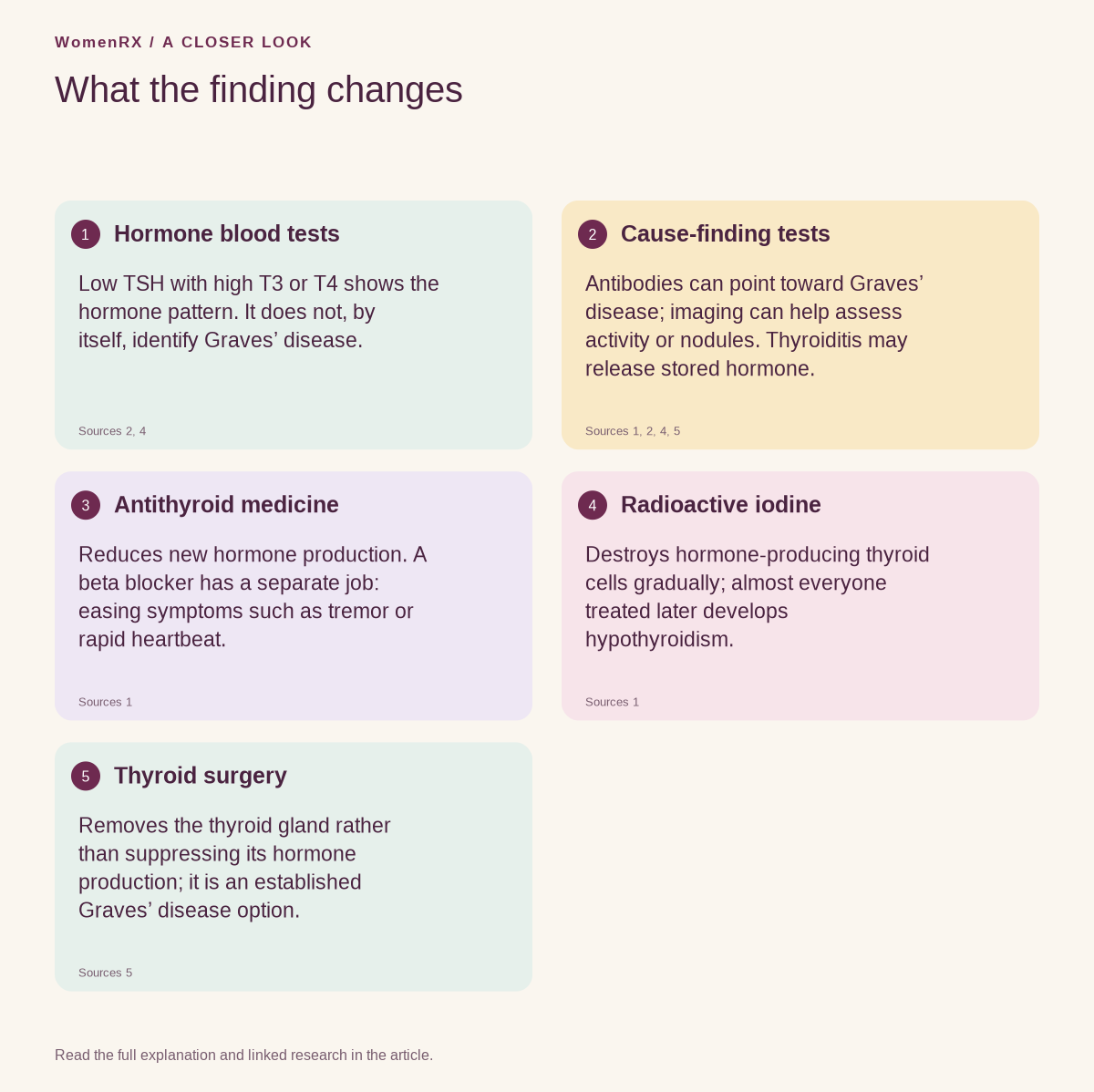
What the finding changes
Hormone blood tests: Low TSH with high T3 or T4 shows the hormone pattern. It does not, by itself, identify Graves’ disease.24
Cause-finding tests: Antibodies can point toward Graves’ disease; imaging can help assess activity or nodules. Thyroiditis may release stored hormone.1245
Antithyroid medicine: Reduces new hormone production. A beta blocker has a separate job: easing symptoms such as tremor or rapid heartbeat.1
Radioactive iodine: Destroys hormone-producing thyroid cells gradually; almost everyone treated later develops hypothyroidism.1
Thyroid surgery: Removes the thyroid gland rather than suppressing its hormone production; it is an established Graves’ disease option.5
Read the figure as text
Compare what establishes excess hormone, what helps identify its cause, and what each treatment category does.- Hormone blood tests: Low TSH with high T3 or T4 shows the hormone pattern. It does not, by itself, identify Graves’ disease.24
- Cause-finding tests: Antibodies can point toward Graves’ disease; imaging can help assess activity or nodules. Thyroiditis may release stored hormone.1245
- Antithyroid medicine: Reduces new hormone production. A beta blocker has a separate job: easing symptoms such as tremor or rapid heartbeat.1
- Radioactive iodine: Destroys hormone-producing thyroid cells gradually; almost everyone treated later develops hypothyroidism.1
- Thyroid surgery: Removes the thyroid gland rather than suppressing its hormone production; it is an established Graves’ disease option.5
More questions, answered
Can TSH be low without T3 or T4 being high?
Yes. Low TSH with T3 and T4 still within the reference range is called subclinical hyperthyroidism. It’s a different test pattern from overt hyperthyroidism, where thyroid hormone levels are elevated. 5
Sources you can check
- Hyperthyroidism | Graves' Disease | Overactive Thyroid | MedlinePlusAccessed 2026-09-25Return to first citation
- Overactive thyroid (hyperthyroidism) - Diagnosis - NHSAccessed 2026-09-25Return to first citation
- Overactive thyroid (hyperthyroidism) - Causes - NHSAccessed 2026-09-25Return to first citation
- Thyroid Tests: MedlinePlusAccessed 2026-09-25Return to first citation
- How to manage autoimmune hyperthyroidism (Graves' disease): from differential diagnosis to emerging immunological therapies.Karapanou O, Saltiki K, Markantes GK, Kasotas A, Michalaki M, Effraimidis G. · Drugs in context · 2026Return to first citation
- A Pruritic Predicament: An Unusual Presentation of Graves' Disease Complicated by Pregnancy.Lawless R, Smith E, Slone C, Salmon T. · Case reports in medicine · 2026Return to first citation