Hyperthyroidism: What Tests Reveal and Why the Cause Matters
A racing heart or shaky hands can be a reason to ask about thyroid testing, but treatment depends on what’s driving the hormone change.
Hyperthyroidism means the thyroid makes more hormone than the body needs. A rapid heartbeat, tremor, or nervousness can raise the question, but symptoms alone can’t establish the cause. Testing usually starts with TSH, followed by thyroid hormone tests and, when needed, tests for Graves’ disease or thyroid nodules. The cause and your circumstances shape the treatment discussion. 123
When symptoms make thyroid testing worth discussing
A fast heartbeat, shaky hands, or a keyed-up feeling can be unsettling, especially when you can’t point to a clear reason. These can occur with hyperthyroidism, but they aren’t a diagnosis. Thyroid hormones affect heart rate, digestion, weight, and mood, so the effects can show up in more than one part of your day. Hyperthyroidism can also affect the menstrual cycle and fertility. A menstrual change is worth mentioning alongside other symptoms, not treating as proof of thyroid disease. 1
If a rapid heartbeat or tremor is persistent or troubling, bring it up with a healthcare professional rather than trying to judge your thyroid function from symptoms alone. Mention if you’re pregnant or planning pregnancy. Those details help frame the conversation; they don’t, by themselves, identify a thyroid condition. 13
Blood tests answer one question; finding the cause answers another
TSH, or thyroid-stimulating hormone, is usually the first thyroid blood test ordered. T4 and T3 tests measure thyroid hormones in the blood. The results help establish what’s happening with thyroid function, while other tests may help explain why. Thyroid antibody tests can help identify an autoimmune disorder; a thyroid scan can check for nodules, and a thyroid scan or radioactive iodine uptake test may help find the cause of hyperthyroidism. Not everyone needs every test. 12
One result especially deserves context: a TSH below the laboratory reference range with free T4 still within range is described as subclinical hyperthyroidism. That finding isn’t the same as a complete treatment decision. A 2024 systematic review found that guidelines vary in their recommendations for evaluating, treating, and following subclinical hyperthyroidism; decisions commonly take account of the TSH level, age, and other health conditions. If that’s your result, a useful question is, “What do the rest of my results and my health history suggest we do next?” 4
Why “overactive thyroid” doesn’t name one treatment
Graves’ disease is an autoimmune condition that stimulates the thyroid to make too much hormone. An overactive thyroid nodule can also make excess hormone. Thyroiditis works differently: inflammation causes hormone already stored in the gland to leak out. Distinguishing among those causes helps clarify whether Graves’ disease treatment guidance applies. 13
For Graves’ disease, a thyroid-stimulating hormone receptor antibody test can help establish the diagnosis. The 2018 European Thyroid Association guideline describes three ways to treat Graves’ hyperthyroidism: antithyroid medication to reduce hormone production, radioactive iodine to reduce thyroid tissue, and thyroid surgery. Methimazole is its generally preferred antithyroid drug for newly diagnosed Graves’ disease, but pregnancy changes medication choices. This is guidance for Graves’ disease, not a menu that automatically applies to every abnormal thyroid test. 3
A beta blocker may be used to ease a rapid heartbeat, tremor, or nervousness while treatment for the underlying condition takes effect. It helps with those symptoms rather than identifying or resolving the cause. Radioactive iodine often leads to an underactive thyroid; removal of the whole thyroid requires lifelong thyroid hormone treatment. These follow-up needs are part of the tradeoff when comparing options. 1
The questions that change a treatment conversation
Once tests show a thyroid problem, ask what evidence points to Graves’ disease, an overactive nodule, thyroiditis, or another cause. Then ask what the proposed treatment is meant to do: relieve symptoms now, reduce hormone production, or provide a longer-term solution. If radioactive iodine or surgery is being considered, ask what thyroid hormone treatment and monitoring you may need afterward. 123
Pregnancy plans deserve an early place in that conversation. The Graves’ guideline recommends a different antithyroid drug approach when planning pregnancy and during the first trimester, and notes that active, severe thyroid eye disease changes whether radioactive iodine is appropriate. If you’re pregnant or planning to be, say so before settling on a treatment. 3
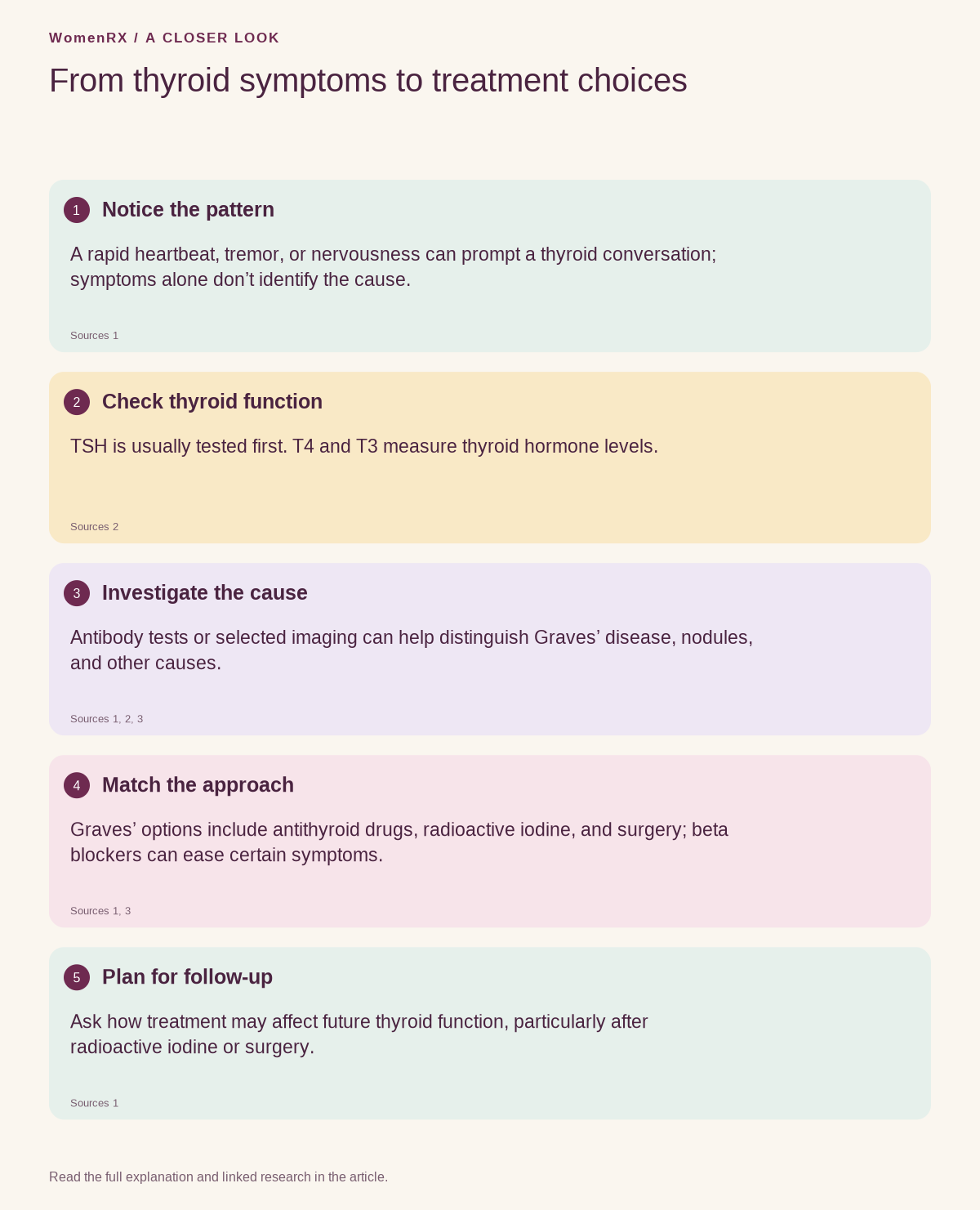
From thyroid symptoms to treatment choices
Notice the pattern: A rapid heartbeat, tremor, or nervousness can prompt a thyroid conversation; symptoms alone don’t identify the cause.1
Check thyroid function: TSH is usually tested first. T4 and T3 measure thyroid hormone levels.2
Investigate the cause: Antibody tests or selected imaging can help distinguish Graves’ disease, nodules, and other causes.123
Match the approach: Graves’ options include antithyroid drugs, radioactive iodine, and surgery; beta blockers can ease certain symptoms.13
Plan for follow-up: Ask how treatment may affect future thyroid function, particularly after radioactive iodine or surgery.1
Read the figure as text
These are different questions in an evaluation, not a fixed sequence of tests everyone needs.- Notice the pattern: A rapid heartbeat, tremor, or nervousness can prompt a thyroid conversation; symptoms alone don’t identify the cause.1
- Check thyroid function: TSH is usually tested first. T4 and T3 measure thyroid hormone levels.2
- Investigate the cause: Antibody tests or selected imaging can help distinguish Graves’ disease, nodules, and other causes.123
- Match the approach: Graves’ options include antithyroid drugs, radioactive iodine, and surgery; beta blockers can ease certain symptoms.13
- Plan for follow-up: Ask how treatment may affect future thyroid function, particularly after radioactive iodine or surgery.1
More questions, answered
Does a low TSH always mean I need treatment?
No. A low TSH with free T4 in the reference range can fall under subclinical hyperthyroidism, for which guidelines differ on when to treat or monitor. The degree of TSH change and your health circumstances matter. 4
Sources you can check
- Hyperthyroidism | Graves' Disease | Overactive Thyroid | MedlinePlusAccessed 2026-09-25Return to first citation
- Thyroid Tests: MedlinePlusAccessed 2026-09-25Return to first citation
- 2018 European Thyroid Association Guideline for the Management of Graves' Hyperthyroidism.Kahaly GJ, Bartalena L, Hegedüs L, Leenhardt L, Poppe K, Pearce SH. · European thyroid journal · 2018Return to first citation
- A systematic review of subclinical hyperthyroidism guidelines: a remarkable range of recommendations.Ursem SR, Boelen A, Bruinstroop E, Elders PJM, Gussekloo J, Poortvliet RKE, Heijboer AC, den Elzen WPJ. · European thyroid journal · 2024Return to first citation