Thyroid Testing and Fertility: What to Ask Before Pregnancy
Known thyroid disease deserves a plan before and during pregnancy, while routine testing and treatment for borderline results remain debated.
If you have diagnosed thyroid disease or take levothyroxine, ask for a preconception medication and testing plan, then clarify how monitoring will change if you become pregnant. For people seeking fertility care without known thyroid disease, routine testing recommendations differ. A positive thyroid antibody test alone does not establish that levothyroxine will improve fertility or prevent pregnancy complications. 1 2 3
Thyroid hormones can affect reproductive function, but a thyroid test is not a universal explanation for difficulty conceiving. The most useful distinction is between known thyroid dysfunction, which may need active management, and a borderline test or thyroid antibodies without abnormal thyroid function, where the value of routine testing or treatment is less settled. 2 3 4
While you’re trying to conceive
If you already have a thyroid diagnosis or take levothyroxine, bring it into the conversation before trying to conceive or starting fertility treatment. Ask what your recent thyroid results mean for you, whether your medication plan needs review, and who will follow your results if pregnancy occurs. Pregnancy can change levothyroxine requirements, so a plan made before conception may need updating. The medication prescribing information advises monitoring thyroid-stimulating hormone (TSH) during pregnancy and adjusting treatment when needed. 1
If you don’t have a known thyroid condition, whether to test before fertility treatment is not settled. A 2025 review describes disagreement among professional guidance: some organizations recommend TSH testing, with or without thyroid antibody testing, for people seeking fertility care; other guidance does not recommend routine testing. The review links this disagreement in part to different thresholds for defining subclinical hypothyroidism, where TSH is elevated but thyroid hormone levels are normal. 3
That means a TSH result should be interpreted in context, not treated as a stand-alone fertility diagnosis. If testing is suggested, ask what the result would change: Would it prompt another test, affect treatment timing, or lead to medication? If antibodies are checked, ask whether your thyroid function is actually abnormal as well. Thyroid autoimmunity can be associated with fertility and pregnancy concerns, but the reasons for those associations are not fully clear. 2 3
If a result is borderline or antibodies are positive
A positive thyroid antibody result and thyroid hormone dysfunction are not the same finding. A review of thyroid autoimmunity without thyroid dysfunction reports that randomized trials did not find levothyroxine effective for preventing adverse pregnancy outcomes in this group. So antibody positivity alone should not be treated as proof that levothyroxine will improve your chance of conception or prevent pregnancy loss. 2
By contrast, overt thyroid disease and subclinical hypothyroidism raise different clinical questions. A narrative review associates thyroid dysfunction with reproductive processes and describes individualized assessment and treatment as relevant; it does not establish that treatment improves fertility for every person or every test pattern. Ask your care team to explain whether your results show actual dysfunction, what threshold they are using, and how the result fits with your fertility plan. 3 4
Once pregnancy begins
Tell the clinician managing your thyroid care as soon as you know you’re pregnant. If you take levothyroxine, don’t stop or change it on your own: the prescribing information says it should not be discontinued during pregnancy and that TSH should be monitored so the dose can be adjusted if needed. It describes checks about every four weeks until the dose is stable; your prescriber can explain the monitoring schedule that applies to you. 1
If thyroid dysfunction is newly identified during pregnancy, ask what the specific TSH and thyroid hormone results show and what follow-up is planned. The prescribing information says hypothyroidism diagnosed during pregnancy should be treated promptly, but it uses different dosing guidance depending on the TSH result. That’s a reason to get an individualized plan rather than applying a dose from a general article. 1
After delivery: make the plan explicit
If you were taking levothyroxine for established hypothyroidism, ask before delivery what to do with your dose after birth and when to recheck TSH. The prescribing information describes returning to the pre-pregnancy dose after delivery and checking TSH four to eight weeks postpartum. Those are product-label instructions, not a reason to adjust your own medication without the clinician managing it. 1
A useful question for each stage is: What finding are we monitoring, what would make the plan change, and who is following up? That keeps a real thyroid condition from being overlooked while avoiding the assumption that every antibody or borderline result needs treatment.
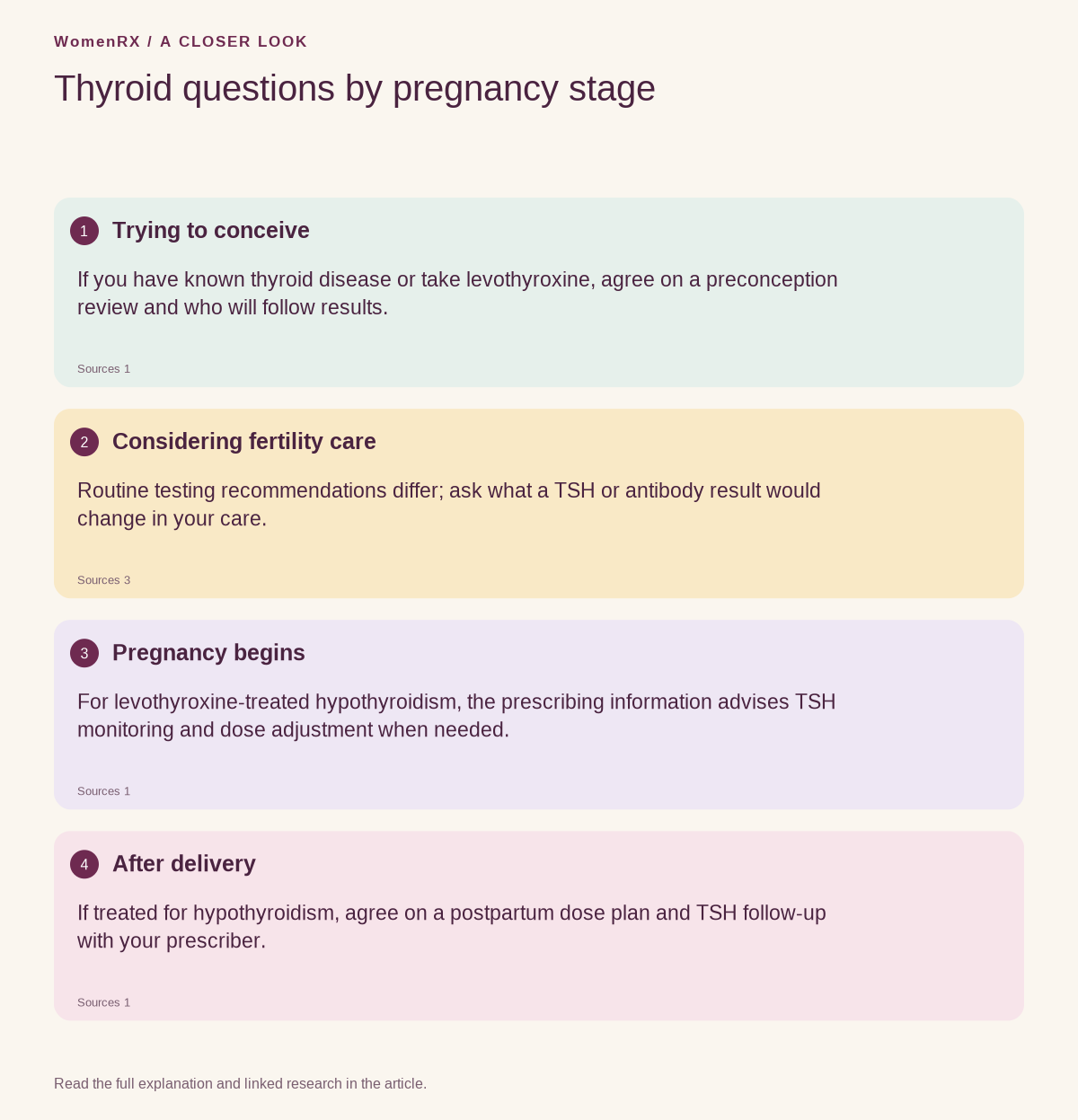
Thyroid questions by pregnancy stage
Trying to conceive: If you have known thyroid disease or take levothyroxine, agree on a preconception review and who will follow results.1
Considering fertility care: Routine testing recommendations differ; ask what a TSH or antibody result would change in your care.3
Pregnancy begins: For levothyroxine-treated hypothyroidism, the prescribing information advises TSH monitoring and dose adjustment when needed.1
After delivery: If treated for hypothyroidism, agree on a postpartum dose plan and TSH follow-up with your prescriber.1
Read the figure as text
The discussion changes from interpreting results before conception to monitoring known disease during pregnancy and planning follow-up after delivery.- Trying to conceive: If you have known thyroid disease or take levothyroxine, agree on a preconception review and who will follow results.1
- Considering fertility care: Routine testing recommendations differ; ask what a TSH or antibody result would change in your care.3
- Pregnancy begins: For levothyroxine-treated hypothyroidism, the prescribing information advises TSH monitoring and dose adjustment when needed.1
- After delivery: If treated for hypothyroidism, agree on a postpartum dose plan and TSH follow-up with your prescriber.1
More questions, answered
Does a positive thyroid antibody test mean I need levothyroxine?
Not by itself. Antibodies can be present without thyroid dysfunction, and a review reports that randomized trials did not show levothyroxine prevented adverse pregnancy outcomes in women with thyroid autoimmunity but no thyroid dysfunction. Ask how your antibody result relates to your thyroid function tests. 2
Should everyone have thyroid testing before fertility treatment?
Recommendations differ. A 2025 review describes professional guidance that supports testing and other guidance that does not recommend routine testing. Ask whether testing is being suggested for your specific history and what the care team would do with the result. 3
Sources you can check
- LEVOTHYROXINE SODIUM TABLET [CARDINAL HEALTH 107, LLC] | US prescribing information and patient instructionsAccessed 2026-09-25Return to first citation
- Thyroid autoimmunity and its negative impact on female fertility and maternal pregnancy outcomes.Tańska K, Gietka-Czernel M, Glinicki P, Kozakowski J. · Frontiers in endocrinology · 2022Return to first citation
- Thyroid function testing prior to fertility treatment: will we ever agree?Dunbar S, Dhillon-Smith R, Maheshwari A. · Human reproduction (Oxford, England) · 2025Return to first citation
- Thyroid dysfunction and female infertility. A comprehensive review.Concepción-Zavaleta MJ, Coronado-Arroyo JC, Quiroz-Aldave JE, Concepción-Urteaga LA, Paz-Ibarra J. · Diabetes & metabolic syndrome · 2023Return to first citation