What Metformin Stories Can Tell You About PCOS
A personal account can help you think of questions to ask, but it can’t show how often an effect happens or predict your own results.
Metformin stories can help you identify questions about daily tolerability and whether a treatment fits your goal. Check what the person experienced, what else changed, and whether their goal resembles yours. Then use clinical evidence to judge likely benefits: metformin may help metabolic features and menstrual regularity in PCOS, but it isn’t a first-choice treatment for every symptom. 1
A post saying metformin helped, disappointed, or felt difficult to take describes one person’s experience. It may give you a useful question to raise, but it can’t tell you what most people experience, whether metformin caused the change, or what will happen for you.
That distinction matters in PCOS, where people may be treating different concerns. Metformin may help menstrual regularity as well as metabolic features, while acne, unwanted hair, and ovulation induction call for a different look at the treatment options. What makes sense depends on your goal and circumstances. 1
First ask what the story is measuring
When you read an account, look for the specific change the person describes. Is it a symptom they noticed, a lab result, a change in menstrual cycles, or progress toward a fertility goal? These aren’t interchangeable outcomes.
Metformin is used in PCOS for metabolic features, including insulin resistance. A 2025 review describes evidence of improvements in insulin resistance and menstrual regularity, particularly for women with obesity or insulin resistance. It also says metformin alone isn’t a first-choice treatment for weight loss, ovulation induction, or clinical signs such as acne and hirsutism. 1
That doesn’t mean someone’s account about acne, weight, or fertility is false. It means the account alone can’t establish that metformin caused the change, or that the medication is a reliable treatment for that goal. Ask what else changed, what outcome was measured, and how the person’s goal compares with yours.
A story can raise a question, not give you odds
A personal account may be useful for learning what someone chose to ask about daily treatment or what they wanted to monitor. But a set of posts isn’t automatically a representative sample. People who share experiences online may not reflect everyone using the medication, and similar posts can’t establish how common an experience is.
In an Italian survey of 769 women aged 18-40 recruited through a PCOS community, respondents often relied on unofficial internet sources for information. Their responses offer a reason to read online accounts carefully, not a measure of what all women with PCOS experience on metformin. 2
So be cautious with claims such as “everyone feels better,” “it never works,” or “this side effect always happens.” A personal story can’t establish those claims.
Match the evidence to your goal
A useful next step is to name the outcome you care about most, then ask whether metformin is intended to address it. For example, if your main concern is metabolic, ask what change your care team hopes to assess. If your priority is acne or unwanted hair, ask how those concerns are usually addressed and whether metformin is being offered for a different reason. If cycle regularity matters most, ask what improvement you might look for. If pregnancy is your goal, ask how this plan fits with fertility treatment rather than assuming that a post about regular periods means metformin will achieve pregnancy.
PCOS care is tailored to symptoms and circumstances. The review describes different approaches for metabolic features, menstrual irregularity, hyperandrogenic symptoms, and fertility goals. That makes one person’s result a poor substitute for knowing why metformin was suggested in your case. 1
Turn a tolerability story into a useful question
If an account sounds relevant because taking metformin felt difficult for that person, look past the verdict of “worth it” or “not worth it.” What did they actually experience? Did it interfere with meals, work, sleep, or another part of daily life? Does the account say when the difficulty appeared, whether anything else changed, and whether the person was also taking other treatments? Missing details don’t make their experience less real. They do make it harder to apply to your situation.
If you’re deciding whether to start metformin, those details can help you ask what difficulties to watch for and what choices you’d have if treatment proved hard to fit into daily life. If you’re already taking it, describe your own experience just as specifically: what’s happening, when it happens, and what it’s getting in the way of. That gives you a clearer starting point for discussing whether to continue or change your plan.
Useful questions include:
- What specific PCOS concern is metformin meant to address for me?
- What change would count as a benefit, and how would we assess it?
- If my main goal is acne, unwanted hair, cycle regularity, or pregnancy, how does this plan address that goal?
- If I’m finding the treatment hard to continue, what options should I discuss before changing it?
Your priorities may differ from someone else’s because PCOS affects people in different ways. A personal account can help you put those priorities into words. Clinical evidence and a plan tied to your own goal are better guides to whether metformin makes sense for you.
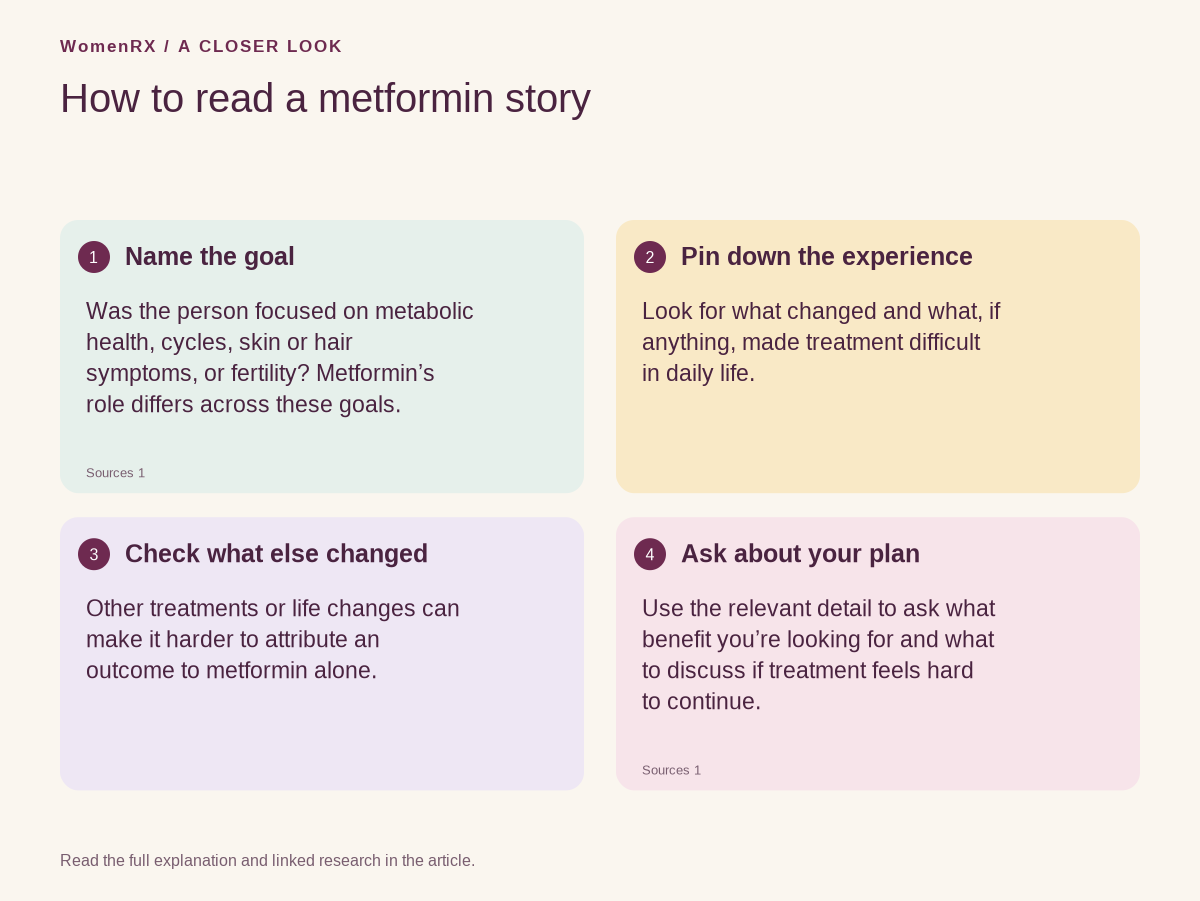
How to read a metformin story
Name the goal: Was the person focused on metabolic health, cycles, skin or hair symptoms, or fertility? Metformin’s role differs across these goals.1
Pin down the experience: Look for what changed and what, if anything, made treatment difficult in daily life.
Check what else changed: Other treatments or life changes can make it harder to attribute an outcome to metformin alone.
Ask about your plan: Use the relevant detail to ask what benefit you’re looking for and what to discuss if treatment feels hard to continue.1
Read the figure as text
Use the details in an account to decide what to ask, without treating one person’s outcome as a forecast.- Name the goal: Was the person focused on metabolic health, cycles, skin or hair symptoms, or fertility? Metformin’s role differs across these goals.1
- Pin down the experience: Look for what changed and what, if anything, made treatment difficult in daily life.
- Check what else changed: Other treatments or life changes can make it harder to attribute an outcome to metformin alone.
- Ask about your plan: Use the relevant detail to ask what benefit you’re looking for and what to discuss if treatment feels hard to continue.1
More questions, answered
Can someone else’s positive or negative experience predict mine?
No. It describes one person’s outcome, not your likely response. The reason metformin was prescribed and the outcome being tracked matter; PCOS treatment is tailored to different metabolic, menstrual, symptom, and fertility goals. 1
Sources you can check
- Metformin use in women with polycystic ovary syndrome (PCOS): Opportunities, benefits, and clinical challenges.Saadati S, Mason T, Godini R, Vanky E, Teede H, Mousa A. · Diabetes, obesity & metabolism · 2025Return to first citation
- Insights from the EGOI-PCOS patient survey: Diagnosis, treatment, and quality of life according to Italian PCOS patients.Carriero VC, Forte G, Dinicola S, Oliva MM, Mudarris GA, Unfer V. · European journal of obstetrics, gynecology, and reproductive biology · 2025Return to first citation