Metformin for PCOS: Review Each Outcome on Its Own Timeline
There’s no single countdown for metformin: decide what you’re tracking, check how the medicine feels, and assess each intended outcome separately.
Metformin’s effects on PCOS shouldn’t be judged by one fixed deadline. Check in about tolerability as you start or change treatment, then review the specific reason it was prescribed using a measure that fits that goal. In one trial of women with PCOS and insulin resistance, researchers assessed insulin sensitivity after four months. That study point isn’t a guaranteed response window for you or for other outcomes. 3
Start with the reason you’re taking it
Metformin’s progress can be judged against different goals, so first agree on what you’re hoping to change. That might be a metabolic measure, such as insulin sensitivity, or cycle regularity. If pregnancy is your goal, make that explicit too: research on insulin sensitivity and AMH does not establish a timetable for ovulation or pregnancy outcomes.
In a randomized trial of 342 women with PCOS and insulin resistance, researchers assessed insulin sensitivity after four months of treatment. The metformin group’s HOMA-IR, a measure of insulin resistance, decreased from baseline by 25% at that assessment. That’s a result in the study’s participants, not a promise about what you’ll experience or when. 3
Review comfort before judging effectiveness
Digestive effects can influence whether metformin is manageable. In that trial, women taking metformin reported gastrointestinal effects including diarrhea, nausea, appetite loss, vomiting, and stomach discomfort. The study doesn’t establish exactly when these effects will begin or settle for an individual. 3
It can help to make tolerability its own early check-in, especially after starting treatment or a change to your prescription. Note what’s bothering you, how often it happens, and whether it affects eating or daily activities. Bring that information to the person managing your prescription rather than deciding on your own that you need to push through or stop. Comfort and effectiveness are related in practice: a treatment that’s hard to take may need a different plan.
Match the review to the outcome
For insulin sensitivity: Ask which measure is being used and when it makes sense to repeat it. The four-month PCOS trial used HOMA-IR and reported an average decrease in the metformin group. Individual response can differ, and the trial’s result isn’t a promise of the same change for you. 3
For cycles or ovulation: If cycle regularity is part of your goal, record the first day of bleeding and the length of each cycle. That gives you concrete information to review, but the trial discussed here did not assess cycle changes or ovulation. If pregnancy is the goal, bring that up separately: this trial’s insulin-sensitivity result cannot tell you whether or when pregnancy will occur. 3
For AMH: Don’t use an anti-Müllerian hormone (AMH) result as a stand-in for a different outcome, such as cycle change or pregnancy. The AMH reviews examined changes in this blood marker, not those outcomes. One review of 20 studies suggested that at least three months might be needed to observe a reduction. Another review of 16 studies found that its duration subgroup results did not show a straightforward relationship between treatment length and AMH change. Taken together, these reviews don’t establish a dependable personal timetable. 12
Make the next review useful
Before each review, write down three things: the outcome the prescription is meant to address, what you’ve observed, and what measurement or conversation will help decide whether the plan is working. For example, if the aim is cycle regularity, bring your cycle dates; if the aim is insulin resistance, ask what result will be compared and when. If the intended outcome hasn’t changed, that’s useful information too. It can lead to a discussion about tolerability, how progress is being measured, or whether the treatment goal needs revisiting.
These findings don’t establish one universal “wait this long” rule. A better plan separates the early question, “Can I manage taking this?”, from the later question, “Is it helping with the outcome we chose?”
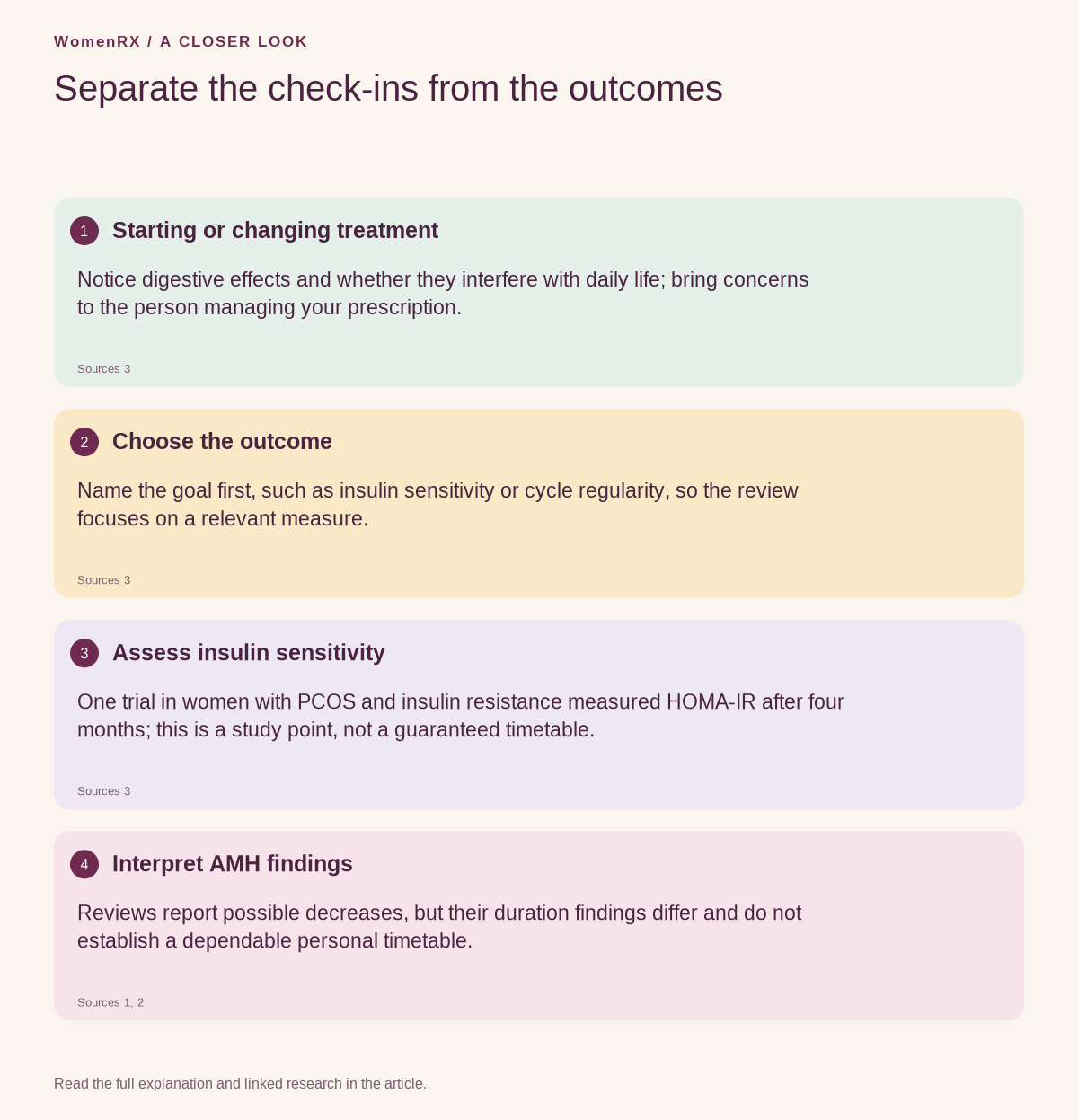
Separate the check-ins from the outcomes
Starting or changing treatment: Notice digestive effects and whether they interfere with daily life; bring concerns to the person managing your prescription.3
Choose the outcome: Name the goal first, such as insulin sensitivity or cycle regularity, so the review focuses on a relevant measure.3
Assess insulin sensitivity: One trial in women with PCOS and insulin resistance measured HOMA-IR after four months; this is a study point, not a guaranteed timetable.3
Interpret AMH findings: Reviews report possible decreases, but their duration findings differ and do not establish a dependable personal timetable.12
Read the figure as text
Use this as a planning aid, not a promised schedule: tolerability and treatment results are different questions, and each outcome needs its own measure.- Starting or changing treatment: Notice digestive effects and whether they interfere with daily life; bring concerns to the person managing your prescription.3
- Choose the outcome: Name the goal first, such as insulin sensitivity or cycle regularity, so the review focuses on a relevant measure.3
- Assess insulin sensitivity: One trial in women with PCOS and insulin resistance measured HOMA-IR after four months; this is a study point, not a guaranteed timetable.3
- Interpret AMH findings: Reviews report possible decreases, but their duration findings differ and do not establish a dependable personal timetable.12
More questions, answered
Should I use AMH to decide whether metformin is working?
The reviews report that AMH may decrease during metformin treatment, but their findings about duration don’t give a dependable personal timetable. They also don’t establish that an AMH change means another outcome, such as cycle regularity or pregnancy, has changed. 12
Sources you can check
- Correlation between anti-müllerian hormone in polycystic ovarian syndrome with metformin: a systematic review and meta-analysis.Liu H, Mo L, Tian X, Fan S, Hu J, Zhang L, Yu B. · Gynecological endocrinology : the official journal of the International Society of Gynecological Endocrinology · 2024Return to first citation
- Effect of metformin on anti-mullerian hormone levels in women with polycystic ovarian syndrome: a systematic review and meta-regression analysis of randomized controlled trials with.Mehdinezhad Roshan M, Sohouli MH, Izze da Silva Magalhães E, Hekmatdoost A. · BMC endocrine disorders · 2024Return to first citation
- Effect of acupuncture and metformin on insulin sensitivity in women with polycystic ovary syndrome and insulin resistance: a three-armed randomized controlled trial.Wen Q, Hu M, Lai M, Li J, Hu Z, Quan K, Liu J, Liu H, Meng Y, Wang S, Wen X, Yu C, Li S, Huang S, Zheng Y, Lin H, Liang X, Lu L, Mai Z, Zhang C, Wu T, Ng EHY, Stener-Victorin E, Ma... · Human reproduction (Oxford, England) · 2022Return to first citation