Berberine for PCOS: What Each Outcome Shows
Berberine has some promising PCOS findings, but evidence for menstrual changes is not the same as evidence for better glucose control or fertility.
The evidence depends on your goal. A 2023 study of a specific berberine formulation found more regular periods over 90 days, but it was open-label and didn’t show a significant difference in metabolic or hormone profiles. A larger infertility trial found berberine alone led to fewer live births than letrozole, and adding it to letrozole didn’t improve results. Pregnancy safety and medicine interactions need separate discussion. 3 5
Start with the outcome you want
PCOS can involve irregular or absent ovulation, higher androgen levels, and metabolic concerns, but those are different problems and don’t respond to a treatment in interchangeable ways. A change in a period pattern, for example, doesn’t by itself show improved blood sugar, increased chances of pregnancy, or a long-term health benefit. 1
That distinction matters with berberine. Studies have examined different formulations and outcomes, and the findings don’t amount to proof that it treats PCOS as a whole.
If your goal is more regular periods
One 2023 randomized, controlled, open-label study included 130 Pakistani women with PCOS and fertility problems linked to menstrual or ovarian abnormalities. After 90 days, regular menstruation was reported in about 70% of women taking a more absorbable berberine phytosome and 16% in the control group. The study also reported changes in ovarian appearance, acne, and hirsutism. However, metabolic and hormone profiles did not significantly differ between groups. 5
Those results are encouraging for the specific formulation and study participants, but they don’t establish that other berberine products have the same effects. Because the trial was open-label, participants knew their treatment assignment. Its period findings also don’t prove that berberine reliably restores ovulation or improves long-term PCOS health.
If your goal is glucose or insulin measures
Insulin resistance is relevant to PCOS, but a study plan is not a study result. A 2016 paper describes a randomized, placebo-controlled trial in women with PCOS designed to compare insulin action after 12 weeks of berberine or placebo. The paper is a statistical analysis plan; it does not report the trial’s results. 2
An earlier study described in a separate trial protocol involved 89 Chinese women who received berberine, metformin, or placebo alongside cyproterone acetate for three months. The protocol reports some favorable metabolic measures in the berberine group, but because all groups also received another medicine and this is a small study, it can’t establish berberine’s effect on its own. 4
So, if your main question is blood sugar or insulin resistance, don’t treat a period change, or a proposed mechanism, as evidence that your metabolic measures will improve. Ask what specific measure would matter for your care and how it would be assessed.
If your goal is pregnancy
A multicenter randomized trial enrolled 644 women with PCOS-related infertility and compared letrozole, berberine, and the combination. Over treatment of up to six months, cumulative live birth was 36% with letrozole, 34% with letrozole plus berberine, and 22% with berberine alone. The combination did not improve live birth compared with letrozole alone; berberine alone had a lower live-birth rate than either letrozole-containing group. 3
This is a direct reason not to treat berberine as a proven fertility aid or a substitute for an evidence-based ovulation treatment. The study assessed infertility treatment outcomes; it was not designed to establish that taking berberine is safe after conception. If you’re trying to conceive, discuss the supplement before starting it, and revisit the question if you become pregnant.
A practical discussion about medicines and safety
The PCOS studies here don’t establish which prescription medicines or supplements interact with berberine. That means you shouldn’t assume it can be combined safely with a medicine, including metformin. Bring the full list of medicines and supplements you use to a clinician or pharmacist and ask about the specific combination, your goal, and pregnancy plans.
Safety findings from one short study shouldn’t be generalized too far: the 2023 phytosome trial reported that it was well tolerated and recorded no specific side effects during the study, but that does not establish safety for every formulation, longer use, or pregnancy. 5
A focused question can keep the conversation useful: “I’m considering berberine for [period regularity, a metabolic measure, or fertility]. What evidence applies to that goal, and how does it fit with my medicines and pregnancy plans?”
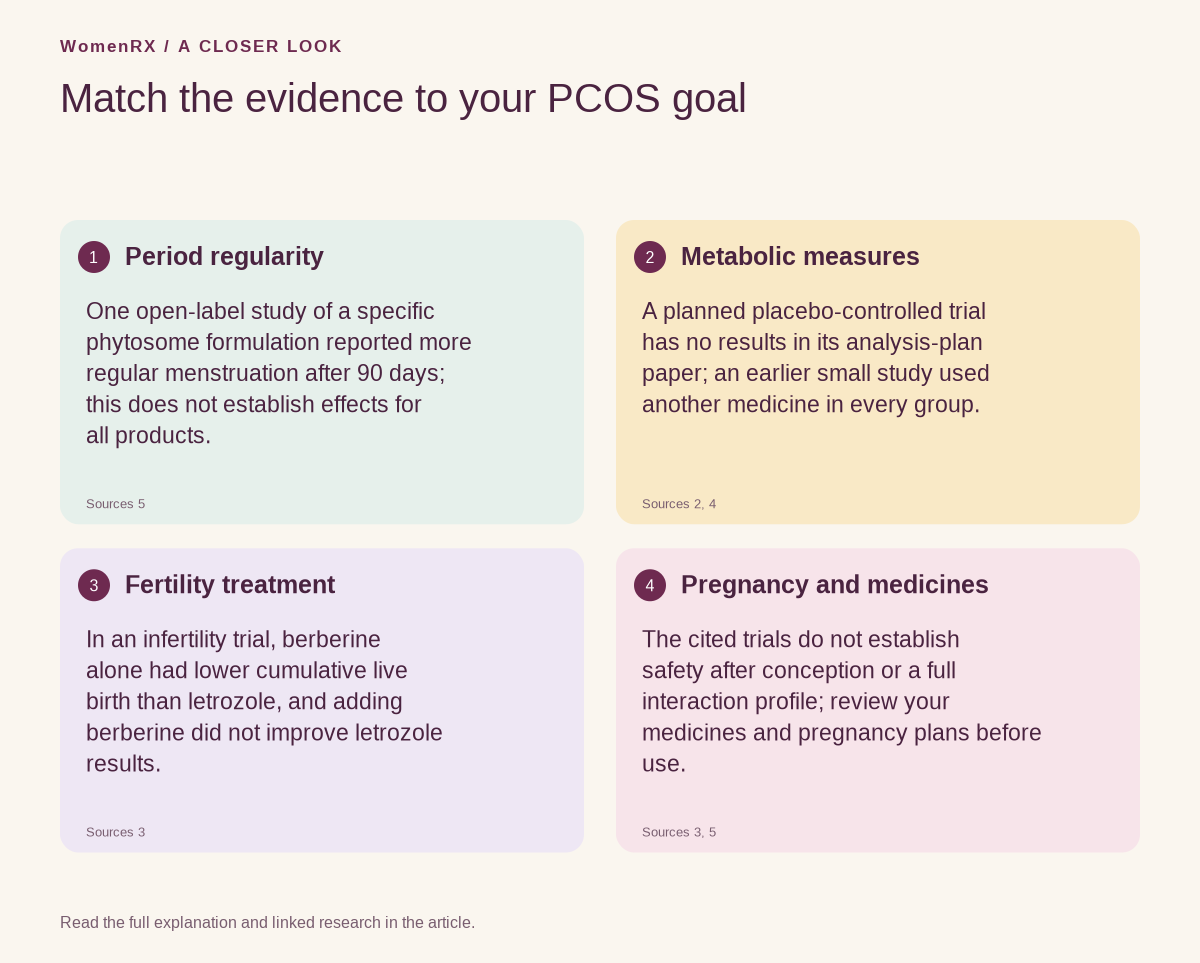
Match the evidence to your PCOS goal
Period regularity: One open-label study of a specific phytosome formulation reported more regular menstruation after 90 days; this does not establish effects for all products.5
Metabolic measures: A planned placebo-controlled trial has no results in its analysis-plan paper; an earlier small study used another medicine in every group.24
Fertility treatment: In an infertility trial, berberine alone had lower cumulative live birth than letrozole, and adding berberine did not improve letrozole results.3
Pregnancy and medicines: The cited trials do not establish safety after conception or a full interaction profile; review your medicines and pregnancy plans before use.35
Read the figure as text
These findings answer different questions. A result in one outcome should not be read as proof of an effect in another.- Period regularity: One open-label study of a specific phytosome formulation reported more regular menstruation after 90 days; this does not establish effects for all products.5
- Metabolic measures: A planned placebo-controlled trial has no results in its analysis-plan paper; an earlier small study used another medicine in every group.24
- Fertility treatment: In an infertility trial, berberine alone had lower cumulative live birth than letrozole, and adding berberine did not improve letrozole results.3
- Pregnancy and medicines: The cited trials do not establish safety after conception or a full interaction profile; review your medicines and pregnancy plans before use.35
More questions, answered
Does a more regular period mean berberine improved fertility?
Not necessarily. A period outcome is different from ovulation or live birth. In a randomized infertility trial, berberine alone produced a lower cumulative live-birth rate than letrozole, and adding berberine to letrozole did not improve the result. 3 5
Is berberine proven safe when trying to conceive?
The infertility trial measured treatment outcomes, not safety after conception. A few pregnancies reported in another study don’t establish pregnancy safety. Discuss use before starting if you’re trying to conceive, and revisit it if you become pregnant. 3 5
Sources you can check
- PCOS | Polycystic Ovary Syndrome | MedlinePlusAccessed 2026-09-25Return to first citation
- The effect of berberine on insulin resistance in women with polycystic ovary syndrome: detailed statistical analysis plan (SAP) for a multicenter randomized controlled trial.Zhang Y, Sun J, Zhang YJ, Chai QY, Zhang K, Ma HL, Wu XK, Liu JP. · Trials · 2016Return to first citation
- Randomized controlled trial of letrozole, berberine, or a combination for infertility in the polycystic ovary syndrome.Wu XK, Wang YY, Liu JP, Liang RN, Xue HY, Ma HX, Shao XG, Ng EH, Reproductive and Developmental Network in Chinese Medicine. · Fertility and sterility · 2016Return to first citation
- Effect of berberine on insulin resistance in women with polycystic ovary syndrome: study protocol for a randomized multicenter controlled trial.Li Y, Ma H, Zhang Y, Kuang H, Ng EH, Hou L, Wu X. · Trials · 2013Return to first citation
- Effect of Berberine Phytosome on reproductive, dermatologic, and metabolic characteristics in women with polycystic ovary syndrome: a controlled, randomized, multi-centric, open-label clinical trial.Di Pierro F, Sultana R, Eusaph AZ, Abrar S, Bugti M, Afridi F, Farooq U, Iqtadar S, Ghauri F, Makhduma S, Nourin S, Kanwal A, Bano A, Bugti AA, Mureed S, Ghazal A, Irshad R, Recchi... · Frontiers in pharmacology · 2023Return to first citation