Taking Ozempic With Metformin: What to Review
The combination has been studied in adults with type 2 diabetes, but side effects and glucose checks depend on your full medication regimen.
Ozempic (semaglutide) and metformin have been studied together in adults with type 2 diabetes, and a post hoc analysis of clinical trials found that taking metformin did not increase gastrointestinal side effects when a GLP-1 medicine was started. That doesn’t mean everyone should take both or that symptoms can’t happen. Review your other diabetes medicines, glucose-checking plan, and what to do if stomach symptoms persist with your prescriber. 1 3

The combination is used in type 2 diabetes, but it isn’t automatic
Semaglutide has been studied in adults with type 2 diabetes taking metformin as part of their treatment. In one 56-week trial, semaglutide was compared with sitagliptin in people taking metformin and/or a thiazolidinedione. That shows the combination has been studied; it doesn’t mean it’s the right plan for every person or that your other medicines can be ignored. 1
The useful question isn’t just “Can these two be taken together?” It’s “How does adding semaglutide fit with the rest of my diabetes treatment, and what should I watch for?”
Stomach symptoms can overlap, but metformin didn’t worsen them in this analysis
Both medicines can be associated with digestive symptoms. Metformin can cause abdominal pain, cramps, or diarrhea, while gastrointestinal symptoms are also a common concern during GLP-1 medicine initiation and titration. When symptoms begin after adding a medicine, it may not be obvious which one is contributing. 3
A post hoc analysis of four clinical trials included 16,996 participants, 76% of whom were taking metformin. During GLP-1 medicine initiation, metformin use was not associated with a higher percentage of participants experiencing gastrointestinal events, more severe events, or more study-drug discontinuation. The analysis included trials of semaglutide and liraglutide, so it is evidence about the broader GLP-1 medicine group, not a guarantee about what any one person will experience with Ozempic. 3
One practical limit matters: the analysis didn’t study starting metformin and a GLP-1 medicine at the same time. So it can’t answer whether beginning both together changes symptoms. Don’t stop or change metformin on your own because you’re starting Ozempic; ask your prescriber what to do if nausea, diarrhea, or other stomach symptoms become hard to manage. 3
Your other diabetes medicines shape the glucose plan
Ask how often to check your blood glucose and whether the plan should change after Ozempic is added. The right approach depends on your full regimen and your individual treatment plan. MedlinePlus recommends asking your provider how to check glucose and how often. 2
Be especially sure to review insulin or a sulfonylurea, if either is part of your treatment. Ozempic prescribing information says the risk of low blood sugar can rise when semaglutide is used with insulin or an insulin-releasing medicine such as a sulfonylurea; the prescriber may consider reducing the dose of insulin or the insulin-releasing medicine when initiating Ozempic. Don’t make those changes yourself. 1
Useful questions include:
- How often should I check my glucose while starting or adjusting this treatment?
- Do any of my other diabetes medicines need review, especially insulin or a sulfonylurea?
- If stomach symptoms start, what should I do about each medicine?
- What should I report if symptoms continue or get worse?
If metformin was prescribed for PCOS, the evidence is different
If you take metformin for PCOS rather than type 2 diabetes, make sure the person prescribing Ozempic knows why you take metformin and what you hope treatment will address. The trials discussed here studied people with type 2 diabetes; they don’t establish what adding semaglutide does to menstrual cycles or fertility in PCOS. Diabetes-trial findings shouldn’t be treated as answers to those separate questions. 1 3
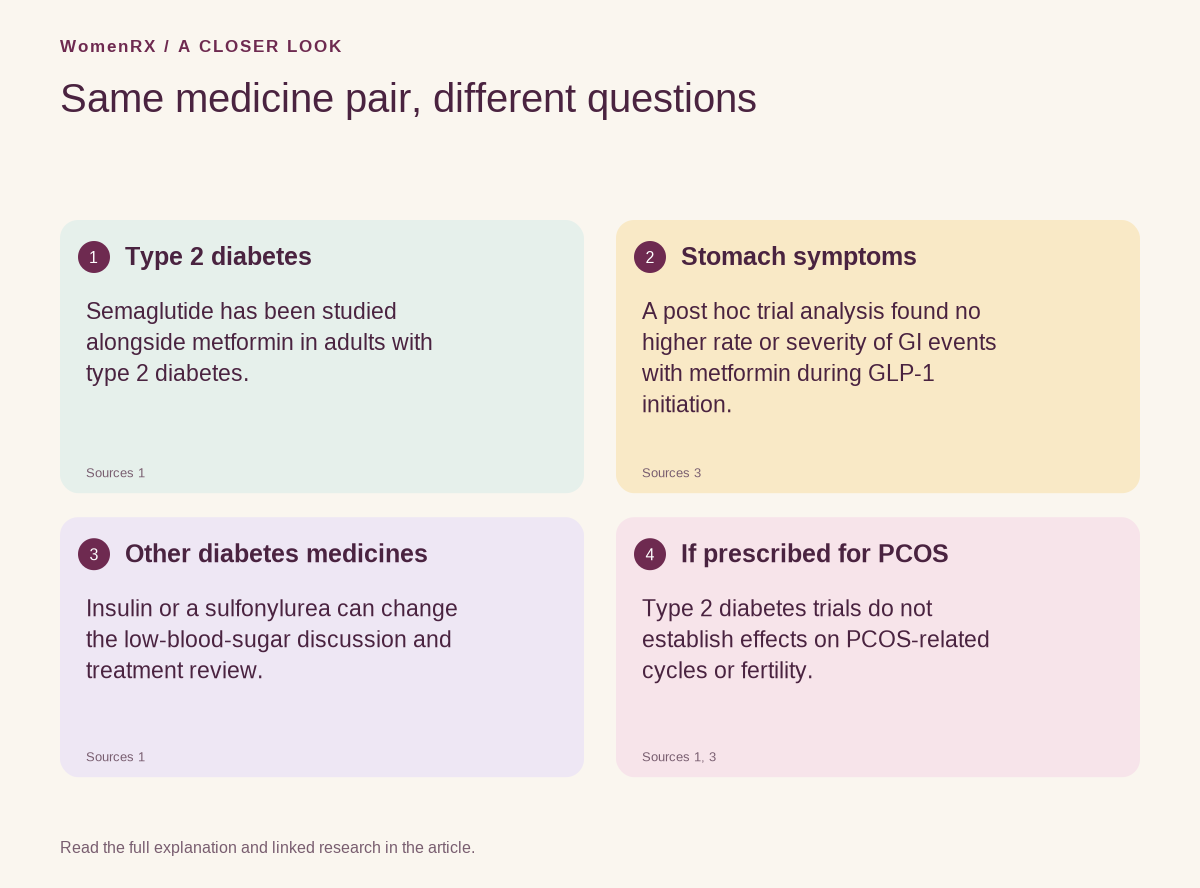
Same medicine pair, different questions
Type 2 diabetes: Semaglutide has been studied alongside metformin in adults with type 2 diabetes.1
Stomach symptoms: A post hoc trial analysis found no higher rate or severity of GI events with metformin during GLP-1 initiation.3
Other diabetes medicines: Insulin or a sulfonylurea can change the low-blood-sugar discussion and treatment review.1
If prescribed for PCOS: Type 2 diabetes trials do not establish effects on PCOS-related cycles or fertility.13
Read the figure as text
The reason you take metformin changes what the available semaglutide evidence can answer.- Type 2 diabetes: Semaglutide has been studied alongside metformin in adults with type 2 diabetes.1
- Stomach symptoms: A post hoc trial analysis found no higher rate or severity of GI events with metformin during GLP-1 initiation.3
- Other diabetes medicines: Insulin or a sulfonylurea can change the low-blood-sugar discussion and treatment review.1
- If prescribed for PCOS: Type 2 diabetes trials do not establish effects on PCOS-related cycles or fertility.13
More questions, answered
Does taking metformin mean I should stop it when starting Ozempic?
Not based on the clinical-trial analysis alone. It found no increase in gastrointestinal events associated with metformin use during GLP-1 medicine initiation, but it didn’t study starting both medicines at the same time. Ask your prescriber what to do if symptoms develop; don’t change your treatment on your own. 3
Does this evidence answer questions about Ozempic and PCOS?
No. These studies involved people with type 2 diabetes and don’t establish effects on menstrual cycles or fertility in PCOS. Those are separate questions to raise with your prescriber. 1 3
Sources you can check
- OZEMPIC (SEMAGLUTIDE) INJECTION, SOLUTION [A-S MEDICATION SOLUTIONS] | US prescribing information and patient instructionsAccessed 2026-09-25Return to first citation
- Diabetes | Type 1 Diabetes | Type 2 Diabetes | MedlinePlusAccessed 2026-09-25Return to first citation
- Occurrence of Gastrointestinal Adverse Events Upon GLP-1 Receptor Agonist Initiation With Concomitant Metformin Use: A Post Hoc Analysis of LEADER, STEP 2, SUSTAIN-6, and PIONEER 6.Klein KR, Clemmensen KKB, Fong E, Olsen S, Abrahamsen T, Lingvay I. · Diabetes care · 2024Return to first citation