Who Needs Extra Review Before Taking Metformin?
Kidney function is central, but other health conditions, medicines, procedures, and life changes can affect the plan too.
Kidney function is the first check: two US labels for metformin-containing combinations contraindicate use below an eGFR of 30 mL/min/1.73 m². 1 2 Other health conditions, medicines, and upcoming procedures deserve review too. If you're pregnant, breastfeeding, or in fertility treatment, bring that into the conversation rather than using a checklist to decide whether to take metformin. If you feel seriously unwell with trouble breathing or marked sleepiness, seek urgent help. 1
Metformin suitability isn’t decided by a checklist you have to interpret alone. The most useful first question is whether your kidney function has been checked and what your estimated glomerular filtration rate (eGFR) means for the specific product you take. Other health conditions, medicines, and temporary situations can change the risk-benefit discussion too.
Start with kidney function, not a blanket rule
Metformin is cleared through the kidneys, so reduced kidney function can allow more of the medicine to build up. US prescribing information for two metformin-containing combination products says these products are contraindicated below an eGFR of 30 mL/min/1.73 m². At an eGFR of 30 to below 45, both labels advise against starting their combination products, though they phrase the recommendation differently. For someone already taking treatment whose eGFR falls below 45, one label calls for reassessing the benefits and risks rather than applying an automatic rule. These are product-specific labels, so ask your prescriber or pharmacist how the guidance applies to your exact prescription. 1 2
If you have kidney disease, a history of abnormal kidney tests, or a health change that could affect your kidneys, make sure the prescriber knows. The labels recommend checking eGFR before starting these products and monitoring it during treatment, with more frequent assessment for people at higher risk of kidney impairment. 1 2
Health conditions worth mentioning
Tell your prescriber about significant liver disease, heavy alcohol use, or a history of heart failure, especially if it’s acute or unstable. Severe illness affecting oxygen levels or circulation is also relevant. These situations can increase concern about a rare but serious complication called metformin-associated lactic acidosis, particularly when kidney function is impaired. This is a reason to have your circumstances reviewed, not a reason to decide on your own that you must stop. 1 3
Age can matter because kidney, liver, or heart problems become more common with age, so kidney function may need closer monitoring. 1
If you're pregnant, breastfeeding, or in fertility treatment, tell both your metformin prescriber and the clinician managing that care. Ask them to review how metformin fits your plan. This is a prompt for an individualized conversation, not a rule to avoid the medicine.
When symptoms call for urgent help
Routine review is different from feeling seriously unwell. If you take metformin and feel seriously unwell with trouble breathing, muscle pain, marked sleepiness, or abdominal pain, seek urgent medical help and tell the care team you take metformin. These symptoms are nonspecific and don’t diagnose lactic acidosis, but suspected lactic acidosis needs hospital care. 1
Bring your full medicine list
Mention prescription medicines, over-the-counter products, and supplements. One specifically named example is topiramate, a carbonic anhydrase inhibitor that can increase concern about lactic acidosis when used with a metformin-containing product. Other medicines may matter if they affect kidney function, circulation, the body’s acid-base balance, or how much metformin builds up. A pharmacist can help check the list against your exact prescription. 1 2
Check in before a scan or procedure
Call the prescribing team before imaging that uses injected iodinated contrast, or before surgery or another procedure that limits eating and drinking. Depending on kidney function, medical history, and the procedure, the care team may give temporary instructions for your medicine and tell you when it’s appropriate to restart. Don’t make that change based on a general checklist: the instructions depend on the details. 1 2
A useful message to send is: “I take metformin for [reason]. My latest eGFR was [result, if known]. I have [condition] and take [medicines]. I’m planning [scan or procedure]. Does my plan need to change?” If you don’t know your eGFR, ask whether it has been checked and what the result means for your prescription. If pregnancy, breastfeeding, or fertility treatment is relevant, include that in your message too.
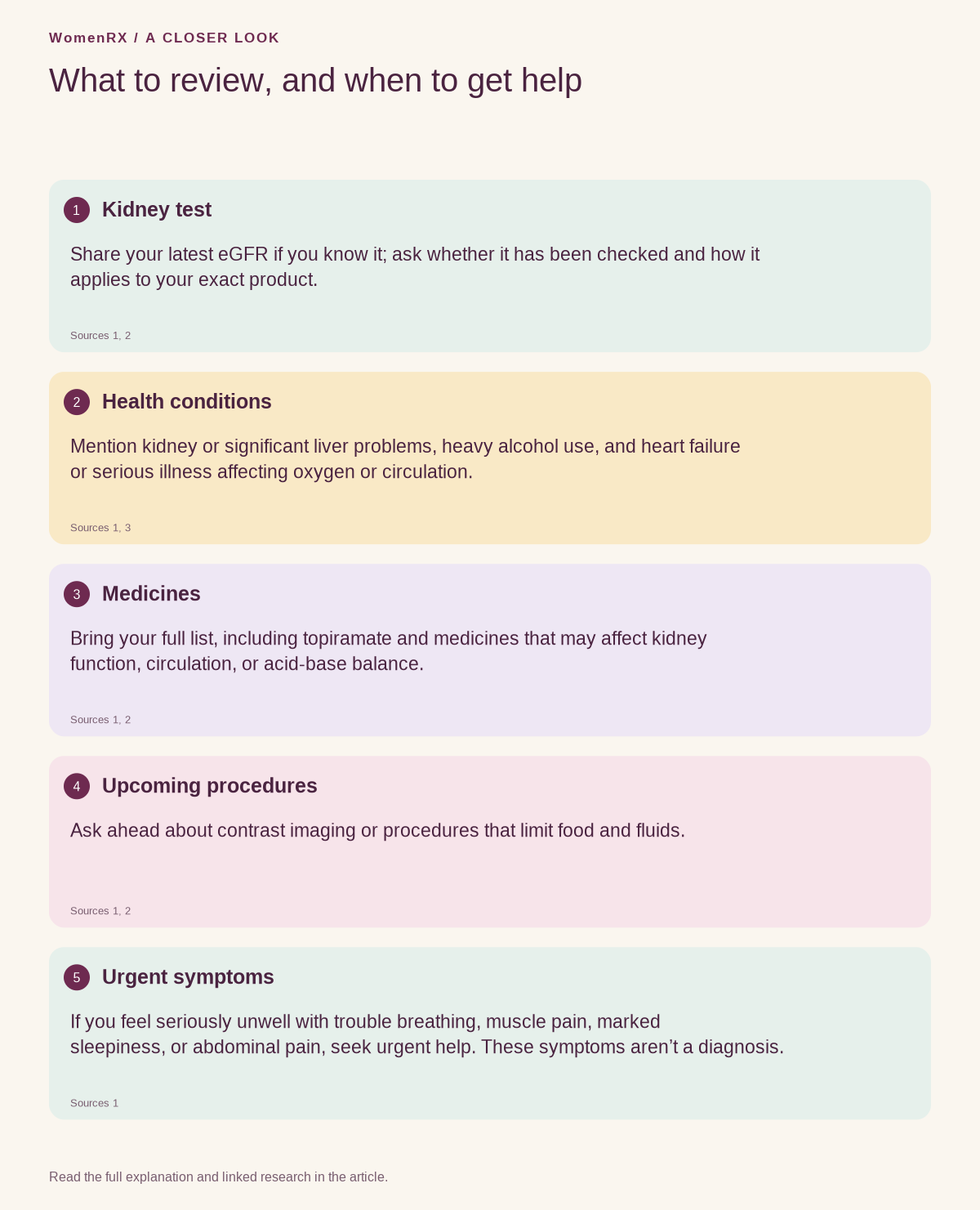
What to review, and when to get help
Kidney test: Share your latest eGFR if you know it; ask whether it has been checked and how it applies to your exact product.12
Health conditions: Mention kidney or significant liver problems, heavy alcohol use, and heart failure or serious illness affecting oxygen or circulation.13
Medicines: Bring your full list, including topiramate and medicines that may affect kidney function, circulation, or acid-base balance.12
Upcoming procedures: Ask ahead about contrast imaging or procedures that limit food and fluids.12
Urgent symptoms: If you feel seriously unwell with trouble breathing, muscle pain, marked sleepiness, or abdominal pain, seek urgent help. These symptoms aren’t a diagnosis.1
Read the figure as text
Use the first four items to organize a review. If pregnancy, breastfeeding, or fertility treatment is relevant, mention it in that conversation too. The last item identifies symptoms to take seriously when you feel very unwell. This checklist doesn’t tell you to start or stop metformin.- Kidney test: Share your latest eGFR if you know it; ask whether it has been checked and how it applies to your exact product.12
- Health conditions: Mention kidney or significant liver problems, heavy alcohol use, and heart failure or serious illness affecting oxygen or circulation.13
- Medicines: Bring your full list, including topiramate and medicines that may affect kidney function, circulation, or acid-base balance.12
- Upcoming procedures: Ask ahead about contrast imaging or procedures that limit food and fluids.12
- Urgent symptoms: If you feel seriously unwell with trouble breathing, muscle pain, marked sleepiness, or abdominal pain, seek urgent help. These symptoms aren’t a diagnosis.1
More questions, answered
Does a lower eGFR always mean I have to stop metformin?
No single answer fits every prescription or situation. The cited US labels contraindicate their combination products below an eGFR of 30 mL/min/1.73 m². At 30 to below 45, both advise against starting their combination products; one calls for reassessing benefits and risks if eGFR falls below 45 during treatment. Ask the prescriber to interpret your result for your exact medicine. 1 2
Sources you can check
- GLIPIZIDE AND METFORMIN HYDROCHLORIDE TABLET, FILM COATED [REMEDYREPACK INC.] | US prescribing information and patient instructionsAccessed 2026-09-25Return to first citation
- DAPAGLIFLOZIN AND METFORMIN HYDROCHLORIDE TABLET, FILM COATED, EXTENDED RELEASE [SUN PHARMACEUTICAL INDUSTRIES, INC.] | US prescribing information and patient instructionsAccessed 2026-09-25Return to first citation
- [CME/Answers: Metformin - Dos and Don'ts].Slahor L. · Praxis · 2022Return to first citation