How Insulin Resistance Can Shape PCOS Hormones
In PCOS, higher insulin levels may encourage ovarian androgen production, but insulin resistance is neither the same thing as PCOS nor a requirement for its diagnosis.
Insulin and reproductive hormones can reinforce one another in PCOS. Higher insulin may stimulate ovarian androgen production, while lower liver production of sex hormone-binding globulin (SHBG) is described as part of a proposed feedback cycle. That doesn’t establish that insulin directly lowers SHBG in every person. PCOS varies, insulin resistance isn’t a diagnostic criterion, and one insulin result can’t explain the whole picture. 1 2
The connection is a loop, not a single cause
Insulin helps the body use and store energy. In insulin resistance, some tissues respond less effectively to insulin. The body may compensate by releasing more of it, a pattern called hyperinsulinemia. In PCOS, this higher insulin level can affect reproductive hormones as well as metabolism. 1
One proposed link is the ovary’s response to insulin. Ovarian cells involved in making hormones can remain responsive to insulin’s androgen-producing effects, even when other tissues are less responsive to some of insulin’s metabolic effects. In other words, insulin resistance throughout the body doesn’t necessarily mean the ovary is resistant to every action of insulin. 1
A second proposed link involves sex hormone-binding globulin, or SHBG, a blood protein that binds sex hormones. Lower hepatic SHBG is described as part of a proposed feedback cycle in PCOS. That proposed cycle doesn’t establish that higher insulin directly lowers SHBG in every person, so it’s better understood as one possible part of a more complex relationship. 2
Together, ovarian androgen production and changes in hormone availability may contribute to androgen-related features of PCOS, such as excess facial or body hair, acne, or scalp hair loss. These features vary, and none alone explains the underlying hormone pattern. 1 3
The relationship may run in both directions. The 2025 review describes evidence that high androgen levels can contribute to insulin resistance and higher insulin, as well as evidence that hyperinsulinemia may come first in some cases. The sequence isn’t settled for every person, and PCOS doesn’t follow one metabolic pattern. 1
PCOS doesn’t look the same in everyone
Some people with PCOS have clear metabolic findings; others don’t. The review reports reduced insulin-stimulated glucose disposal in both lean and higher-weight people with PCOS, but that doesn’t mean every person has the same degree or type of insulin resistance. 1
A 2025 retrospective study illustrates variation rather than establishing a universal rate: it assessed HOMA-IR in 200 Caucasian women ages 18 to 36 with PCOS and classified 57.5% as having insulin resistance. The study found differences across PCOS phenotypes, and its result describes that particular group and method, not everyone with PCOS. 2
Insulin resistance also isn’t the same as PCOS. It isn’t itself a PCOS diagnostic criterion, and a person can’t infer a PCOS diagnosis from insulin resistance alone. 2
What an insulin test can and can’t tell you
Research studies use measures such as HOMA-IR to assess insulin resistance, but a score is only one piece of a metabolic picture. The study above used HOMA-IR to compare groups; it doesn’t establish a universal cutoff or show that one result explains someone’s menstrual pattern, androgen symptoms, or their cause. 2
It helps to separate two questions: “Are there signs of altered insulin or glucose regulation?” and “Do my reproductive features fit PCOS?” Insulin resistance may be relevant to the first. It doesn’t answer the second by itself. The distinction matters because a single insulin measurement can’t capture the different ways insulin signaling may act in the liver, muscle, fat, and ovary. 1 2
If you’re reviewing test results, a useful question is what the result is meant to clarify: metabolic risk, a possible PCOS pattern, or both. Then ask how it fits with your cycle history, androgen-related symptoms, and any other findings. The aim is to interpret the result in context, not to treat one number as a stand-alone explanation.
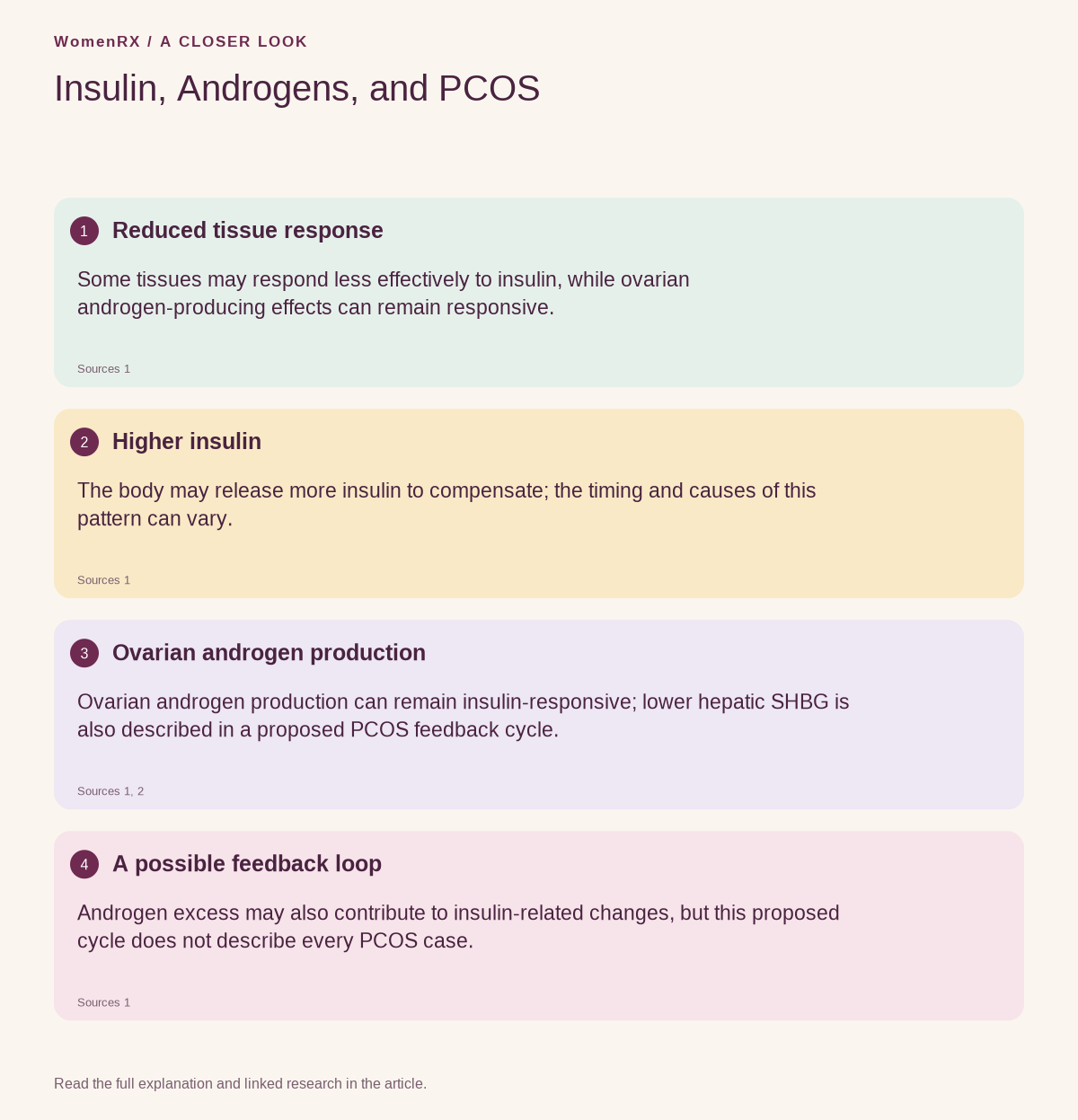
Insulin, Androgens, and PCOS
Reduced tissue response: Some tissues may respond less effectively to insulin, while ovarian androgen-producing effects can remain responsive.1
Higher insulin: The body may release more insulin to compensate; the timing and causes of this pattern can vary.1
Ovarian androgen production: Ovarian androgen production can remain insulin-responsive; lower hepatic SHBG is also described in a proposed PCOS feedback cycle.12
A possible feedback loop: Androgen excess may also contribute to insulin-related changes, but this proposed cycle does not describe every PCOS case.1
Read the figure as text
A proposed feedback cycle helps explain how insulin signaling may relate to androgen activity, while showing why the pattern isn’t identical in everyone.- Reduced tissue response: Some tissues may respond less effectively to insulin, while ovarian androgen-producing effects can remain responsive.1
- Higher insulin: The body may release more insulin to compensate; the timing and causes of this pattern can vary.1
- Ovarian androgen production: Ovarian androgen production can remain insulin-responsive; lower hepatic SHBG is also described in a proposed PCOS feedback cycle.12
- A possible feedback loop: Androgen excess may also contribute to insulin-related changes, but this proposed cycle does not describe every PCOS case.1
More questions, answered
Does insulin resistance mean I have PCOS?
No. Insulin resistance is associated with PCOS, but it isn’t itself a diagnostic criterion. It can’t establish PCOS without considering the reproductive and hormone picture. 2
Sources you can check
- Reappraising the relationship between hyperinsulinemia and insulin resistance in PCOS.Houston EJ, Templeman NM. · The Journal of endocrinology · 2025Return to first citation
- Insulin resistance in polycystic ovary syndrome phenotypes and the vicious cycle model in its etiology.Szkodziak P, Szkodziak F, Trzeciak K, Woźniak S, Mlynarczyk M, Paszkowski T. · Scientific reports · 2025Return to first citation
- The role of combined Metformin and pharmaceutical molecules with anti-androgenic properties in the therapy of PCOS in adult women.Antoniou-Tsigkos A, Karras G, Papagianni M, Christopoulos P, F Vlahos N, Mastorakos G. · Endocrine · 2025Return to first citation