PCOS Hormones: What Androgens, Ovulation, and Insulin Reveal
PCOS is identified from a combination of features, not a single hormone result, and those features can look different from person to person.
In adults, PCOS is generally diagnosed when at least two of three features are present: ovulatory dysfunction, clinical or blood-test evidence of higher androgens, and polycystic ovarian morphology on ultrasound or, in adults, an elevated AMH used for that purpose. Insulin resistance is associated with PCOS, but it isn’t one of those three diagnostic features. No single hormone test settles the diagnosis. 4 5
Three features, not one hormone profile
PCOS can involve androgen excess, irregular or absent ovulation, and metabolic features such as insulin resistance. These patterns can overlap, but they don’t have to appear together in the same way for every person. For adults, diagnosis uses at least two of three features: ovulatory dysfunction; clinical or biochemical hyperandrogenism; and polycystic ovarian morphology, assessed by ultrasound or, in adults, with anti-Müllerian hormone (AMH) as an alternative way to define that feature. Insulin resistance is associated with PCOS, but it sits outside those diagnostic criteria. 1 4 5
That framework explains why a normal result on one hormone test doesn’t automatically rule PCOS in or out. It also explains why seeing multiple follicles on an ultrasound, by itself, isn’t the whole diagnosis.
Androgens: symptoms and blood tests answer different questions
Androgens are hormones that women also make. Higher androgen activity can show up as unwanted facial or body hair, acne, or hair thinning; clinicians may also assess androgen levels in blood. Clinical signs and blood tests are separate ways to assess the androgen feature of PCOS. 1 3
When biochemical testing is used, total testosterone and free testosterone are the recommended first-line measures in the evidence reviewed for the international guideline. Free testosterone may be measured directly with certain methods or calculated; the review describes calculated free testosterone and the free androgen index as options. It also found that measurement method matters: liquid chromatography-tandem mass spectrometry performed better than direct immunoassays for several androgen measures. 3
Other androgens, including androstenedione and DHEAS, may be considered when total or free testosterone isn’t elevated, but the review found they were less specific. In practical terms, an androgen result is one piece of the picture, not a standalone PCOS verdict. 3 4
Ovulation: what cycle history can tell you
If ovulation doesn’t happen regularly, periods may be irregular or absent. Cycle history can therefore help assess ovulatory dysfunction alongside the other PCOS features. Irregular periods can have other causes, including pregnancy, hormonal contraception, and thyroid problems, so a changed period pattern doesn’t establish PCOS on its own. 1 2
The life stage matters. During adolescence, cycle patterns are still maturing, and the diagnostic approach differs from the adult one. The criteria summarized for adolescents require both menstrual irregularity and clinical or biochemical hyperandrogenism; ovarian ultrasound isn’t recommended for diagnosis within eight years of the first period. 6
Insulin: a metabolic connection, not a diagnostic shortcut
Insulin helps move glucose from the blood into cells. Insulin resistance means the body doesn’t use insulin as effectively; it is among the factors associated with PCOS and can accompany higher blood glucose. But insulin resistance isn’t one of the three diagnostic features above, and an insulin-related result alone can’t establish PCOS. 1 4
This distinction helps make sense of apparently different results. A person may have PCOS features without every metabolic feature, while checking glucose-related health answers a different question from checking androgens or ovulation. The association also doesn’t mean that every person’s PCOS has the same cause or pathway. 1 7
AMH and age: useful context, not a universal signature
In adults, AMH may be used as an alternative to ultrasound to define polycystic ovarian morphology within the diagnostic framework. It doesn’t replace the full assessment: PCOS still requires two of the three features. AMH also varies with age and with the assay used, and a study of women with PCOS found levels differed across phenotypes. A single AMH number therefore shouldn’t be treated as a timeless hormone signature. 4 5
The useful question is not simply, “Are my hormones normal?” It’s, “Which PCOS feature is this test or symptom helping assess?” Cycle history points toward ovulation; symptoms and androgen tests assess androgen excess; ultrasound or AMH may assess ovarian morphology in adults; insulin-related measures concern metabolic health. Keeping those questions distinct makes mixed or incomplete results easier to understand.
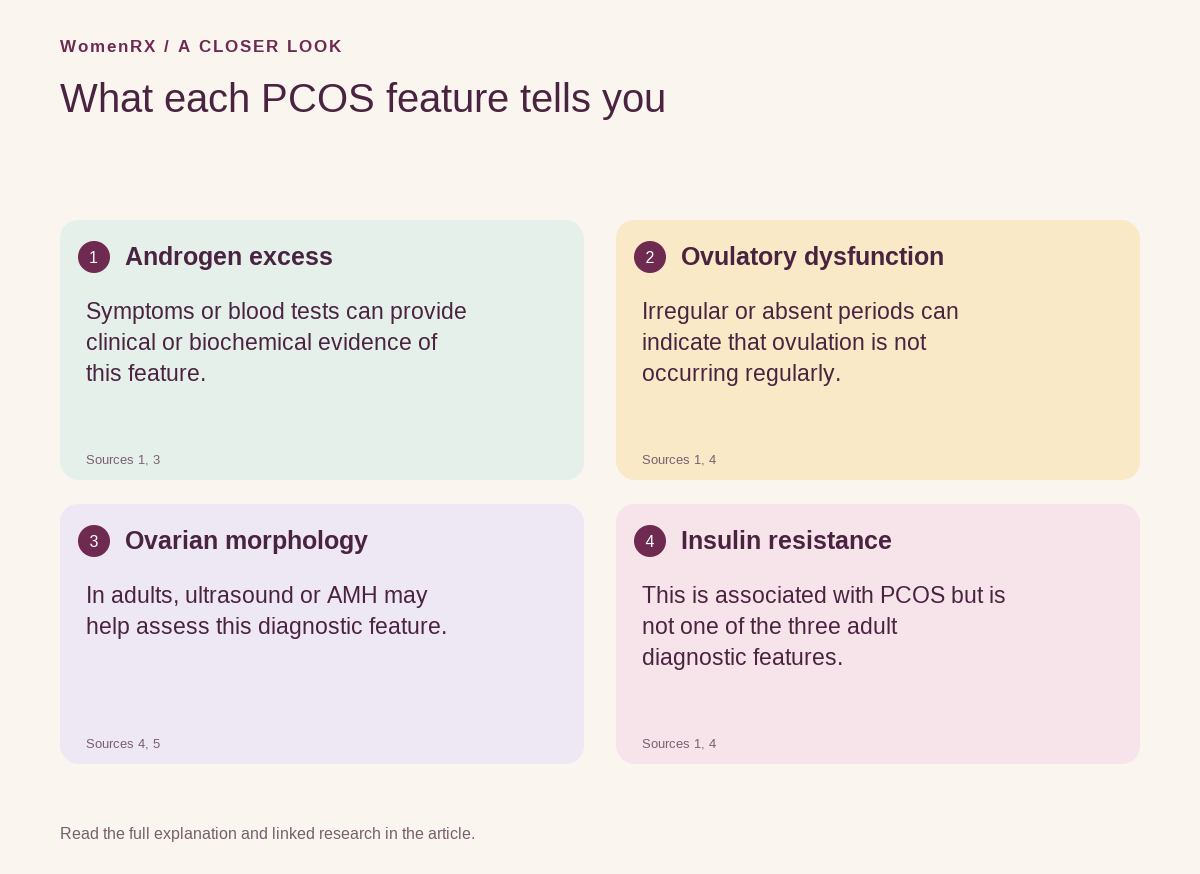
What each PCOS feature tells you
Androgen excess: Symptoms or blood tests can provide clinical or biochemical evidence of this feature.13
Ovulatory dysfunction: Irregular or absent periods can indicate that ovulation is not occurring regularly.14
Ovarian morphology: In adults, ultrasound or AMH may help assess this diagnostic feature.45
Insulin resistance: This is associated with PCOS but is not one of the three adult diagnostic features.14
Read the figure as text
This map separates the three adult diagnostic features from insulin resistance, a related metabolic feature.- Androgen excess: Symptoms or blood tests can provide clinical or biochemical evidence of this feature.13
- Ovulatory dysfunction: Irregular or absent periods can indicate that ovulation is not occurring regularly.14
- Ovarian morphology: In adults, ultrasound or AMH may help assess this diagnostic feature.45
- Insulin resistance: This is associated with PCOS but is not one of the three adult diagnostic features.14
More questions, answered
Can a normal testosterone result rule out PCOS?
No. Total and free testosterone are useful tests for biochemical androgen excess, but PCOS is assessed using a combination of features. Ovulatory dysfunction and ovarian morphology are separate parts of the adult criteria. 3 4
Does a high AMH result mean I have PCOS?
Not by itself. In adults, AMH may help define the ovarian morphology feature, but the diagnosis still relies on at least two of the three criteria. AMH also varies with age and assay. 4 5
Sources you can check
- PCOS | Polycystic Ovary Syndrome | MedlinePlusAccessed 2026-09-25Return to first citation
- Irregular periods - NHSAccessed 2026-09-25Return to first citation
- Evaluating the diagnostic accuracy of androgen measurement in polycystic ovary syndrome: a systematic review and diagnostic meta-analysis to inform evidence-based guidelines.Bizuneh AD, Joham AE, Teede H, Mousa A, Earnest A, Hawley JM, Smith L, Azziz R, Arlt W, Tay CT. · Human reproduction update · 2025Return to first citation
- Diagnosis of Polycystic Ovary Syndrome With Predictive Modeling of Select Clinical Features.Evans AT, Rehani E, Smith B, Hong MD, Lewin Z, Hiroshige K, Spandorfer SD, Hajirasouliha I, Lujan ME, Hoeger KM. · O&G open · 2026Return to first citation
- Age-related Curves of AMH Using the Gen II, the picoAMH, and the Elecsys Assays in Women With Polycystic Ovary Syndrome.Barbagallo F, van der Ham K, Willemsen SP, Louwers YV, Laven JS. · The Journal of clinical endocrinology and metabolism · 2024Return to first citation
- Prevalence of polycystic ovary syndrome among adolescents depending on the adopted diagnostic criteria.Jakubowska-Kowal K, Skrzyńska K, Kowalczyk K, Gawlik-Starzyk A. · Frontiers in endocrinology · 2026Return to first citation
- From polycystic ovary syndrome to polyendocrine metabolic ovarian syndrome: what obstetricians and gynecologists need to know.Bahri-Khomami M, Hoeger KM, Huddleston H, Mahalingaiah S, Teede HJ, Dokras A. · American journal of obstetrics and gynecology · 2026Return to first citation