PCOS Treatment Alternatives Depend on Your Main Goal
A treatment that helps regulate periods may not address insulin resistance or help you ovulate, so start by naming what you want to change.
There isn’t one PCOS treatment that replaces metformin for every goal. If you’re not trying to get pregnant, hormonal birth control may help make periods more regular and improve acne or unwanted hair. If you’re trying to conceive and irregular ovulation is the issue, letrozole is an option to discuss. These treatments serve different purposes, and cycle or fertility treatment shouldn’t be assumed to address metabolic concerns too. 1 2 3
Start with the job you want treatment to do
PCOS can involve irregular or absent ovulation, higher androgen levels, and insulin resistance. One person may mainly want more predictable bleeding; another may be focused on acne, metabolic health, or pregnancy. Those goals point to different treatment conversations. A medicine that helps with one concern may not treat the others. 1
For example, if you’re considering an alternative because metformin is hard to tolerate, it may help to ask: “Which PCOS concern were we treating with it, and what should we use to track whether that concern is improving?” That keeps a switch from becoming a simple one-for-one substitution.
If pregnancy isn’t your current goal
Hormonal birth control is one option to discuss for irregular periods and androgen-related symptoms. MedlinePlus notes that hormonal methods, including pills, shots, and IUDs, may make periods more regular and help with acne and excess facial or body hair. These methods aren’t an option for someone who is currently trying to get pregnant. 1
Anti-androgen medicines may also be considered for symptoms such as acne or excess hair. They address the effects of androgens, rather than serving as a substitute for a treatment aimed at insulin resistance. MedlinePlus notes that these medicines can cause problems during pregnancy, so pregnancy plans matter when discussing them. 1
If your main concern is irregular bleeding, ask what a proposed treatment is expected to change: bleeding pattern, acne or hair growth, or a metabolic measure. Those are related PCOS concerns, but they aren’t interchangeable outcomes.
If you’re trying to conceive
If irregular ovulation is making it harder to become pregnant, letrozole is a fertility-treatment option to discuss. In a prospective cohort of 207 infertile women with PCOS, letrozole was associated with more ovulation than clomiphene, but treatment wasn’t randomly assigned, so the comparison can’t establish that the medicine alone caused the difference. 2
A randomized trial in women with clomiphene-resistant PCOS compared letrozole, gonadotropins, and laparoscopic ovarian drilling. It found different pregnancy outcomes across these approaches, illustrating that fertility options have tradeoffs and may be considered in different circumstances. The trial applies to that specific group, not to everyone with PCOS or to treatment of insulin resistance. 3
The useful question isn’t simply “What replaces metformin?” It’s “Is the immediate goal to induce ovulation, and which fertility approach fits my situation?” A fertility medicine is not automatically a replacement for metabolic care.
If metabolic health is the main concern
PCOS is linked with insulin resistance, but that doesn’t mean every PCOS treatment improves it. A secondary analysis of a randomized trial involving 746 women ages 18 to 40 with PCOS who were undergoing ovulation induction found that higher prepregnancy insulin resistance was associated with lower ovulation, pregnancy, and live-birth rates, and with more gestational diabetes. This was an analysis of associations, not a trial showing that a particular alternative medicine improves those outcomes. 4
Healthy eating is one part of PCOS care, and health concerns linked to PCOS may need monitoring. Neither means food choices alone are an equivalent substitute for prescribed treatment. If metformin isn’t working for you, ask which metabolic concern is being followed and what care fits your results. Studies of letrozole for fertility looked at ovulation and pregnancy, not whether it could replace metformin for metabolic outcomes. 1 2 3
Make the conversation specific
You might say: “I’m not trying to conceive right now, and my main concern is irregular periods and acne. What options address those symptoms, and what would they leave untreated?” Or, if pregnancy is the goal: “Could my irregular ovulation be affecting conception, and should we discuss an ovulation-induction option such as letrozole?”
Also tell your prescriber if pregnancy is possible or planned, and whether the proposed treatment is meant to address symptoms, ovulation, or metabolic risk. Those details can change which alternatives make sense.
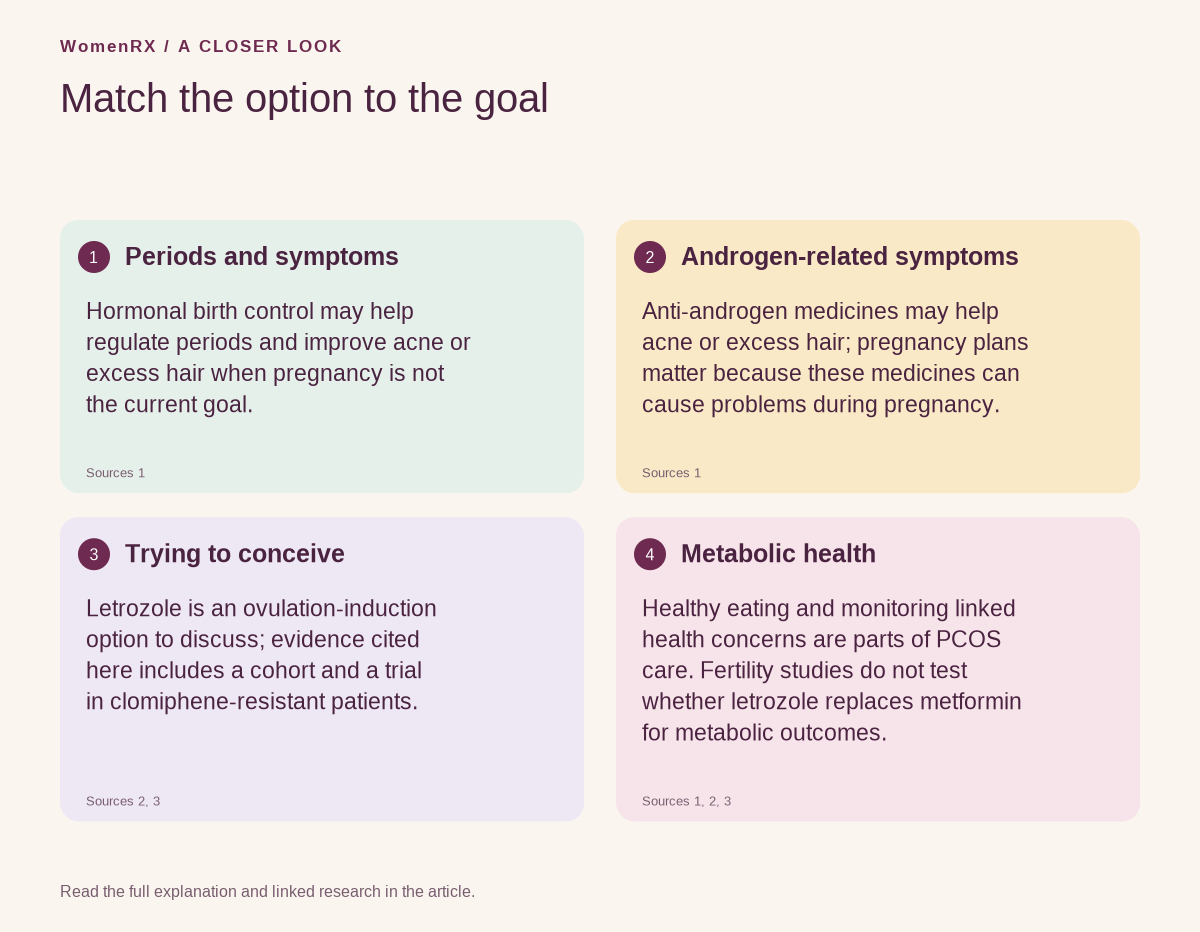
Match the option to the goal
Periods and symptoms: Hormonal birth control may help regulate periods and improve acne or excess hair when pregnancy is not the current goal.1
Androgen-related symptoms: Anti-androgen medicines may help acne or excess hair; pregnancy plans matter because these medicines can cause problems during pregnancy.1
Trying to conceive: Letrozole is an ovulation-induction option to discuss; evidence cited here includes a cohort and a trial in clomiphene-resistant patients.23
Metabolic health: Healthy eating and monitoring linked health concerns are parts of PCOS care. Fertility studies do not test whether letrozole replaces metformin for metabolic outcomes.123
Read the figure as text
PCOS treatments target different concerns. This comparison separates symptom relief, fertility treatment, and metabolic questions.- Periods and symptoms: Hormonal birth control may help regulate periods and improve acne or excess hair when pregnancy is not the current goal.1
- Androgen-related symptoms: Anti-androgen medicines may help acne or excess hair; pregnancy plans matter because these medicines can cause problems during pregnancy.1
- Trying to conceive: Letrozole is an ovulation-induction option to discuss; evidence cited here includes a cohort and a trial in clomiphene-resistant patients.23
- Metabolic health: Healthy eating and monitoring linked health concerns are parts of PCOS care. Fertility studies do not test whether letrozole replaces metformin for metabolic outcomes.123
More questions, answered
Does letrozole replace metformin for PCOS?
Letrozole is an option for inducing ovulation when pregnancy is the goal. These studies examined ovulation or fertility outcomes; they did not test whether letrozole can replace metformin for metabolic care. 2 3
Can hormonal birth control help with PCOS symptoms?
It may help make periods more regular and improve acne or excess facial and body hair. It isn’t suitable if you’re currently trying to get pregnant, and it shouldn’t be assumed to address insulin resistance. 1
Sources you can check
- PCOS | Polycystic Ovary Syndrome | MedlinePlusAccessed 2026-09-25Return to first citation
- Phenotype-specific efficacy of letrozole versus clomiphene citrate in polycystic ovary syndrome: a prospective cohort study.Aytemiz EA, Aslan B, Kaplan NB, Aytaç R, Atabekoğlu C, Berker B, Sönmezer M, Özmen B, Şükür YE. · BMC women's health · 2026Return to first citation
- Comparative study of two ovulation induction therapies and laparoscopic ovarian drilling on clinical outcomes in women with clomiphene citrate-resistant polycystic ovary syndrome.Mahmoud SI, Ahmedy ZAM, Shaker AN, Sheeba M, Ageez MN. · Clinical and experimental reproductive medicine · 2026Return to first citation
- Prepregnancy Insulin Resistance and Fertility and Pregnancy Outcomes in Women With Polycystic Ovarian Syndrome.Yun BH, Seo SK, Maher JY, Dowlut-McElroy T, Gomez-Lobo V. · Obstetrics and gynecology · 2026Return to first citation