PCOS Treatment Choices: Start With What You Want to Change
PCOS care is easier to compare when you choose the goal first, because cycle control, skin symptoms, metabolic concerns, and fertility call for different discussions.
There isn’t one PCOS treatment that addresses every concern. Hormonal birth control can help regulate periods and may improve acne and unwanted hair when you aren’t trying to conceive; metabolic concerns call for a different conversation, while fertility treatment focuses on ovulation. Letrozole is recommended for ovulation induction in one national guideline, but the right choice depends on your goal and pregnancy plans. 1 4
Start with the outcome that matters most
PCOS can involve irregular or absent periods, acne or unwanted hair, metabolic concerns, and difficulty ovulating. Those concerns can overlap, but an option that helps one may not be the best fit for another. Before comparing medicines, decide what you most want care to address now, and whether you’re trying to become pregnant. 1
That doesn’t mean you must choose only one goal. It gives you a clearer way to weigh benefits and trade-offs, and to revisit the plan if your priorities change.
If your priority is more predictable periods
Hormonal birth control, including combined oral contraceptives, can make periods more regular. It may also help with acne and unwanted facial or body hair. It is not an option for someone currently trying to get pregnant, so pregnancy plans are central to this choice. 1
A 2025 Indonesian PCOS guideline summary also recommends combined oral contraceptives as first-line treatment for menstrual disorders and hyperandrogenism. That is one national guideline, not a rule that makes this the best choice for every person or every country. The decision still depends on your priorities and circumstances. 4
If you have long gaps between periods, make that concern explicit rather than focusing only on when your next period might come. Ask what the proposed treatment is intended to do for your cycle, and what it is not expected to address.
If acne or unwanted hair is the main concern
Combined oral contraceptives may help these symptoms as well as menstrual regularity, but they don’t fit if you’re trying to conceive. Other androgen-blocking medicines are used for acne and unwanted hair; pregnancy matters with this group because these medicines can cause problems during pregnancy. 1
For spironolactone specifically, US prescribing information advises avoiding use during pregnancy because of a potential risk to a male fetus based on its antiandrogenic action and animal findings. That warning is about pregnancy safety, not proof that spironolactone is effective for PCOS symptoms. If it comes up as an option, discuss pregnancy intentions and how pregnancy would be avoided while taking it. 2
PCOS-related acne can also be treated with standard acne therapies. A review describes acne as having several contributors, including oil production, blocked follicles, and inflammation, alongside hormonal influences. That is one reason a skin-focused plan may need more than a treatment aimed at PCOS hormones alone. 3
If metabolic health is your concern
Ask which metabolic issue is being addressed rather than treating “metabolic health” as one single outcome. Insulin-sensitizing medicines can improve insulin resistance and help steady blood glucose; MedlinePlus describes them as one category of medicine used in PCOS care. A 2026 narrative review also discusses metformin among interventions for cardiometabolic risk factors, but that review does not establish that one medicine is right for every person with PCOS. 1 5
A useful question is, “What result are we looking for from this option in my case?” That keeps the conversation focused on the reason for treatment rather than assuming that a medicine chosen for one PCOS concern will also resolve your periods, skin symptoms, or fertility concerns.
If you’re trying to get pregnant
The goal changes from making periods more predictable to addressing ovulation and conception. The 2025 Indonesian guideline summary recommends letrozole as first-line ovulation induction and lists clomiphene citrate, metformin, and other options as later treatments. MedlinePlus also notes that fertility treatments for PCOS can include medicines and procedures such as IVF. 1 4
These recommendations come from an Indonesian guideline, so they shouldn’t be read as a complete US treatment pathway. They do make one important distinction clear: a treatment used to regulate periods when pregnancy is not the goal is not interchangeable with treatment intended to induce ovulation. If you’re trying to conceive, say so before discussing hormonal birth control or antiandrogen medicines. 1 4
For adolescents, make age part of the question
PCOS can appear around the time of a first period, but this comparison should not be used as a treatment plan for a teenager. Ask for an age-appropriate assessment and discussion of goals. 1
A practical way to compare options
For each option being considered, ask three things: What concern is it meant to improve? Does it fit with my pregnancy plans now? What other PCOS concerns should we address separately? Those questions help distinguish a cycle-focused option from an acne treatment, a metabolic approach, or fertility care, without expecting one medicine to do everything.
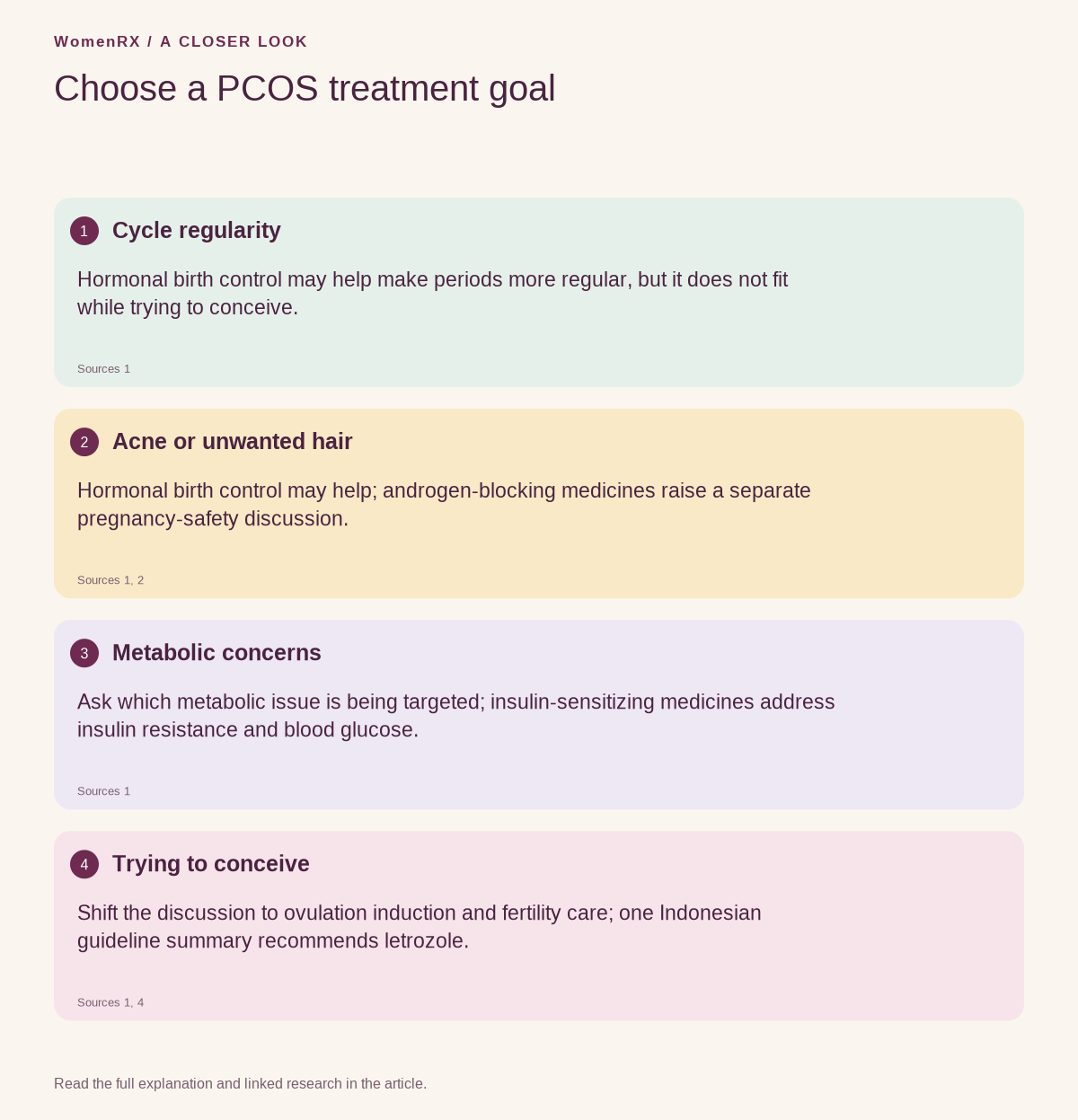
Choose a PCOS treatment goal
Cycle regularity: Hormonal birth control may help make periods more regular, but it does not fit while trying to conceive.1
Acne or unwanted hair: Hormonal birth control may help; androgen-blocking medicines raise a separate pregnancy-safety discussion.12
Metabolic concerns: Ask which metabolic issue is being targeted; insulin-sensitizing medicines address insulin resistance and blood glucose.1
Trying to conceive: Shift the discussion to ovulation induction and fertility care; one Indonesian guideline summary recommends letrozole.14
Read the figure as text
The first split is your priority concern; pregnancy plans then change which options fit.- Cycle regularity: Hormonal birth control may help make periods more regular, but it does not fit while trying to conceive.1
- Acne or unwanted hair: Hormonal birth control may help; androgen-blocking medicines raise a separate pregnancy-safety discussion.12
- Metabolic concerns: Ask which metabolic issue is being targeted; insulin-sensitizing medicines address insulin resistance and blood glucose.1
- Trying to conceive: Shift the discussion to ovulation induction and fertility care; one Indonesian guideline summary recommends letrozole.14
More questions, answered
Can one PCOS treatment help both periods and acne?
Hormonal birth control may help regulate periods and improve acne or unwanted hair, but it is not an option while you’re trying to get pregnant. Whether it matches your priorities depends on your pregnancy plans. 1
Does a fertility treatment also treat PCOS symptoms such as acne?
Fertility care is directed at ovulation and conception. The cited guideline distinguishes ovulation induction from treatment for menstrual disorders or hyperandrogenism, so ask which concerns a proposed treatment is intended to address. 4
Sources you can check
- PCOS | Polycystic Ovary Syndrome | MedlinePlusAccessed 2026-09-25Return to first citation
- SPIRONOLACTONE TABLET, FILM COATED [REMEDYREPACK INC.] | US prescribing information and patient instructionsAccessed 2026-09-25Return to first citation
- Polycystic Ovary Syndrome-Associated Acne: The Interplay of Hyperandrogenism, Insulin Resistance, and Therapeutic Strategies.Damoulaki E, Sioutis D, Sarli V, Trakakis E, Mastorakos G, Katoulis A, Kastrinakis K, Koratzanis C, Machairiotis N, Panagopoulos P, Christodoulaki C. · Cureus · 2025Return to first citation
- Executive summary: indonesian guidelines on polycystic ovary syndrome management.Maidarti M, Harzif AK, Shadrina A, Ummah N, Permadi W, Polycystic Ovary Syndrome (PCOS) Guideline Collaboration Group. · Obstetrics & gynecology science · 2025Return to first citation
- Polycystic Ovary Syndrome and Cardiovascular Risk: Mechanisms, Clinical Evidence, and Prevention Strategies.Moore M, Hirani R, Khessib S, Chirumamilla AP, Frishman WH, Etienne M. · Cardiology in review · 2026Return to first citation