How Weight and Insulin Resistance Are Connected
Weight can offer a clue about metabolic risk, but glucose results and health history tell you more than the scale alone.
Insulin helps move glucose from your blood into your cells. When the body responds less effectively to insulin, glucose regulation may change, although a glucose result alone doesn’t measure insulin resistance. Higher weight, particularly weight carried around the abdomen, is associated with markers of insulin resistance, but the relationship isn’t a diagnosis or proof of cause. Insulin resistance can also occur at a lower weight. 15
Why glucose and insulin results can tell different stories
After you eat, glucose enters your bloodstream and prompts your pancreas to release insulin. Insulin helps glucose move into cells for energy. Diabetes means blood glucose is too high because the body doesn’t make enough insulin, doesn’t use it well enough, or both. Insulin resistance describes a response to insulin; it is not another name for diabetes. 1
That difference matters when you look at test results. An A1C reflects average blood glucose over roughly three months. It doesn’t directly measure how readily your body responds to insulin. Glucose can also remain in a typical range when insulin levels are higher, so a normal glucose result doesn’t settle every question about insulin action. Conversely, a high glucose result needs interpretation in its own right rather than an automatic label of insulin resistance. 12
You may see terms such as high insulin, insulin resistance and prediabetes used as though they’re interchangeable. They aren’t. Fasting insulin and a calculation called HOMA-IR are used to estimate insulin resistance, but neither has one universally accepted cutoff that turns a result into a stand-alone diagnosis. If someone has called a result “insulin resistant,” a useful next question is what was measured and what other findings support that interpretation. 2
Where weight fits, and where it doesn’t
Weight and insulin resistance often appear together, especially when more weight is carried around the abdomen. In a study of adolescents and young adults in Mumbai, participants with high insulin levels and markers of insulin resistance were more likely to have higher body weight and waist measurements. Because the study compared people at one point in time, it cannot show whether weight changes led to insulin resistance, the reverse occurred, or other factors contributed. Its findings also shouldn’t be assumed to describe every age group or population. 5
A waist measurement can add information that weight or body mass index (BMI) misses. BMI compares weight with height, but it doesn’t distinguish fat from muscle or bone. MedlinePlus notes that carrying more fat around the abdomen may be associated with greater type 2 diabetes risk than carrying it around the hips. Neither measurement tells you on its own how your body responds to insulin. 4
Nor does a lower weight rule out a concern. The Mumbai study found high insulin levels in some participants whose BMI was in its normal or underweight category. That’s a reason to take relevant test results and health history seriously without treating anyone’s appearance as a metabolic test. 5
The direction of the relationship may differ by circumstance. For example, a review focused on people with type 1 diabetes describes how weight gain, insulin requirements and insulin resistance can interact. That’s a useful reminder that a single cause-and-effect story is too simple, not evidence that the same pattern applies to everyone. 3
What belongs in the conversation about your results
A clinician can put a glucose or A1C result alongside your health history and other risk information, rather than interpreting weight by itself. Family history, waist circumference and cholesterol are among the factors that may add context to weight-related risk. If weight change is a goal you’re considering, it needn’t replace attention to those other findings. 14
Some parts of a woman’s history are worth mentioning even though they don’t diagnose insulin resistance. For example, a history of gestational diabetes, PCOS and menopause are identified in a review of cardiovascular risk in women as relevant risk contexts. That review does not establish that any one of them proves insulin resistance in an individual. If you’ve had gestational diabetes or PCOS, or you’re discussing health changes around menopause, bring that context to a conversation about your glucose results and overall risk. 6
The most useful distinction is this: weight can be one clue, glucose tests answer a different question, and an insulin-resistance label needs interpretation. If your results seem to conflict, ask what each test shows and whether it changes what you do next. 124
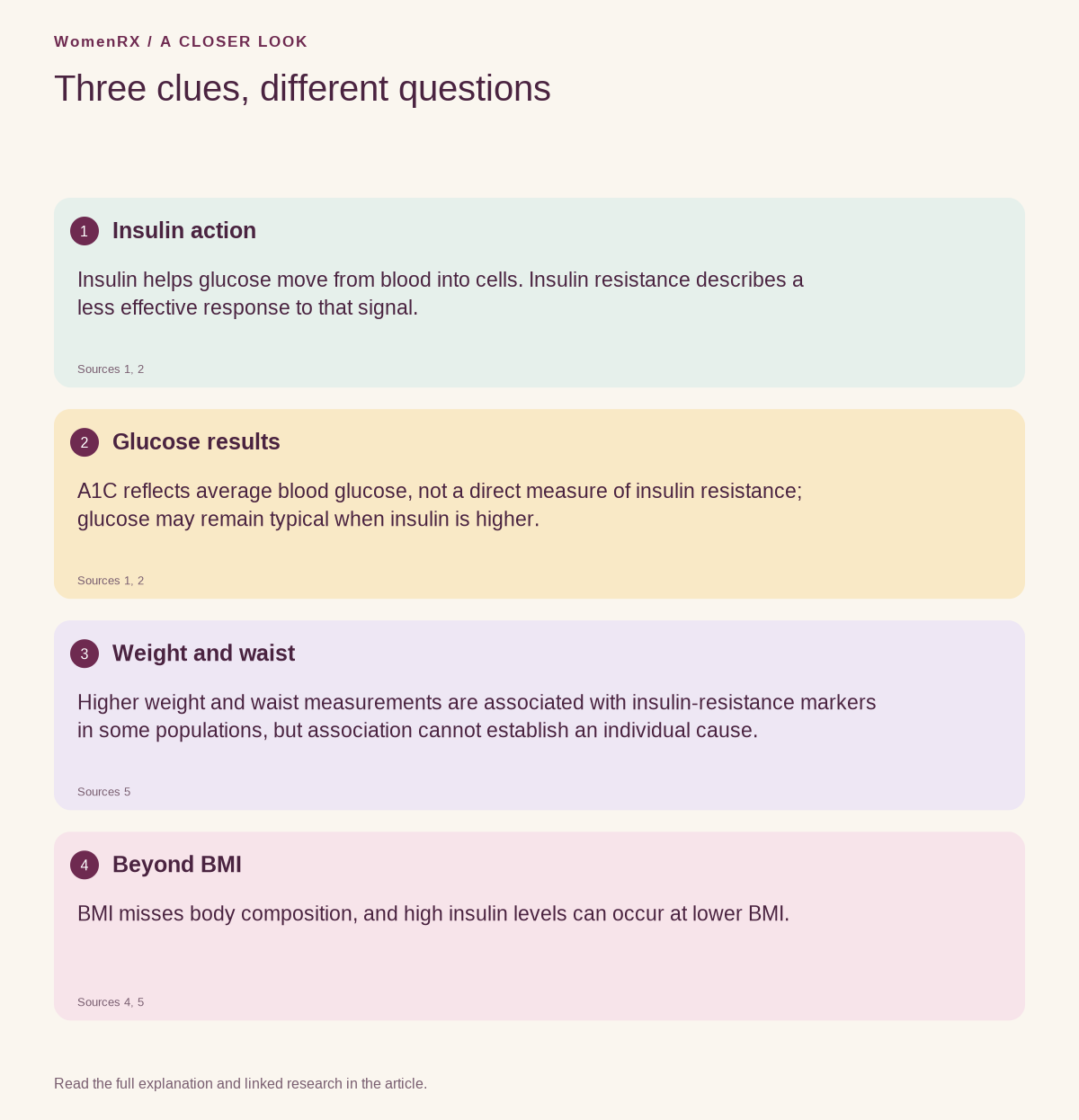
Three clues, different questions
Insulin action: Insulin helps glucose move from blood into cells. Insulin resistance describes a less effective response to that signal.12
Glucose results: A1C reflects average blood glucose, not a direct measure of insulin resistance; glucose may remain typical when insulin is higher.12
Weight and waist: Higher weight and waist measurements are associated with insulin-resistance markers in some populations, but association cannot establish an individual cause.5
Beyond BMI: BMI misses body composition, and high insulin levels can occur at lower BMI.45
Read the figure as text
Insulin action, glucose results and body measurements are connected, but none is a substitute for the others.- Insulin action: Insulin helps glucose move from blood into cells. Insulin resistance describes a less effective response to that signal.12
- Glucose results: A1C reflects average blood glucose, not a direct measure of insulin resistance; glucose may remain typical when insulin is higher.12
- Weight and waist: Higher weight and waist measurements are associated with insulin-resistance markers in some populations, but association cannot establish an individual cause.5
- Beyond BMI: BMI misses body composition, and high insulin levels can occur at lower BMI.45
Sources you can check
- Blood Glucose | Blood Sugar | Diabetes | MedlinePlusAccessed 2026-09-25Return to first citation
- Insulin Resistance: Current State of Knowledge and Clinical Implications-Toward a Better Diagnostic Framework and the Question of Its Disease Status.Rodzeń Ł, Rodzeń M, Dyńka D, Łojko D, Karakuła-Juchnowicz H, Kraszewski S, Fazio S, Unwin D, Bikman B. · Nutrients · 2026Return to first citation
- Type 1 diabetes in the era of obesity: Pathophysiology and therapeutic implications.Bloomgarden Z. · Journal of diabetes investigation · 2026Return to first citation
- Body Weight: MedlinePlusAccessed 2026-09-25Return to first citation
- Prevalence of hyperinsulinemia and its association with measures of adiposity and body composition in 16-25-year-old adolescents and young adults in Mumbai.Moitra P, Madan J, Kalita S, Desai S, Udipi SA, Vaidya R. · BMC endocrine disorders · 2026Return to first citation
- Stable ischemic heart disease in women: current perspectives.Samad F, Agarwal A, Samad Z. · International journal of women's health · 2017Return to first citation