Rybelsus Reviews: What the Results Really Mean
A Rybelsus review can describe one person’s experience, but the treatment goal, dose, comparison group, and time period determine what a result can tell you.
Treat reviews as accounts of what one person noticed, not as estimates of what Rybelsus will do for you. The clearest comparison is with studies of oral semaglutide in adults with type 2 diabetes using the Rybelsus dose range, where weight change was measured alongside a placebo group. Higher-dose obesity trials answer a different question, and none of these group results predicts an individual outcome. 1 2 4
Start with the treatment goal
Rybelsus is oral semaglutide. The US product information describes its established use as improving blood sugar control in adults with type 2 diabetes, alongside diet and exercise. That matters when you read a post focused on weight loss: the person may be taking the medicine for a different reason, and a weight change may be one part of a broader treatment result. 1
A review can still be useful. It might describe appetite, digestion, energy, or how someone felt during treatment. But it usually can’t tell you whether the medicine caused a change, how common that experience is, or whether it applies to people with a different health history or treatment goal.
Match the result to the study
A useful study comparison asks: Who took part? What dose and treatment were studied? What was the comparison? How long were people followed? Those details can change the meaning of a weight-loss number.
For example, the SOUL randomized trial studied adults with type 2 diabetes and cardiovascular disease or chronic kidney disease. Participants received oral semaglutide, up to 14 mg, or placebo on top of standard care. At week 156, the estimated difference in body-weight change favored semaglutide by 3.26 percentage points. That is a difference between the treatment groups, not a promise that each person lost 3.26% of their starting weight. Weight reductions developed gradually in both groups. 2
Other oral semaglutide trials studied higher doses and weight management in people with overweight or obesity. In OASIS 4, adults without diabetes were assigned to 25 mg oral semaglutide or placebo, alongside lifestyle interventions. At week 64, estimated average weight change was −13.6% with semaglutide and −2.2% with placebo. These findings are not a direct estimate of what to expect from Rybelsus in its type 2 diabetes treatment context. 4
OASIS 2 studied 50 mg in East Asian adults with overweight or obesity, with or without type 2 diabetes. At week 68, average weight change was −14.3% with semaglutide and −1.3% with placebo. The different dose, study population, and treatment purpose are reasons not to swap this result into a Rybelsus review comparison. 3
Read the fine print on symptoms and stopping
Personal accounts can help you notice which experiences matter to you, but a handful of posts can’t establish how often a symptom happens. Controlled trials collect adverse-event reports across participants and compare treatment groups. For example, in OASIS 2, gastrointestinal adverse events were reported by 85 of 134 participants (63.4%) assigned semaglutide and 23 of 66 (34.8%) assigned placebo. Adverse events led 6 of 134 people in the semaglutide group (4.5%) to stop treatment. Those figures come from a 50 mg trial, not a rate estimate for Rybelsus. 3
When reading a review, look for whether the person says how long they took treatment, whether symptoms changed over time, and whether they stopped or interrupted it. If a post leaves those details out, it’s harder to compare with a study that reports a set follow-up period. And neither a review nor a trial average tells you what your own response will be.
Real-world studies add another kind of evidence, but they have their own limits. A Dutch observational study reported an estimated 12-month weight change of −4.73 kg among 260 people with weight measurements; their average follow-up was 8.2 months. Because this wasn’t a randomized comparison, it describes outcomes in a selected group receiving routine care, rather than isolating the medicine’s effect as a placebo-controlled trial can. 5
What women-specific results can and can’t show
Women were included in these studies, but that alone doesn’t establish a women-specific result. In SOUL, 2,790 of 9,650 participants (28.9%) were women; in OASIS 2, 87 of 201 participants (43.3%) were women. The reported summaries give overall results, not separate weight outcomes by sex or reproductive stage. They therefore can’t tell you whether results differ across women, or across cycling years, perimenopause, and postmenopause. 2 3
When a review says “this worked for women,” check whether it describes one person or cites results analyzed separately for women. A personal account may feel familiar, but it can’t fill in a missing subgroup analysis.
A quick way to assess a review
Before treating a story as relevant to your decision, see whether it gives you:
- The reason the person is taking Rybelsus, especially whether it’s for type 2 diabetes or weight management.
- The treatment and follow-up period, and whether the person is describing a change in blood sugar, weight, or symptoms.
- Any important context, such as other treatments or whether they stopped because of side effects.
- A clear distinction between an individual experience and a result measured across a comparison group.
Use reviews for the texture of lived experience. Use studies to understand group outcomes, and match those studies to the treatment goal and population that are closest to yours.
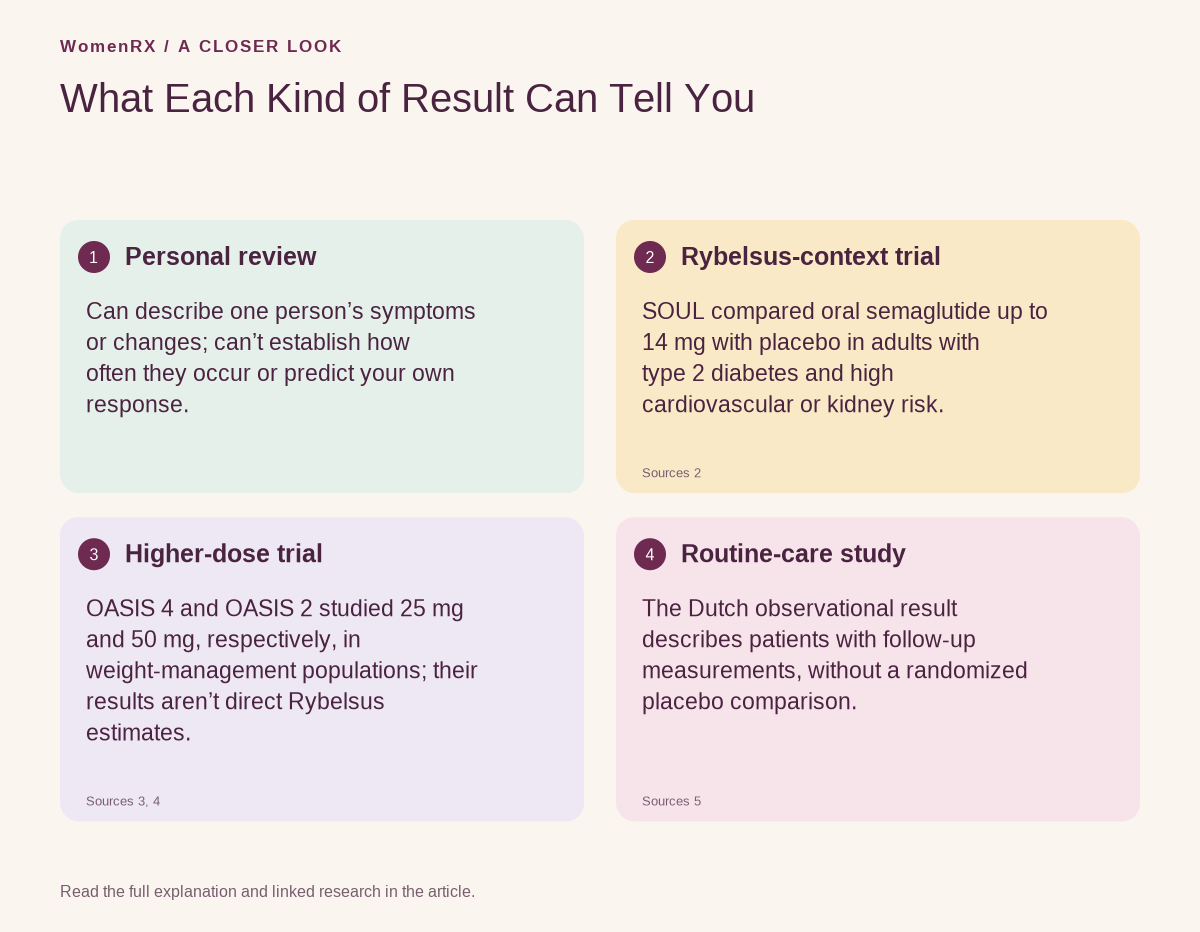
What Each Kind of Result Can Tell You
Personal review: Can describe one person’s symptoms or changes; can’t establish how often they occur or predict your own response.
Rybelsus-context trial: SOUL compared oral semaglutide up to 14 mg with placebo in adults with type 2 diabetes and high cardiovascular or kidney risk.2
Higher-dose trial: OASIS 4 and OASIS 2 studied 25 mg and 50 mg, respectively, in weight-management populations; their results aren’t direct Rybelsus estimates.34
Routine-care study: The Dutch observational result describes patients with follow-up measurements, without a randomized placebo comparison.5
Read the figure as text
Reviews, randomized trials, and routine-care studies answer different questions. Match the evidence type to the decision you’re trying to make.- Personal review: Can describe one person’s symptoms or changes; can’t establish how often they occur or predict your own response.
- Rybelsus-context trial: SOUL compared oral semaglutide up to 14 mg with placebo in adults with type 2 diabetes and high cardiovascular or kidney risk.2
- Higher-dose trial: OASIS 4 and OASIS 2 studied 25 mg and 50 mg, respectively, in weight-management populations; their results aren’t direct Rybelsus estimates.34
- Routine-care study: The Dutch observational result describes patients with follow-up measurements, without a randomized placebo comparison.5
Sources you can check
- OZEMPIC (ORAL SEMAGLUTIDE) TABLET RYBELSUS (ORAL SEMAGLUTIDE) TABLET [NOVO NORDISK PHARMACEUTICAL INDUSTRIES, LP] | US prescribing information and patient instructionsAccessed 2026-09-25Return to first citation
- Oral Semaglutide and Change in Cardiovascular Risk Factors in High-Risk Type 2 Diabetes: A Post Hoc Secondary Analysis of the SOUL Randomized Clinical Trial.Mulvagh SL, Inzucchi SE, Marx N, Poulter NR, Deanfield JE, Pop-Busui R, Emerson SS, Mann JFE, Engelmann MDM, Hovingh GK, Mandavya K, Davicevic-Elez Z, Jeppesen OK, Lorenzatti A, Og... · JAMA cardiology · 2026Return to first citation
- Oral Semaglutide in an East Asian Population With Overweight or Obesity, With or Without Type 2 Diabetes: The OASIS 2 Randomized Clinical Trial.Kadowaki T, Heftdal LD, Ko HJ, Overvad M, Shimomura I, Thamattoor UK, Kim KK, OASIS 2 Investigators. · JAMA internal medicine · 2025Return to first citation
- Oral Semaglutide at a Dose of 25 mg in Adults with Overweight or Obesity.Wharton S, Lingvay I, Bogdanski P, Duque do Vale R, Jacob S, Karlsson T, Shaji C, Rubino D, Garvey WT, OASIS 4 Study Group. · The New England journal of medicine · 2025Return to first citation
- Real-world evaluation of clinical outcomes in Dutch patients with type 2 diabetes treated with oral semaglutide: A retrospective, observational cohort study using the PHARMO data network.Postema A, Gaspersz J, Baak BN, Huisman EL, Hoogstraten C, Hagelund LM, Penning-van Beest FJA, Overbeek JA. · Diabetes, obesity & metabolism · 2026Return to first citation